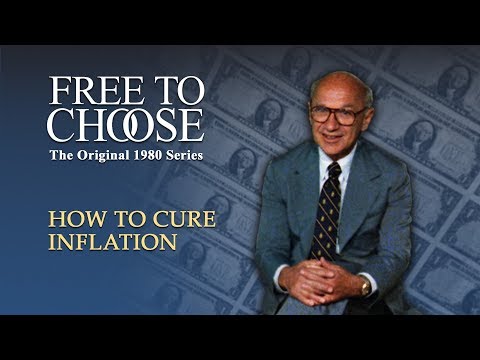
Milton Friedman explores the causes and cures of inflation, emphasizing that inflation is primarily a result of excessive money supply growth. He discusses historical examples, the impact of government policies, and the importance of monetary discipline to stabilize economies.
Hello, I’m Robert McKenzie, at the Harper Library of the University of Chicago. Almost everyone here, like every family in the United States, has suffered one of the great evils of our time—inflation. Spiraling prices bring unemployment and threaten to undermine the savings of the whole population. In this film, Milton Friedman shares his analysis of inflation and his proposed solutions.
Milton Friedman begins by taking us to the Sierra Nevadas in California, where the ghost town of Bodie once thrived due to gold mining. This town, filled with people seeking wealth, illustrates a crucial point: while gold may represent wealth, it does not provide sustenance or shelter. As more gold was mined, prices for goods and services increased, leading to inflation.
Friedman explains that throughout history, various items have served as money, from rock salt in Ethiopia to tobacco in colonial America. The production of more money, whether gold or tobacco, inevitably leads to inflation, as seen when the price of tobacco rose significantly due to overproduction.
Friedman highlights that inflation is often misunderstood. Many blame labor unions for pushing up wages, but he argues that higher wages are typically a response to inflation rather than a cause. Similarly, the notion that inflation is imported through higher prices abroad is flawed; it is the domestic money supply that primarily drives inflation.
Friedman points out that inflation is fundamentally a government issue. The government controls the money supply, and when it increases too rapidly, inflation follows. He cites President Nixon's wage and price controls as a misguided attempt to manage inflation, which ultimately only postponed the problem.
Friedman takes us to Britain, Tokyo, and Berlin to illustrate how different countries have dealt with inflation. In Britain during the 1960s, inflation initially seemed manageable, but by the 1970s, it spiraled out of control. In contrast, Japan successfully curbed inflation in the 1970s by reducing monetary growth, despite facing a recession.
Germany's post-war recovery serves as a powerful example. In 1948, Ludwig Erhard introduced a new currency and abolished price controls, leading to a rapid economic recovery. This demonstrates the effectiveness of allowing market forces to operate freely.
Friedman emphasizes that inflation affects different groups in society unevenly, creating social tensions. He argues that the public must recognize inflation as a destructive force that requires tough choices. The only way to combat inflation is to reduce the growth of the money supply, which may involve short-term pain for long-term stability.
The discussion shifts to the political landscape, where Friedman and other guests debate the challenges of implementing effective monetary policy. Congressman Clarence Brown notes that while politicians may advocate for reducing inflation, they often lack the courage to make the necessary cuts to government spending.
Friedman asserts that the real culprits behind inflation are not just politicians but the citizens themselves, who demand government spending without wanting to pay for it. This creates a cycle of inflation that is difficult to break.
In conclusion, Friedman argues that the key to curing inflation lies in controlling the money supply and reducing government spending. He warns that without public recognition of the severity of inflation and the need for discipline, the cycle will continue. The path to recovery may be painful, but it is essential for a stable economy.
As we reflect on these insights, it becomes clear that understanding the roots of inflation and the importance of monetary policy is crucial for both policymakers and the public. Only through collective awareness and action can we hope to address this persistent economic challenge.





