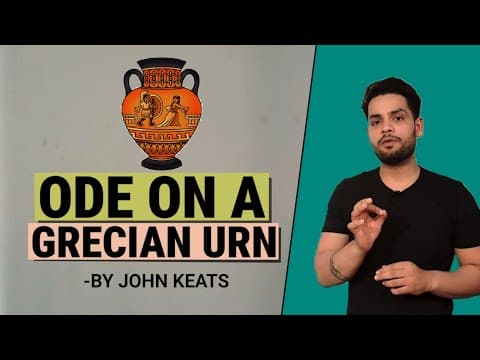
This blog post provides a comprehensive line-by-line summary of John Keats' famous poem 'Ode on a Grecian Urn', exploring its themes, imagery, and the poet's reflections on beauty and truth.
In this blog post, we will delve into the world-class ode written by the English late Romantic poet John Keats, titled "Ode on a Grecian Urn," composed in 1819. This poem is a testament to Keats' love for Greek literature and art, and we will explore its meaning line by line.
John Keats wrote this ode in May 1819, and it was published in January 1820. The poem is renowned worldwide and reflects Keats' admiration for Greek art. The title refers to a Grecian urn, a type of vase that often features intricate designs and scenes from mythology.
Keats was inspired by a Grecian urn he saw in a museum in London, which had beautiful pictures carved on its surface. This led him to compose an ode consisting of five stanzas, each containing ten lines.
The poem begins with the line:
"Thou still unravished bride of quietness"
This line suggests that the urn is like a bride who has not been touched, symbolizing purity and untouched beauty. Keats refers to the urn as a child of silence and slow time, indicating that it has existed for ages, preserving its beauty.
"Thou foster-child of Silence and slow Time"
Here, Keats describes the urn as an adopted child of silence and time, emphasizing its eternal nature.
"Sylvan historian, who canst thus express"
The urn is portrayed as a historian of the forest, capable of telling stories through its images.
"A flowery tale more sweetly than our rhyme"
Keats suggests that the stories depicted on the urn are sweeter than his poetry.
As he observes the urn closely, he wonders about the legends depicted:
"What leaf-fringed legend haunts about thy shape"
This line questions what stories the leaves around the urn might tell.
"Of deities or mortals, or of both"
Keats ponders whether the stories are about gods or humans.
"In Tempe or the dales of Arcady?"
He references mythical places, indicating the timelessness of the scenes.
"What men or gods are these? What maidens loth"
Keats is curious about the figures depicted, questioning their identities.
"What mad pursuit? What struggle to escape?"
He observes a scene of pursuit, hinting at a narrative of love and desire.
"What pipes and timbrels? What wild ecstasy?"
The stanza concludes with a sense of wild joy and music, evoking the beauty of the moment captured on the urn.
In the second stanza, Keats reflects on the music associated with the urn:
"Heard melodies are sweet, but those unheard"
He acknowledges that while heard melodies are sweet, the unheard ones are even sweeter.
"Are sweeter, therefore, ye soft pipes, play on"
He urges the pipes to continue playing, suggesting that the music transcends physical sound.
"Not to the sensual ear, but, more endear'd"
The music resonates with the spirit rather than the senses.
"To the spirit ditties of no tone"
Keats describes the music as ethereal, existing beyond mere sound.
"Fair youth beneath the trees, thou canst not leave"
He addresses a young man depicted on the urn, suggesting he cannot leave the moment.
"Thy song, nor ever can those trees be bare"
The trees will never lose their leaves, symbolizing eternal beauty.
"And, though the sun is not, thou canst not leave"
The youth is forever captured in this moment, unable to change.
"Bold lover, never, never canst thou kiss"
Keats laments that the lover can never kiss his beloved, as they are merely images.
"Though winning near the goal, yet do not grieve"
He reassures the lover not to be sad, as beauty remains eternal.
"She cannot fade, though thou hast not thy bliss"
The beauty of the beloved will never fade, despite the lover's inability to experience it fully.
In the third stanza, Keats addresses the trees:
"O happy, happy boughs! that cannot shed your leaves"
He celebrates the trees that will never lose their leaves, symbolizing eternal youth.
"Nor ever bid the Spring adieu"
The trees will never say goodbye to spring, representing perpetual renewal.
"And, happy melodist, unwearied"
He praises the musician who plays endlessly, creating eternal music.
"For ever piping songs for ever new"
The songs played are always fresh and new, reflecting the timelessness of art.
"More happy love! more happy, happy love!"
Keats emphasizes the joy of love depicted on the urn.
"For ever warm and still to be enjoyed"
The love portrayed is forever warm and enjoyable.
"Forever panting, and forever young"
The lovers are eternally youthful, always in pursuit of each other.
"All breathing human passions far above"
The urn transcends human emotions, capturing a higher essence.
"That leaves a heart high-sorrowful and cloy'd"
Keats expresses a sense of sadness, as the beauty of the urn contrasts with human experience.
"A burning forehead and a parching tongue"
He uses vivid imagery to convey the pain of longing.
In the fourth stanza, Keats observes another scene:
"Who are these coming to the sacrifice?"
He questions the figures approaching a sacrificial altar.
"To what green altar, O mysterious priest"
He wonders about the significance of the altar and the priest leading the sacrifice.
"Lead'st thou that heifer lowing at the skies"
The priest brings a cow for sacrifice, symbolizing innocence.
"What little town by river or sea shore"
He describes a peaceful town near water, now deserted.
"And all its people?"
The town is empty as people gather for the sacrifice.
"What pipes and timbrels? What wild ecstasy?"
The scene is filled with anticipation and excitement.
In the final stanza, Keats reflects on the urn itself:
"O Attic shape! Fair attitude! with breed of marble men and maidens overwrought"
He admires the urn's form and the intricate carvings of men and women.
"Thou silent form! dost tease us out of thought"
The urn provokes deep contemplation and reflection.
"As doth eternity: Cold Pastoral"
He describes the urn as a cold pastoral scene, evoking timelessness.
"When old age shall this generation waste"
He contemplates the future, when the current generation will pass away.
"Thou shalt remain, in midst of other woe"
The urn will endure, witnessing the sorrows of future generations.
"Than ours, a friend to man, to whom thou say'st"
The urn becomes a friend to humanity, offering wisdom.
"Beauty is truth, truth beauty"
The poem concludes with the profound statement that beauty and truth are intertwined.
"That is all ye know on earth, and all ye need to know"
This line encapsulates the essence of the poem, suggesting that understanding beauty and truth is fundamental to human experience.
In "Ode on a Grecian Urn," John Keats explores themes of beauty, truth, and the nature of art. Through vivid imagery and profound reflections, he captures the essence of timelessness and the eternal nature of beauty. The urn serves as a symbol of art's ability to transcend time, preserving moments of joy and love for generations to come. This ode remains a significant work in the canon of English literature, inviting readers to ponder the relationship between art and life.