This article explores the application of Keynes and Say's Law to the aggregate demand and supply model, highlighting the differences in their focus on supply and demand changes in both the short and long run, particularly during recession and full employment scenarios.
In this article, we will delve into the application of Say's Law and Keynes' Law within the framework of the aggregate demand and aggregate supply model. By examining the perspectives of both economists, we can better understand how supply and demand interact in different economic scenarios, particularly during recessions and periods of full employment.
Say's Law, attributed to Jean-Baptiste Say, emphasizes the role of supply in the economy. One of Say's famous quotes is "supply creates its own demand." This principle suggests that production inherently generates demand for goods and services, focusing primarily on long-term economic outcomes.
In contrast, John Maynard Keynes focused on the importance of demand in driving economic activity. His well-known quote, "demand creates its own supply," highlights the significance of demand changes, particularly in the short run. Keynesian economics suggests that fluctuations in demand can lead to economic cycles, including recessions.
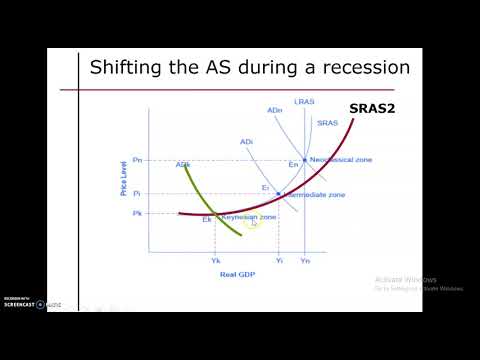
To illustrate the concepts of Say's and Keynes' laws, we will use the aggregate demand (AD) and aggregate supply (AS) model. Let's assume we are currently experiencing a recession, represented by the intersection of the upward-sloping short-run aggregate supply curve and the aggregate demand curve at equilibrium point E.
At this point, our GDP is at Yk, and the price level is at Pk. The long-run aggregate supply curve (potential GDP) is represented by Yn, indicating that we are currently operating to the left of full employment, which signifies a recession.
If we attempt to shift the aggregate supply curve to the right in an effort to reach full employment, we find that the intersection of the new short-run aggregate supply and the initial aggregate demand remains to the left of potential GDP. This indicates that merely shifting the aggregate supply curve during a recession may not be an effective strategy for achieving full employment.
Conversely, if we shift the aggregate demand curve to the right, this can be achieved through increased consumption, government spending, investment, or net exports. As we shift the aggregate demand curve rightward, we gradually approach full employment. This suggests that increasing aggregate demand during a recession is a more efficient approach than shifting aggregate supply.
When the economy is at potential GDP (full employment), shifting the aggregate demand curve to the right results in only a minimal increase in GDP, while the price level rises significantly. This indicates that increasing aggregate demand at full employment is not as effective, as the potential GDP remains unchanged.
On the other hand, if we shift the aggregate supply curve to the right while at potential GDP, we can achieve a more substantial increase in GDP. This demonstrates that shifting the aggregate supply curve is more efficient when the economy is operating at full employment.
In summary, the analysis of Say's and Keynes' laws within the aggregate demand and supply model reveals that changes in aggregate demand are more effective in the short run, particularly during recessions. Conversely, in the long run, shifting the aggregate supply curve proves to be more efficient. Thus, both economists present valid points, with Keynesian principles being more applicable in the short term and Say's Law holding more relevance in the long term.





