Neoclassical economics, emerging in the early 1900s, emphasizes the role of potential GDP in determining economic size and asserts that wages and prices are flexible, allowing economies to adjust back to full employment in the long run. This blog post explores the foundational concepts of neoclassical economics, its focus on long-term growth, and the implications of shifts in aggregate demand and supply.
Neoclassical economics emerged in the early 1900s as a response to classical economics, introducing new perspectives on how economies function. This blog post delves into the fundamental concepts of neoclassical economics, its focus on long-term growth, and the implications of shifts in aggregate demand and supply.
Neoclassical economics is built on two major concepts:
Potential GDP Determines Economic Size
The size of an economy is dictated by its potential GDP, which reflects the maximum output it can produce when fully utilizing its resources. This concept emphasizes that the economy's capacity is not merely a function of current demand but rather its inherent ability to produce goods and services.
Flexibility of Wages and Prices
Unlike Keynesian economics, which posits that wages and prices are inflexible (or sticky), neoclassical economics asserts that wages and prices can adjust flexibly. This flexibility allows the economy to return to its potential GDP level of output over time.
Neoclassical economists prioritize long-run growth over short-run fluctuations. While Keynesian economics often emphasizes immediate issues like unemployment and inflation, neoclassical thought centers on potential GDP. The long-run aggregate supply curve in neoclassical economics is vertical, indicating that real GDP is determined by potential GDP, regardless of aggregate demand levels.
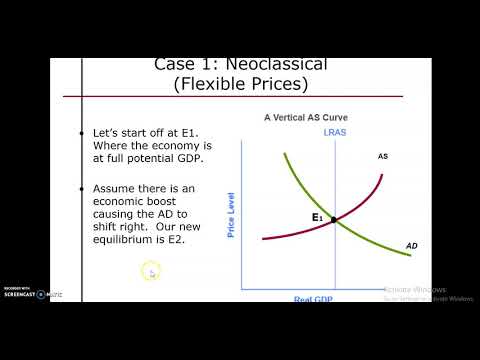
In neoclassical economics, the long-run aggregate supply curve is positioned at potential GDP. This vertical curve signifies that the economy operates at full employment when producing at potential GDP. Changes in aggregate demand do not affect the long-run output level; instead, they may lead to temporary fluctuations in employment and inflation.
Potential GDP can shift due to several factors:
An increase in any of these determinants will shift the long-run aggregate supply curve to the right, indicating growth in potential GDP. Conversely, a decrease will shift the curve to the left, reflecting a reduction in potential output.
To illustrate the implications of aggregate demand shifts, we can examine two scenarios:
Initial Equilibrium
The economy starts at equilibrium (E1) where aggregate supply aligns with potential GDP.
Shift in Aggregate Demand
An economic boost causes the aggregate demand curve to shift right, leading to a new equilibrium (E2) that exceeds potential GDP. This situation results in an inflationary gap, characterized by increased demand for goods and a decrease in unemployment.
Wage Adjustments
As firms compete for workers, wages rise. Higher wages increase production costs, prompting firms to reduce aggregate supply, shifting it left until the economy returns to full employment (E3).
Initial Equilibrium
The economy again starts at equilibrium (E1).
Decrease in Aggregate Demand
A decline in demand shifts the aggregate demand curve left, resulting in a recessionary gap at equilibrium (E2), where output is below potential GDP and unemployment rises.
Wage Adjustments
With higher unemployment, firms lower wages to reduce costs. This decrease in wages allows aggregate supply to shift right, eventually restoring the economy to full employment (E1).
Neoclassical economics provides a framework for understanding how economies adjust over time. The flexibility of wages and prices, combined with the focus on potential GDP, illustrates that economies can return to full employment in the long run, despite short-term fluctuations. By recognizing the determinants of potential GDP and the implications of aggregate demand shifts, we gain valuable insights into economic behavior and policy-making.





