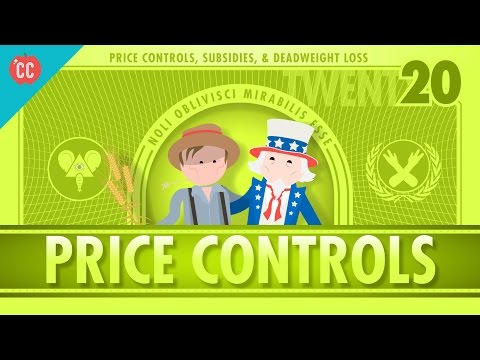
This blog post explores the implications of price controls and subsidies in economics, highlighting how well-intentioned policies can lead to market distortions, shortages, and inefficiencies. It discusses historical examples, the mechanics of price ceilings and floors, and the debate surrounding agricultural subsidies.
Welcome to Crash Course Economics. Today, we delve into the complexities of price controls and subsidies, examining how good intentions can lead to unintended consequences in the economy.
Price controls are government-imposed limits on the prices that can be charged for goods and services. They come in two forms: price ceilings and price floors.
A price ceiling is a maximum price set by the government for a specific good or service. For example, if the government mandates that gas stations charge no more than one dollar per gallon for gas, it may seem beneficial at first. However, this leads to increased demand from consumers while producers find it unprofitable to sell at that price, resulting in a shortage of gasoline.
Historically, this scenario played out during President Richard Nixon's administration in the early 1970s when he implemented a price and wage freeze to combat inflation. While the public supported the initiative, economists like Milton Friedman warned that such policies often lead to negative outcomes.
Conversely, a price floor sets a minimum price for a good or service. For instance, if the government establishes a price floor of seven dollars for a bushel of corn, it incentivizes farmers to produce more corn. However, consumers may turn to substitutes like wheat or rice due to the higher price, leading to a surplus of corn and deadweight loss in the market.
Economists generally agree that price controls, including rent control, reduce the quantity and quality of goods available. Rent control, for example, aims to make housing affordable but often results in fewer available apartments and neglected properties.
Subsidies are government payments to individuals or businesses intended to offset costs and promote specific public goals. For example, if the government subsidizes strawberry farmers, it can lead to an increase in supply and lower prices for consumers. While this may seem advantageous, economists caution against subsidies for several reasons.
Many farmers today are not impoverished; in fact, they often earn more than non-farming families. Economists argue that subsidies can discourage innovation and efficiency in farming practices, as guaranteed income may reduce the incentive to adapt to market changes. A significant majority of economists believe that agricultural subsidies should be eliminated, as they distort market dynamics.
Historically, agricultural subsidies in the U.S. date back to the Great Depression, with programs designed to stabilize farm prices. However, these subsidies have evolved into direct payments that often benefit large agribusinesses rather than small farmers. In 2005, for instance, the government provided over $25 billion in aid to farmers, even when farm profits were at record highs.
While subsidies can distort markets, there are instances where they may be justified. For example, if a product is underproduced relative to societal demand, a subsidy could help correct this inefficiency. Renewable energy technologies often receive support because they may not be developed sufficiently without government intervention.
However, the debate continues over whether subsidies create false demand or if they are necessary to foster innovation. The effectiveness of subsidies ultimately depends on the specific market conditions and societal values.
In conclusion, while markets generally function well to allocate resources efficiently, government interventions like price controls and subsidies can lead to significant distortions and inefficiencies. Understanding these concepts is crucial for evaluating economic policies and their impacts on society. Sometimes, markets fail, and that is when government intervention may be necessary. Thank you for joining us in this exploration of economics, and we look forward to our next discussion.





