This blog post explores the concepts of producer surplus and market supply within the framework of perfectly competitive markets, discussing short-run and long-run scenarios, the implications of price changes, and the behavior of firms in response to economic profits and losses.
In this lecture, we continue our exploration of microeconomics, focusing on the concepts of producer surplus and market supply within perfectly competitive markets. We will review the short-run dynamics of producer behavior and then transition into long-run considerations, examining how firms adjust their output levels in response to market conditions.
In the short run, producers in a perfectly competitive market select their output levels based on the relationship between price, marginal cost, and average variable cost. It is possible for firms to earn economic profits or incur losses during this period. If a firm's variable costs are covered and a portion of fixed costs is also met, it may continue operating despite losses, aiming to recover these losses in the long run.
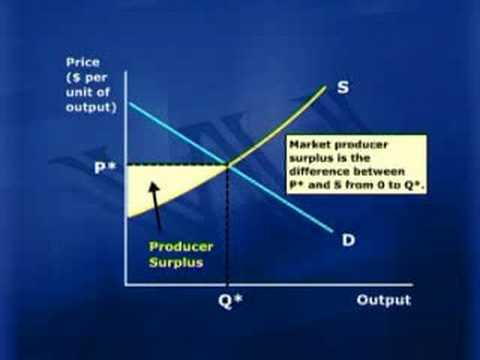
Producer surplus is a crucial concept that we will discuss today. It represents the difference between what producers are willing to accept for a good versus what they actually receive. In the context of short-run supply, the producer surplus can be visualized as the area above the marginal cost curve and below the market price.
The short-run supply curve for a producer is derived from the upward-sloping portion of the marginal cost curve above the average variable cost. If prices rise, the quantity supplied by producers increases, leading to a positively sloped industry supply curve when aggregating all individual producers' supply curves.
As we transition to the long run, we must define the characteristics of this period. In the long run, all factors of production are variable, allowing firms to adjust their plant sizes and production capacities. The market price is determined by market forces, and firms must decide their output levels based on this price.
In the long run, firms will enter or exit the market based on their economic profits. If firms are earning positive economic profits, new firms will be attracted to the market, increasing supply and driving prices down until profits reach zero. Conversely, if firms incur losses, inefficient firms will exit the market, reducing supply and potentially increasing prices.
Producer surplus in the long run can be calculated similarly to the short run, as the area above the supply curve and below the market price. However, in long-run equilibrium, economic profits are zero, meaning that firms earn just enough to cover their opportunity costs, including normal profits.
It is essential to distinguish between economic profits and accounting profits. Economic profits consider both explicit costs (like wages and materials) and implicit costs (like opportunity costs), while accounting profits only account for explicit costs. In a perfectly competitive market, firms will earn zero economic profits in the long run, but they will still earn normal profits.
In summary, we have explored the concepts of producer surplus and market supply in perfectly competitive markets, focusing on both short-run and long-run dynamics. We discussed how firms make output decisions based on market prices and costs, the implications of economic profits and losses, and the eventual stabilization of the market at a point where economic profits are zero. In our next lecture, we will continue our discussion on long-run cost curves, examining constant, decreasing, and increasing cost industries.





