This article explores the concept of Purchasing Power Parity (PPP) and its application to exchange rates, illustrating how nominal and real exchange rates can reflect or distort the true purchasing power of currencies through examples and the Big Mac Index.
Purchasing Power Parity (PPP) is a crucial economic theory that relates to exchange rates between currencies. It posits that the exchange rate between two currencies should equal the ratio of the two countries' price levels for a specific basket of goods and services. This article delves into the intricacies of PPP, how it applies to exchange rates, and the implications of nominal versus real exchange rates.
Economists assert that the exchange rate between two currencies should reflect the purchasing power of those currencies. In simpler terms, if you have a basket of goods and services in one country, when converted to another currency, it should allow you to purchase the same level of goods and services in that foreign country.
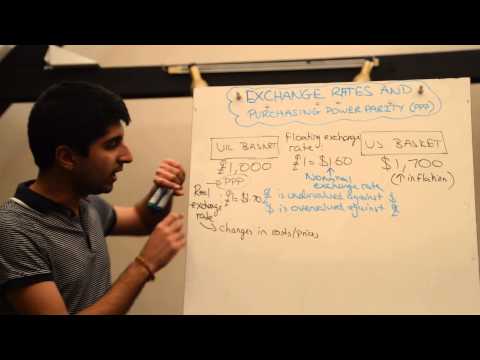
To illustrate this concept, consider a basket of goods and services in the UK valued at £1,000 and the same basket in the US valued at $1,600. If the floating exchange rate is 1 pound to $1.60, this exchange rate reflects purchasing power parity. Here’s how:
Conversely, if you take $1,600 and convert it back to pounds, it should also allow you to purchase the same basket of goods in the UK, confirming that the exchange rate is balanced.
Now, let’s consider a scenario where the value of the US basket increases to $1,700 due to inflation or rising wages. If the nominal exchange rate remains at 1 pound to $1.60, a discrepancy arises:
In this case, the nominal exchange rate does not reflect purchasing power parity, leading to the conclusion that the dollar is overvalued against the pound.
Given the limitations of nominal exchange rates, economists prefer to use the real exchange rate, which accounts for changes in costs and prices. The real exchange rate should ideally reflect purchasing power parity. In our example, the real exchange rate would be 1 pound to $1.70, allowing £1,000 to buy the same level of goods and services in the US as it does in the UK.
In theory, if a currency is undervalued or overvalued, it should self-adjust in a floating exchange rate system. For instance, if the dollar is overvalued, US consumers might buy more UK goods, increasing the supply of dollars and the demand for pounds. This would lead to an appreciation of the pound and a depreciation of the dollar until the exchange rate reflects purchasing power parity.
However, in reality, this self-adjustment does not always occur. Speculative flows often dominate the market, leading to persistent undervaluation or overvaluation of currencies, rather than adjustments based on trade effects.
To provide a tangible measure of purchasing power parity, economists developed the Big Mac Index. This index compares the price of a Big Mac in the US to its price in other countries, using it as a proxy for the overall price level.
For example, as of February 2015:
These comparisons illustrate how the Big Mac Index can highlight discrepancies in currency values relative to purchasing power. If the price of a Big Mac in another country is higher than in the US, that currency is considered overvalued, and vice versa.
Purchasing Power Parity is a fundamental concept in understanding exchange rates and the relative value of currencies. While nominal exchange rates can sometimes misrepresent the true purchasing power of currencies, the real exchange rate provides a more accurate measure. Tools like the Big Mac Index offer practical insights into whether currencies are overvalued or undervalued, helping economists and consumers alike navigate the complexities of global economics.





