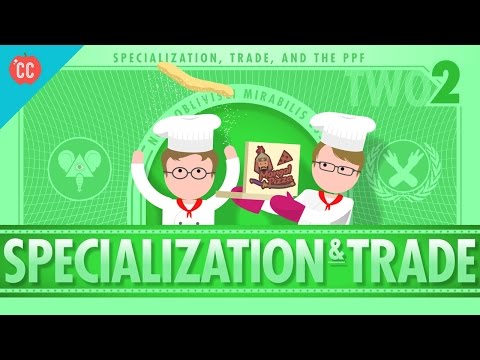
This blog post explores the concepts of specialization and trade as explained in Crash Course Economics, highlighting their historical significance, the benefits of division of labor, and the importance of comparative advantage in international trade.
In the second episode of Crash Course Economics, hosts Adriene Hill and Mr. Clifford delve into the fundamental concepts of specialization and trade. They aim to simplify complex economic ideas, emphasizing that economics is fundamentally about scarcity and choices. This post will summarize their insights, illustrating how these concepts have shaped human history and continue to influence our modern economy.
Economics is not just a dry academic subject; it is deeply intertwined with human history. The hosts argue that many significant events, such as wars and the rise and fall of empires, can be understood through an economic lens. For instance, the American Civil War was not solely about freedom but also about the economic interests of southern states that relied on cheap slave labor. Understanding these economic motivations provides a clearer picture of historical events.
The discussion transitions to the progress of humanity, particularly during the Industrial Revolution. Prior to this period, most people lived in dire conditions, with low life expectancy and high child mortality rates. The Industrial Revolution marked a turning point, leading to significant improvements in living standards, population growth, and advancements in healthcare and sanitation.
At the heart of this economic transformation was Adam Smith, often regarded as the father of modern economics. In his seminal work, "An Inquiry Into the Nature and Causes of the Wealth of Nations," Smith introduced the concept of specialization, or the division of labor. He argued that specialization increases productivity, allowing workers to focus on tasks they perform best.
To illustrate specialization, the hosts use the example of a pizza restaurant. In such a setting, different workers handle specific tasks—preparing ingredients, baking, and packaging. This division of labor enhances efficiency and productivity. Beyond the restaurant, specialization extends to various industries, from dairy farming to engineering, all contributing to the production of a single product like pizza.
While specialization boosts productivity, trade is what allows individuals and nations to benefit from their specialized skills. The hosts present a hypothetical scenario involving two individuals, John and Hank, who specialize in making pizza and t-shirts, respectively. By trading, both can enjoy more of each product than if they attempted to produce both on their own.
To further explain the benefits of trade, Mr. Clifford introduces the Production Possibilities Frontier (PPF), a graphical representation of the maximum output combinations of two goods that an economy can produce. For example, if the United States focuses entirely on producing airplanes, it can produce 500 per day, but at the cost of not producing any shoes. Conversely, if it focuses on shoes, it can produce 1000 tons per day.
The concept of opportunity cost is crucial in this discussion. The opportunity cost of producing one additional airplane in the U.S. is two tons of shoes, while in China, it is eight tons. This difference leads to the idea of comparative advantage, where countries should specialize in producing goods for which they have a lower opportunity cost and trade with others to maximize overall efficiency and output.
The hosts emphasize that trade is mutually beneficial. For instance, if the U.S. specializes in airplanes and trades with China for shoes, both countries can enjoy more of both goods than if they tried to produce everything independently. This principle holds true in the real world, where the U.S. is a leading manufacturer of airplanes but imports the majority of its shoes.
Critics of international trade often argue that it destroys domestic jobs. However, the hosts clarify that economists generally agree that trade enhances overall economic welfare. Countries that engage in open trade, like Japan and Taiwan, have seen significant improvements in living standards, while those that isolate themselves economically, such as Cuba and Venezuela, remain underdeveloped.
In conclusion, the concepts of specialization and trade are foundational to understanding economics. They explain not only the historical progress of societies but also the dynamics of modern economies. As the hosts point out, self-sufficiency can lead to inefficiency and poverty, while specialization and trade can foster prosperity. The next episode promises to explore how these ideas translate into different economic systems and their impact on global development.





