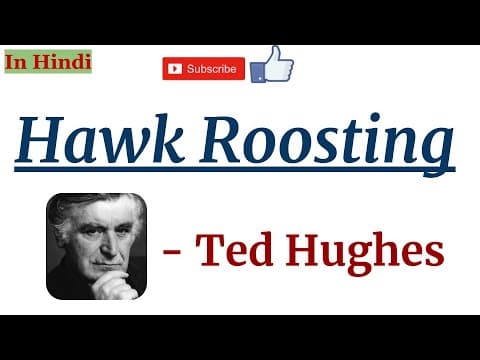
This blog post explores Ted Hughes' poem 'Hawk Roosting,' analyzing its themes of power, arrogance, and the relationship between nature and the predator. The poem presents the hawk as a symbol of dominance, reflecting on its perspective and the inherent violence in nature.
In this blog post, we will delve into Ted Hughes' renowned poem "Hawk Roosting," published in his collection Lupercal in 1962. This poem consists of twenty-four lines, divided into six stanzas, and presents a hawk's perspective on life, power, and nature. The hawk, a bird of prey, symbolizes dominance and arrogance, believing itself to be the ruler of its environment.
The title "Hawk Roosting" suggests a hawk perched high above the ground, surveying its domain. The poem anthropomorphizes the hawk, imbuing it with human emotions and thoughts, particularly a sense of pride and superiority. The hawk perceives itself as the master of the world, with everything around it existing to serve its needs.
From the very beginning, the hawk expresses its arrogance. It sits atop the tallest tree, eyes closed, not dreaming but rather contemplating its power. The hawk believes that the world revolves around it, and it has the right to hunt and kill without remorse. This sense of entitlement is a central theme in the poem, showcasing the hawk's belief that it is perfect in its hunting abilities.
The hawk views nature as a tool for its survival. It describes the trees, the sun, and the air as elements that cater to its needs. The hawk's perspective is one of domination; it believes that everything in its environment is designed to assist it in its predatory lifestyle. This reflects a broader commentary on the relationship between predators and their prey in the natural world.
Hughes also touches on the theme of creation. The hawk acknowledges the time and effort that went into its creation, emphasizing its physical prowess and the intricate design of its body. The hawk's confidence in its abilities is evident as it claims dominion over the creations of God, asserting that it has the right to rule and hunt.
The poem starkly presents the cycle of life and death. The hawk's existence is intertwined with violence; it hunts and kills, and in doing so, it perpetuates the natural order. The hawk does not shy away from its brutal nature; instead, it embraces it, viewing death as a necessary part of life. This acceptance of violence raises questions about morality and the instinctual behaviors of animals.
Towards the end of the poem, the hawk reflects on the unchanging nature of the world. It believes that nothing has altered since its creation, asserting its power to maintain the status quo. This perspective highlights the hawk's desire for control and its refusal to allow any changes that might disrupt its dominance.
In conclusion, Ted Hughes' "Hawk Roosting" is a powerful exploration of nature, power, and the inherent violence within the animal kingdom. Through the hawk's perspective, Hughes illustrates themes of arrogance, dominance, and the unyielding cycle of life and death. The poem serves as a reminder of the raw power of nature and the complex relationships between predator and prey. The hawk, as depicted by Hughes, is not just a bird but a symbol of the primal instincts that govern the natural world, reflecting a profound understanding of life’s brutal realities.