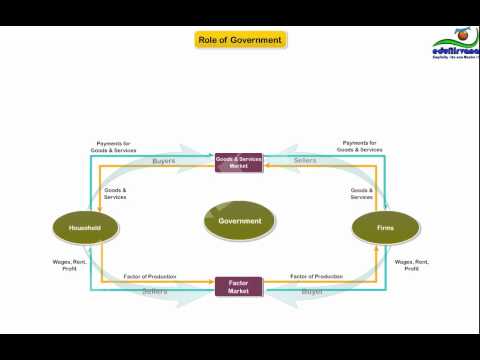
The circular flow diagram illustrates the interactions between households and firms in an economy, detailing how goods, services, and factors of production flow between them. It also highlights the roles of government, financial markets, and international trade in the economy, providing insights into GDP and economic transactions.
The circular flow diagram is a fundamental concept in economics that provides a clear and organized view of how different entities interact within an economy. This diagram simplifies the complex web of economic transactions that occur between households and firms, making it easier to understand the flow of goods, services, and resources.
In the circular flow model, there are two primary decision-makers: households and firms. Each plays a crucial role in the economy, interacting in two main types of markets:
In the goods and services market, households act as buyers while firms are sellers. Households purchase the output produced by firms, which includes various goods and services. Conversely, in the factor market, households become sellers, providing firms with the necessary inputs for production. Here, firms act as buyers, paying households for their contributions.
The flow of economic transactions can be summarized as follows:
The circular flow diagram also helps in understanding Gross Domestic Product (GDP). From the perspective of the goods and services market, the total spending by households represents GDP. This spending is equivalent to the total revenue that firms earn from selling goods and services to households.
Similarly, from the factor market perspective, the payments made by firms for inputs (wages, rent, profits) represent the income of households, which also contributes to GDP. Therefore, GDP can be computed in two ways:
Both methods yield the same GDP figure, illustrating the interconnectedness of these economic activities.
While the basic circular flow diagram focuses on households and firms, it can be expanded to include three additional key players: government, financial markets, and the rest of the world.
The government is a significant participant in the economy. It collects taxes (both direct and indirect) from households and firms, which serve as the primary source of funds. These funds are utilized for various public projects, including:
Additionally, the government engages in direct purchasing from the goods and services market, further influencing economic activity.
Financial markets play a crucial role in channeling savings from individuals and firms with surpluses to those in need of funds. This includes banks, merchant banks, and other financial institutions. Savings can originate from:
These savings are then reinvested back into the economy, facilitating growth and development.
The circular flow diagram also incorporates the global economy, highlighting the interactions between domestic economies and the rest of the world. Key elements include:
The circular flow diagram serves as a vital tool for understanding the dynamics of economic transactions between households and firms. By incorporating the roles of government, financial markets, and international trade, it provides a comprehensive view of how economies function. This model not only aids in grasping the concept of GDP but also illustrates the intricate relationships that drive economic activity.





