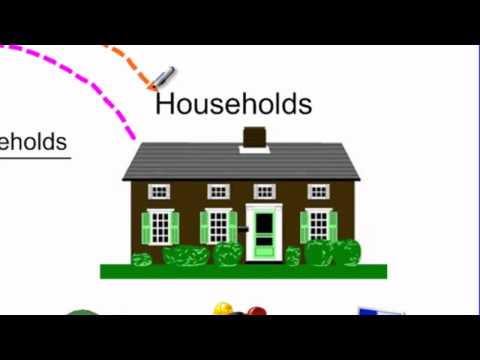
The Circular Flow Model illustrates the interactions between households and firms in a market economy, highlighting the flow of resources, goods, services, and money. Households provide land, labor, and capital to firms in exchange for income, which they use to purchase goods and services produced by those firms, creating a continuous cycle that drives the economy.
In the study of market economics, understanding the Circular Flow Model is fundamental. This model illustrates how households and firms interact within a market economy, facilitating mutually beneficial exchanges. In this blog post, we will explore the key components of the Circular Flow Model, including the roles of households and firms, the flow of resources, and the significance of money in these exchanges.
A market is defined as a place where buyers and sellers meet to engage in exchanges. In a market economy, two fundamental types of markets exist: resource markets and product markets. These markets enable households and firms to engage in exchanges that benefit both parties.
Households possess three scarce resources:
Households are the owners of these resources and provide them to firms in exchange for money.
Firms are established by entrepreneurs who seek to make a profit. They require resources from households to produce goods and services. In the resource market, firms act as buyers, acquiring land, labor, and capital from households, who are the sellers.
The Circular Flow Model begins with the flow of resources from households to firms in the resource market. Firms need these resources to produce goods and services. However, acquiring these resources requires firms to pay money to households, creating a flow of income. This income comes in various forms:
This money serves as an incentive for households to provide their resources to firms.
Once firms have acquired the necessary resources, they can produce goods and services. These products are then sold in the product market, where firms act as suppliers and households as demanders. The flow of goods and services moves from firms to households, while money flows in the opposite direction—from households to firms.
Money is crucial in a market economy as it facilitates transactions. Households use the income earned from providing resources to purchase goods and services. This exchange is essential for the functioning of the economy, as it allows households to satisfy their needs and wants.
The goals of households and firms in the Circular Flow Model are distinct yet interconnected:
The Circular Flow Model of a market economy illustrates the continuous interaction between households and firms. Households provide resources in exchange for income, which they use to purchase goods and services produced by firms. This model highlights the essential nature of a market economy, where the goals of maximizing utility and profits drive economic activity. Understanding this model is crucial for grasping the dynamics of market economies and the role of various economic agents within them. Future lessons will expand on this model to include the roles of government and the banking sector in the economy.





