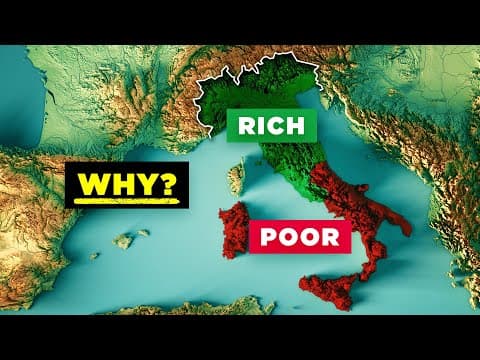
Italy's stark economic divide between the North and South is rooted in geography, history, and industrial development. The North benefits from fertile land, better infrastructure, and a history of industrialization, while the South struggles with higher unemployment, lower GDP, and historical exploitation. This divide has persisted for centuries, making it challenging for the South to catch up economically.
Italy is a country marked by a significant economic divide between its northern and southern regions. This disparity is evident in various aspects, including population density, infrastructure, religious attendance, and voter turnout. Maps illustrating these differences reveal a stark contrast that has persisted for centuries.
One of the most striking factors contributing to the economic divide is geography. The northern region of Italy, particularly the Po Valley, is characterized by flat, fertile land that is conducive to agriculture and industrial development. In contrast, southern Italy is predominantly rugged and mountainous, making infrastructure development more challenging and expensive.
The Po Valley is the largest continuous area of flat land in southern Europe, fed by the Po River and its tributaries from the Alps. This region has become an agricultural powerhouse, supporting major cities like Turin, Milan, and Bologna. The accessibility of freshwater resources from the Alps further enhances the North's agricultural productivity.
Southern Italy faces severe water stress, with projections indicating a greater risk of water scarcity by 2050. This has historically limited agricultural output and economic development in the South, exacerbating the divide.
Two critical indicators of economic disparity are the Human Development Index (HDI) and GDP per capita. While southern regions like Calabria and Sicily have HDI scores of 0.859, which are relatively high globally, they still lag behind northern regions. In terms of GDP per capita, southern Italy represents only about a quarter of the nation's total GDP despite housing a third of its population.
Unemployment rates in southern Italy are alarmingly high, with regions like Sicily and Calabria experiencing rates over 16%, compared to much lower rates in the North. This economic struggle is compounded by a lack of industrial development and job opportunities.
The historical context of Italy's unification in 1861 plays a crucial role in understanding the current economic divide. The North was more industrialized and developed, while the South was characterized by feudalism and foreign rule, which stunted its growth.
Southern Italy was subjected to centuries of foreign domination, which established a culture of absentee landlords and limited local governance. This historical exploitation prevented the emergence of a strong middle class and fostered distrust towards government institutions.
After unification, the Italian government focused investments on the North, further widening the gap. Protectionist policies favored northern industries, while the South continued to rely on agriculture, leading to a decline in industrial employment.
Today, the majority of Italy's industrial activity is concentrated in the North, with major brands and high-paying jobs located there. In contrast, the South remains reliant on agriculture and public sector jobs, which typically offer lower wages.
Tourism is another area where the divide is evident. In 2019, 60% of international tourists visited northern Italy, while only 15% traveled to the South. This uneven distribution of tourism revenue further exacerbates the economic challenges faced by southern regions.
The economic divide between North and South Italy is a complex issue rooted in geography, history, and industrial development. While the North has leveraged its advantages to become a thriving economic hub, the South continues to grapple with high unemployment and lower GDP. Addressing these disparities will require targeted investments and policies aimed at fostering growth in the South, but the historical legacies and geographic challenges present significant hurdles to overcome.