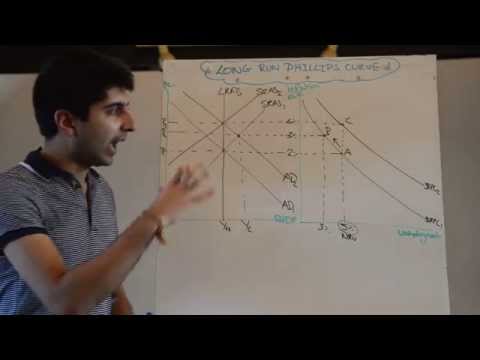
The Long Run Phillips Curve illustrates that in the long term, economies return to the natural rate of unemployment, emphasizing the importance of supply-side policies for sustainable growth and stable inflation.
The Long Run Phillips Curve is a crucial concept in economics that builds upon the ideas presented in the Short Run Phillips Curve. To fully grasp the implications of the Long Run Phillips Curve, it is essential to understand its foundation in classical economic theory and how it relates to inflation and unemployment.
To begin, we must revisit the classical model of economics. In this model, an increase in aggregate demand (AD) can occur due to various factors such as a sudden rise in consumption, investment, or net exports. In the short term, this increase in AD leads to a rise in output from the full employment level (YF) to a higher output level (Y2), resulting in increased inflation.
As output increases, the demand for labor also rises, leading to a decrease in unemployment. This relationship is depicted in the Short Run Phillips Curve, where an increase in inflation corresponds with a reduction in unemployment. For instance, if the initial equilibrium shows 2% inflation with a natural rate of unemployment at 5%, an increase in AD might raise inflation to 3% and reduce unemployment to 3%. This movement is represented as a shift up the Phillips Curve from point A to point B.
However, the Short Run Phillips Curve has limitations. It does not account for how the economy self-adjusts over time. Eventually, workers will adjust their wage expectations upwards, demanding higher wages. This adjustment increases production costs for firms, leading to a leftward shift in the Short Run Aggregate Supply (SRAS) curve, which in turn raises inflation and returns the economy to the full employment output level (YF).
As the SRAS shifts left from SR1 to SR2, the Short Run Phillips Curve also shifts to the right, indicating a new equilibrium. For example, if the new equilibrium shows inflation at 4%, the unemployment rate returns to the natural rate of 5%. By connecting these points, we derive the Long Run Phillips Curve, which illustrates that the economy will always revert to the natural rate of unemployment in the long run.
The Long Run Phillips Curve conveys several important insights:
The Long Run Phillips Curve aligns with classical economic theories, emphasizing that increasing aggregate demand is not a sustainable method for long-term growth or reducing unemployment. Instead, the focus should be on supply-side policies. These policies aim to enhance the long-run aggregate supply (LRAS), which can shift the Long Run Phillips Curve to the left, effectively lowering the natural rate of unemployment from 5% to 4%.
In summary, the Long Run Phillips Curve illustrates the relationship between inflation and unemployment over time, reinforcing the idea that economies tend to return to their natural rates of unemployment. To achieve sustainable growth and lower unemployment rates, policymakers must prioritize supply-side strategies rather than relying solely on demand-side interventions. Understanding this dynamic is essential for addressing key macroeconomic objectives and ensuring long-term economic stability.





