The Phillips Curve illustrates the inverse relationship between inflation and unemployment, suggesting that low unemployment correlates with high inflation and vice versa. However, stagflation presents a contradiction to this theory, where both inflation and unemployment rise simultaneously due to supply shocks and changing expectations.
In this article, we will explore the concept of inflation with a particular focus on the Phillips Curve, a key economic theory that examines the relationship between inflation and unemployment.
A.W. Phillips was a professor at the London School of Economics who conducted significant research on the relationship between inflation and unemployment. His inquiry aimed to determine whether inflation changes in response to unemployment levels. This question led him to investigate the potential direct, indirect, or nonexistent relationships between these two critical economic variables.
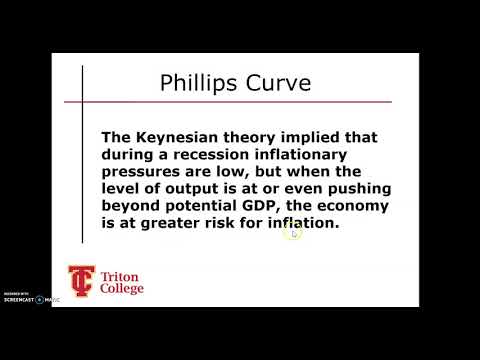
To understand the Phillips Curve, it is essential to revisit Keynesian economic theory. According to Keynesian principles, during a recession, inflationary pressures tend to be low. This is primarily because high unemployment rates result in decreased aggregate demand. When people are out of work, they have less income to spend, leading to lower overall spending in the economy. Consequently, with reduced demand, inflation remains low.
Conversely, when the economy operates at or above its potential GDP, it approaches full employment. In this scenario, unemployment is minimal, and income levels rise, leading to increased consumer spending. As demand for goods and services increases, prices begin to rise, resulting in inflation.
A.W. Phillips discovered a trade-off between inflation and unemployment, which is visually represented by the Phillips Curve. This curve illustrates an inverse relationship: as unemployment decreases, inflation tends to increase, and vice versa.
For example, when the unemployment rate is low (around 4%), the inflation rate may be high (around 5%). In this situation, more people are employed, leading to increased spending and higher prices. On the other hand, when unemployment is high (for instance, at 7%), inflation tends to be low due to decreased consumer spending.
Stagflation is a term used to describe a situation where both unemployment and inflation rise simultaneously. This phenomenon appears to contradict the Phillips Curve, which suggests that inflation and unemployment have an inverse relationship.
There are two primary reasons why stagflation may occur:
The Phillips Curve provides valuable insights into the relationship between inflation and unemployment, highlighting a fundamental trade-off in economic theory. However, the occurrence of stagflation challenges this relationship, demonstrating that both inflation and unemployment can rise under certain conditions. Understanding these dynamics is crucial for policymakers and economists as they navigate the complexities of economic management.





