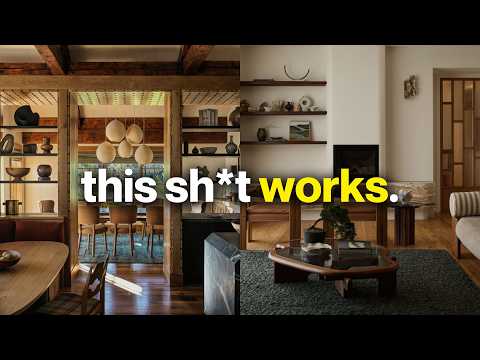
This article explores the psychological principles and design techniques that make certain homes feel inviting and aesthetically pleasing. It covers the importance of vertical and horizontal visual planes, lighting strategies, the use of odd-numbered groupings in decor, and the balance between professional design rules and personal touches to create a space that feels both stylish and lived-in.
Have you ever looked at a beautifully designed room and wondered, "Why does this look so good?" While personal taste plays a role, there is a significant amount of science and psychology behind what makes certain rooms timeless and aesthetically pleasing. This article delves into how you can harness these psychological insights to upgrade your home without major renovations or buying new furniture.
Many rooms, despite having trendy furniture like a stylish sofa, marble coffee table, and expensive rug, still feel flat or two-dimensional. This common mistake is known as the "single plane trap." In such rooms, all furniture and decor occupy a narrow horizontal band starting at the floor and ending around 2.5 feet up. Sofas, coffee tables, media consoles, and beds all live within this same horizontal slice.
When the eye scans a room like this, it has no reason to travel upward or into corners, causing the brain to collapse the space into a flat, static image. Designers call this the "dollhouse effect," where scale feels distorted and nothing feels substantial or anchored.
To fix this, you need to reclaim the vertical plane. Think of your space as a 3D puzzle where visual weight is distributed vertically, leading the eye from floor to ceiling. A room is defined by how the eye moves through it. In a flat room, the eye scans horizontally and hits a dead end at the walls, making ceilings feel lower and walls closer, shrinking the perceived volume.
Adding vertical rhythm disrupts this by placing visual interest at low, medium, and high altitudes. This forces the viewer's gaze to travel in a zigzag pattern, engaging peripheral vision and signaling to the brain that the space is expansive and dynamic.
Curtain Height Hack: Instead of mounting curtain rods at the top of the window frame, mount them 2 to 4 inches below the ceiling line. This makes the room feel taller and more expensive by tricking the brain into perceiving a grander floor-to-ceiling aperture.
Vertical Lines: Use fluted wall panels or tall, slim bookcases. Vertical lines act like visual runways, elongating the room's perceived volume and creating an optical illusion known as lofting. This breaks the monotony of horizontal lines created by sofas and tables.
Besides vertical spaciousness, depth can be created horizontally by avoiding pushing furniture flush against walls. When a sofa is pushed against a wall, it loses its mass and looks like part of the architecture.
Professional designers often "float" furniture by moving it away from walls, even by as little as 6 inches. This gap creates negative space and a shadow line, proving to the eye that the object is three-dimensional and occupies real volume. It also allows the room to breathe, creating circulation and flow.
Think of your room like a landscape painting with three layers:
Pulling the sofa away from the wall introduces these layers, preventing the room from feeling like a shoebox.
A single overhead light that floods the room with uniform brightness is detrimental to good interior design. Uniform light bleaches out contrast, making furniture look like flat cardboard cutouts.
Directional light acts like a flashlight beam, creating high contrast and shadows that help the brain recognize form and distance. Shadows are constructive tools that breathe life into a space.
Terminator Line: The boundary where light meets shadow on an object’s surface. This line helps the brain perceive three-dimensionality.
Sidelighting: Positioning light at a 45° angle to textured surfaces (like fluted panels) sculpts the wall, creating tactile dimension.
Grazing: Lighting a wall from a steep angle exaggerates texture and creates rhythmic patterns of highlights and shadows, adding depth.
Layering prevents corners from collapsing into darkness and creates an immersive 3D experience.
Many people arrange decor symmetrically, grouping items in pairs because symmetry signals order and safety to the brain. However, in homes, symmetry can make spaces feel stiff, sterile, or like a furniture catalog.
To create organic energy and visual interest, avoid grouping items in pairs. Instead, use odd numbers like three, five, or seven. But it’s not just about the number; the items must have the right scale and purpose.
Create a hierarchy with three items of varying heights:
Cluster these tightly so they touch or overlap, creating a micro landscape that guides the eye naturally.
For long desks or wide consoles, use five or seven pieces. Anchor one side with a chunky lamp and layer other items with deliberate gaps of negative space to maintain breathing room and a high-end look.
This approach is known as the 357 rule, a flexible guideline for grouping decor.
Even a perfectly designed room can feel emotionally hollow if it lacks personality. This happens when you follow design rules too strictly or stick to a specific aesthetic, editing out all traces of your own pulse.
Break the monotony by adding something unusual or imperfect—an intentional imperfection that adds realness. Examples include:
These personal anchors create friction, adding depth and a sense of permanence.
This balance keeps the room functional and stylish while making it feel lived-in and welcoming.
Your brain constantly seeks proof of life in your surroundings—shadows that indicate depth and imperfections that signal human presence. Overly logical design, with perfectly matched materials and catalog sets, starves the brain of the visual data it needs to feel comfortable.
By introducing visual friction, breaking up flat planes, and layering light and decor thoughtfully, you create a space that feels stable, intentional, and inviting. The eye has a journey to go on, which is the hallmark of a high-end, comfortable home.
Now that you understand these principles, you can move beyond quick fixes and learn systems to tie it all together, transforming uninspiring rooms into spaces you love to spend time in.