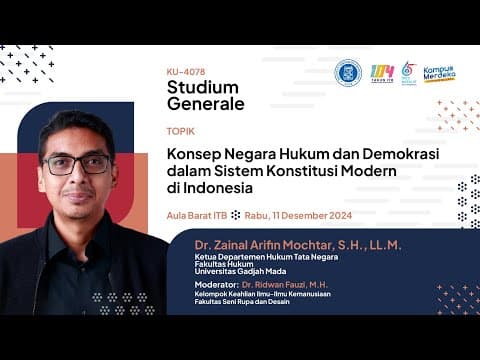
Dr. Zainal Arifin Mochtar discusses the concepts of rule of law and democracy in Indonesia, emphasizing the importance of limiting power, protecting citizen rights, and the challenges faced by democratic institutions in the country.
On December 11, 2024, a significant studium generale was held featuring Dr. Zainal Arifin Mochtar, the head of the Constitutional Law Department at Gadjah Mada University. The topic of discussion was the concepts of rule of law and democracy within the framework of Indonesia's modern constitutional system. This event aimed to provide students with a broader perspective on governance and legal principles that extend beyond their specific fields of study.
The event commenced with the singing of the Indonesian national anthem, followed by welcoming remarks from the Director of Student Affairs at the Bandung Institute of Technology (ITB). The director highlighted the importance of the topic and expressed gratitude for Dr. Zainal's presence, noting his extensive background in law and activism, particularly in anti-corruption efforts.
Dr. Zainal began his presentation by simplifying the concept of rule of law into two main components: power and citizen rights. He explained that in constitutional law, discussions typically revolve around how power is acquired, exercised, and limited, alongside the protection of citizens' rights. In democratic nations, there is a balance between the discourse on power and the discourse on rights, with an emphasis on limiting power to prevent abuse.
Dr. Zainal introduced the term "autocratic legalism," which refers to regimes that use legal frameworks to justify authoritarian practices. He pointed out that Indonesia has experienced instances where laws were crafted to legitimize undemocratic actions, such as lifetime presidential terms. This phenomenon raises questions about the integrity of laws and their alignment with democratic principles.
Dr. Zainal emphasized that democracy is not merely about holding elections but involves a deeper commitment to protecting civil liberties and ensuring public participation in governance. He outlined several key principles of democracy:
Dr. Zainal identified several challenges facing democracy in Indonesia:
The discussion also touched on the importance of independent institutions in maintaining democracy. Dr. Zainal noted that institutions like the Corruption Eradication Commission (KPK) and the General Election Commission (KPU) were established to oversee government actions and ensure fair elections. However, these institutions have faced significant challenges and pressures that threaten their independence and effectiveness.
Dr. Zainal stressed the importance of public engagement in the democratic process. He argued that a well-informed and active citizenry is crucial for holding leaders accountable and ensuring that governance reflects the will of the people. He encouraged students to participate in discussions, advocate for transparency, and challenge unjust practices.
In conclusion, Dr. Zainal Arifin Mochtar's insights shed light on the complexities of rule of law and democracy in Indonesia. He called for a collective effort to strengthen democratic institutions, protect citizen rights, and foster a culture of accountability. The future of democracy in Indonesia relies on the active participation of its citizens and the commitment to uphold the principles of justice and equality.
As future leaders and citizens, it is imperative for students and the broader community to engage in the democratic process, advocate for reform, and work towards a more just and equitable society. The journey towards a robust democracy requires patience, commitment, and collective action.