A recent study reveals a stark contrast between Americans' perceptions of wealth distribution and the actual reality, highlighting significant wealth inequality where the top 1% holds a disproportionate share of the nation's wealth.
Wealth inequality in America has become a pressing issue, prompting discussions about the distribution of wealth among its citizens. A recent study conducted by a Harvard Business professor and economist surveyed over 5,000 Americans to understand their perceptions of wealth distribution in the United States. The findings reveal a significant gap between what people believe and the actual distribution of wealth.
The survey asked participants to divide the American population into five groups based on wealth: the bottom 20%, the middle three 20% groups, and the top 20%. Respondents were then asked how they thought wealth was distributed and what they believed the ideal distribution should be. Shockingly, 92% of participants indicated that they believed wealth should be distributed more equitably than it currently is.
This overwhelming consensus suggests that most Americans recognize the skewed nature of wealth distribution, yet the reality is even more alarming than their perceptions.
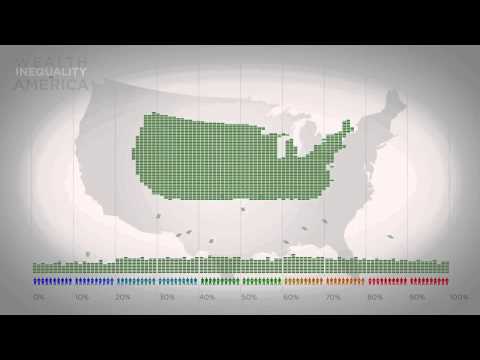
To illustrate the disparity between perception and reality, let’s simplify the population of the United States to a representative group of 100 people. In this scenario, we categorize individuals based on their wealth, from the poorest on the left to the wealthiest on the right. This visualization helps to clarify the stark differences in wealth distribution.
When asked about an ideal distribution of wealth, respondents envisioned a scenario where the wealthiest individuals are about 10 to 20 times better off than the poorest. This ideal also included a healthy middle class, with a smooth transition into wealth. Both Republicans and Democrats agreed on this vision, with 92% supporting this more equitable distribution.
Next, the survey revealed what people believed the current distribution looked like. While this perception was less equitable than the ideal, it still painted a relatively positive picture. However, even this perception does not align with the actual distribution of wealth in America.
The reality is starkly different. The bottom 40% of Americans barely register on the wealth scale, while the top 1% holds an astonishing 40% of the nation’s wealth. To put this into perspective, the wealth of the top 1% is so vast that it requires a separate column on the wealth chart, as it exceeds the scale of the other groups.
The wealth distribution can be summarized as follows:
This inequality has worsened over the past 20 to 30 years, with the richest 1% now taking home nearly a quarter of the national income, a significant increase from just 9% in 1976.
Another critical aspect of wealth inequality is the disparity in investment ownership. The top 1% owns half of the country’s stocks, bonds, and mutual funds, while the bottom 50% of Americans own a mere half a percent of these investments. This lack of investment among the lower and middle classes indicates that many are merely scraping by rather than building wealth.
While it is acknowledged that many wealthy individuals have worked hard for their money, the question arises: do we believe that a CEO works 380 times harder than the average employee? The average worker needs to labor for over a month to earn what a CEO makes in just one hour. This raises concerns about the fairness of the current system.
The findings from this survey highlight a critical need for awareness regarding wealth inequality in America. The reality of wealth distribution is far removed from both the perceived and ideal distributions. It is essential for Americans to recognize this disparity and advocate for a more equitable system that rewards hard work without extreme inequality. The conversation about wealth distribution is not just about achieving socialism; it is about finding a fair balance that allows all Americans to thrive.





