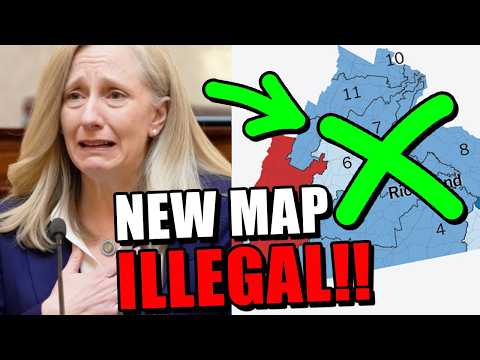
Virginia's recently passed constitutional amendment on redistricting has been swiftly challenged in court, with a Tazewell County judge issuing an injunction less than 24 hours after the vote. Multiple constitutional violations are cited, and the case is expected to move quickly through the Virginia Supreme Court, potentially resulting in the map being struck down by May.
Virginia recently passed a constitutional amendment regarding redistricting, which was initially seen as a victory for Democrats. However, within less than 24 hours, the new map has faced significant legal challenges, with a judge ruling the referendum unconstitutional and issuing an injunction blocking certification of the election results. This article explores the rapid developments, the legal arguments involved, and the potential implications for Virginia's political landscape.
The legal challenge to the new congressional map moved at an unusually fast pace. Less than an hour after a video discussing the potential unconstitutionality of the map was recorded, an injunction was already in place. A Tazewell County judge ruled the referendum unconstitutional and blocked the certification of the election, denying a motion to stay pending appeal. This swift action signals a serious legal battle ahead.
Ken Cuccinelli, the 46th Virginia Attorney General, outlined four main constitutional challenges to the amendment:
Invalid Passage During Special Session:
Violation of Article 12, Section 1 - First Passage Requirement:
Violation of Article 12, Section 1 - Timing of Voter Submission:
Violation of Article 2, Section 6 - District Contiguity:
According to Cuccinelli, the legal process will move very quickly. Briefs are due soon, and oral arguments before the Virginia Supreme Court are expected shortly. Another related case from a circuit court in Southwest Virginia is also underway and may be consolidated with the Supreme Court case. A final ruling is anticipated by May, with Cuccinelli predicting the referendum will likely be tossed out.
The ballot question for the amendment read:
"Should the Constitution of Virginia be amended to allow the General Assembly to temporarily adopt new congressional districts to restore fairness in the upcoming elections while ensuring that Virginia's standard redistricting process resumes after the 2030 census?"
Many have argued that this question was deceptive, as it implied the new districts would restore fairness. However, some politicians, such as Abigail Spanberger, have indirectly admitted that the new districts are unfair, suggesting that the unfairness was intentional.
Spanberger expressed concerns about the precedent this sets for other states and emphasized the importance of returning to a bipartisan commission for redistricting in Virginia. She described the new map as a "responsive and temporary step" rather than a new normal.
The rapid legal challenges to Virginia's new congressional map highlight significant procedural and constitutional issues. The Democrats' celebration of the amendment's passage may be premature, as the courts appear poised to scrutinize and potentially overturn the referendum.
If the map is struck down, it will not only affect Virginia's political landscape but also serve as a cautionary tale about the importance of adhering to constitutional procedures in redistricting efforts.
The coming months will be critical as the Virginia Supreme Court hears arguments and issues its ruling. For now, the situation remains fluid, but the legal foundation for challenging the map is strong and moving quickly.
Stay tuned for further updates as this story develops.