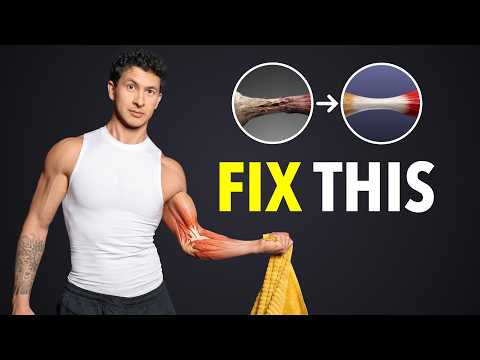
Tendon pain is often caused by improper training and poor load management, not just muscle or bone issues. Tendons require specific types of exercise, especially isometric holds, to heal and strengthen. Avoid sudden increases in training volume and momentum-based movements. Consistent, targeted isometric exercises can rebuild tendons and relieve pain within weeks.
Squeaky and creaky joints are not just a normal part of training. If this discomfort keeps recurring, the problem often lies not in your muscles or bones, but in your tendons. Tendon issues are the number one cause of pain for many people.
Think of tendons as the cables that make your body move. Whether you're lifting your forearm during a curl, pulling your arm across your body during a bench press, or swinging your elbow to hit a tennis ball, tendons are crucial. But movement isn't their only job.
When you jump down stairs and land on your feet, you don't want your muscles to take all the load. Tendons act protectively by stretching quickly and absorbing some of the force, preventing muscles from extending too rapidly. This means your tendons need to be incredibly strong.
While lifting weights is excellent for building muscle, tendons require a different type of training. Research shows that tendons don't respond well to the same loads that build muscle strength. If your muscles grow stronger faster than your tendons, it creates a strength gap that often leads to pain and injury.
This imbalance explains why tendon injuries are so common, especially among athletes. For example, steroid users often experience tendon injuries because their muscles outgrow their tendons' strength. This phenomenon was notably observed in 1990s baseball players who used anabolic steroids.
A common sign of tendon issues is a clicking or popping sound in the joint, often accompanied by pain. Tendons can become slightly swollen or "chubby," which causes them to catch or roll in narrow joint spaces, especially in the shoulder.
However, clicking alone doesn't always indicate damage. Pain accompanying these sounds is a more serious sign.
One of the worst things you can do when experiencing tendon pain is to rest completely. Tendons need load to heal properly. Rest might temporarily reduce pain, but it doesn't fix the underlying problem. Healthy parts of the tendon weaken without load, and damaged areas never rebuild correctly.
As a result, pain returns as soon as you resume activity. This issue worsens with age, leading to chronic musculoskeletal pain in active individuals.
Suddenly increasing your activity level—whether more bench pressing, running, or starting a new sport—can lead to tendon problems. Tendons take longer to adapt than muscles, so a rapid increase in volume or intensity (more than about 30%) raises injury risk.
For example, if you usually do four sets of bench press per week, jumping to ten sets is risky. Instead, increase gradually, adding only one or two sets at a time.
When lifting heavier weights, people often use momentum, such as bouncing the weight off the chest during a bench press or bouncing at the bottom of a squat. This type of loading is harsh on tendons.
While Olympic weightlifters use momentum, their tendons have adapted over time. For most people, controlling the bottom of each rep reduces tendon stress and can also promote faster muscle growth.
Isometric exercises involve contracting a muscle without moving it, like flexing your bicep with your elbow bent at 90 degrees. These exercises maximize "creep" in the tendon, distributing load evenly, including to damaged areas.
Holding an isometric contraction for about 30 seconds signals the tendon to synthesize collagen and rebuild stronger tissue.
Pick an exercise that mimics the motion that causes you pain and hold a position where you can load the tendon without movement.
Tendon pain and injuries are often due to improper training and load management rather than muscle or bone problems. Tendons require specific, controlled loading through isometric exercises to heal and strengthen effectively. Avoid sudden increases in training volume and momentum-based movements to protect your tendons.
By incorporating targeted isometric exercises consistently, you can relieve pain quickly and rebuild stronger tendons in as little as 30 days, ensuring long-term joint health and performance.