Zillow has significantly reduced its 2025 home price forecast to just 0.6% growth, indicating a weakening housing market with rising inventory and price cuts across nearly 250 metropolitan areas. The report highlights a shift towards a buyer's market, particularly in states like Florida, Texas, and Arizona, while some regions in the Northeast and Midwest continue to experience price increases due to low inventory.
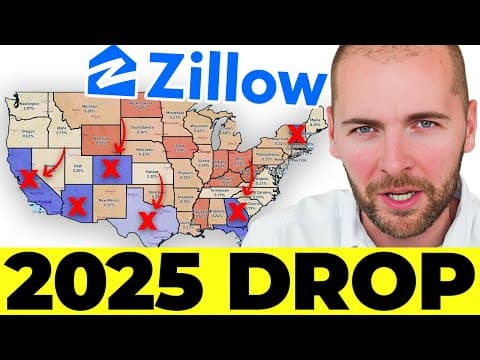
Zillow has recently revised its home price forecast for 2025, indicating a significant downturn in the housing market. The forecast has been slashed to a mere 0.6% growth on a nationwide basis, down from nearly 3% at the beginning of the year. This adjustment reflects a broader trend of declining buyer demand and increasing inventory, leading to a shift towards a buyer's market in many cities across the United States.
The primary driver behind Zillow's downward revisions is the rising inventory levels in the housing market. As supply surges, sellers are increasingly compelled to reduce their asking prices. Recent research indicates that 34% of single-family home listings have experienced price cuts this month, marking the highest rate of price reductions in over a decade.
The states most affected by these price cuts include:
These figures illustrate a growing desperation among sellers in these regions, particularly those that experienced rapid price increases during the pandemic.
Despite the increase in inventory and price cuts, buyer demand remains significantly low. The National Association of Realtors reported that February 2025 marked the worst month for home sales in 14 years, with only 4.26 million seasonally adjusted home sales. This figure represents a decline from the previous year and is reminiscent of the downturn experienced during the 2008-2011 housing crash.
Currently, the housing market is characterized by a standoff between buyers and sellers. Many sellers continue to list their homes at inflated prices, often making only minor reductions that fail to attract buyers. The affordability crisis, exacerbated by high prices and mortgage rates, means that even significant price cuts may not be sufficient to stimulate demand.
Zillow's updated home value figures reveal that several states are experiencing actual declines in home values. States such as California, Arizona, Colorado, Texas, Georgia, and Florida have all reported month-over-month decreases in home values. Notably, California, which had previously shown resilience, is now facing downward pressure due to increased inventory.
Reventure, a real estate analytics firm, has developed its own home price forecast, indicating that approximately 20 states are likely to see declining prices over the next year. Florida and Texas are projected to experience the most significant declines, with forecast scores of 36 and 38 out of 100, respectively. This data suggests a heavy buyer's market in these regions.
To understand the potential for a significant downturn in home prices, it is essential to consider the broader economic context. Historical data shows that substantial declines in home values are often accompanied by recessions and significant job losses. For instance, during the last housing crash, unemployment rates soared above 10%, leading to forced sales and foreclosures.
Currently, job growth in states like Florida and Nevada has slowed considerably. Florida's non-farm payroll growth is at 1.4%, down from pre-pandemic levels, while Nevada's growth is similarly stagnant. If these trends continue and job losses begin to mount, the housing market could face severe challenges, potentially leading to price declines of 20% or more.
As the housing market continues to evolve, it is crucial for buyers and investors to stay informed about local trends and economic indicators. While some regions are experiencing price cuts and increased inventory, others, particularly in the Northeast and Midwest, are still facing tight markets with rising prices due to low inventory.
Understanding these dynamics will be key for anyone looking to navigate the current housing landscape effectively. Buyers should recalibrate their expectations and consider the implications of economic conditions on future home prices as they make decisions in this shifting market.