Editorial Team
6 min read
Adobe demonstrated 10 experimental creative tools and opened Deep Brush and Hands On for testing. The lineup explores more direct control over AI edits, but existing alternatives and unproven production performance limit claims of novelty.
Adobe opened research previews of two experimental editing tools alongside 10 demonstrations at its November 11 MAX Sneaks session in Miami Beach. The maker of Photoshop, Premiere and Illustrator is testing how brushes, drags and other direct controls can guide AI-assisted creative work, including edits that follow an image's contours or persist across video cuts.
Adobe says in its announcement that users can try Project Deep Brush and Project Hands On in its new Labs Playground and provide feedback. Sneaks is its research showcase, rather than a product release: Adobe has not said which experiments will ship or when, according to the session report.
For users of Creative Cloud, Adobe's suite of creative applications, the stakes are practical: whether AI can reduce repetitive work while leaving changes easy to direct and correct. The experiments also give Adobe a way to test prospective features with the creators who use its software. They follow the company's MAX product releases a day earlier, including Photoshop's Relight tool, a Firefly AI agent that plans work and support for outside AI agents. The research previews should be assessed separately from those releases.
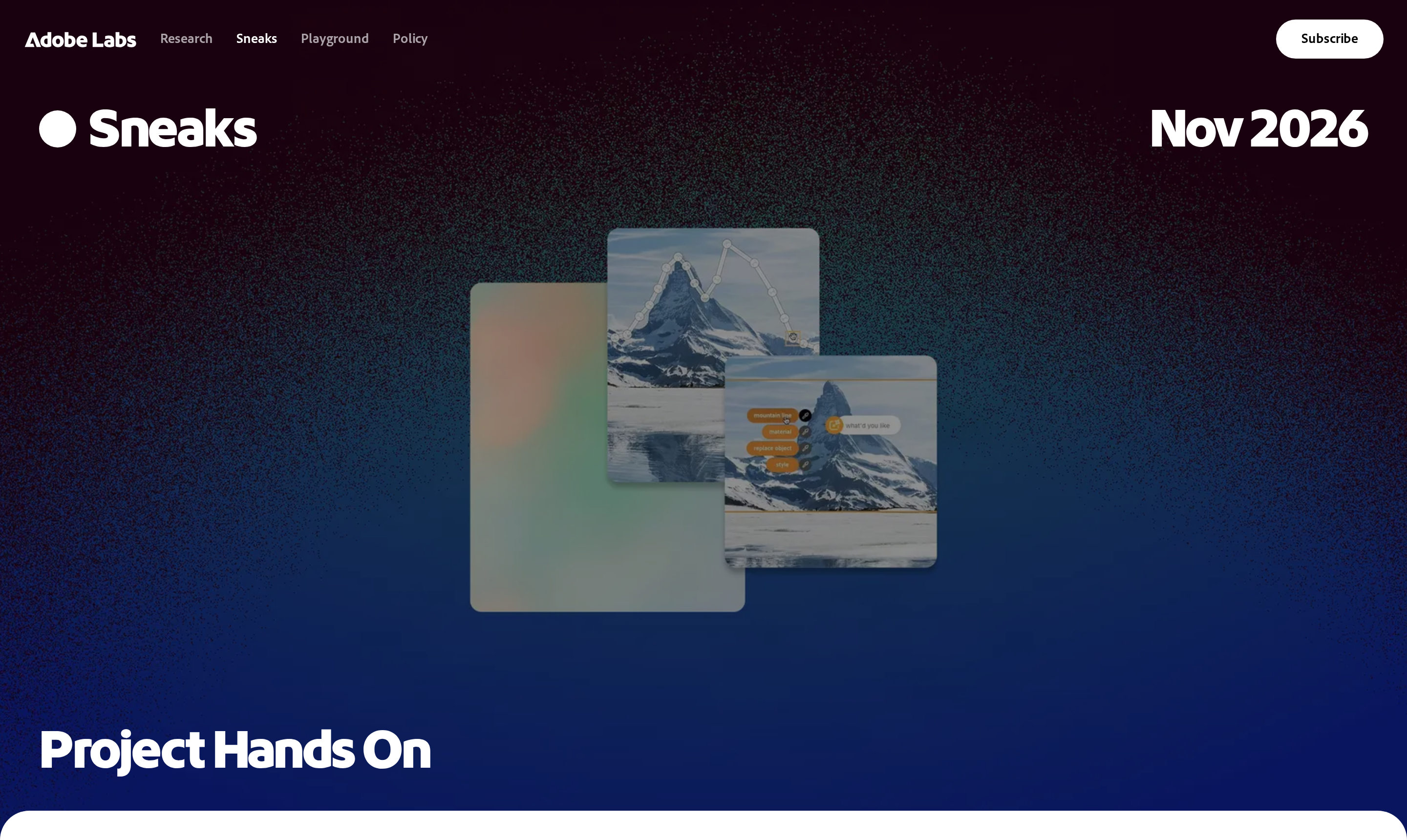
Project Hands On places editing controls directly on images. Company-reported research preview. Source: Adobe. Source: Adobe.
Project Sight Span, one of the demonstrations, turns a still image into an environment users can explore. Adobe describes finding new angles and composing shots beyond the original frame. The demonstration report also describes conversion into navigable 3D data and an upscaling capability for higher-resolution output.
That makes the experiment more than a conventional crop: users can change their viewpoint rather than simply select a smaller rectangle. But the announced capability should not be read as proof that it faithfully recovers everything outside the original camera view. Adobe's does not establish that level of accuracy.
Google launched Gemini 4 Hydrogen and automatic model switching in Antigravity, claiming near-Carbon task success with less quota and faster completion. Lower token rates support the efficiency pitch, but reasoning settings, mixed competitive results and inconsistent benchmark labels leave the cost of completed work to be tested.
Creating a 3D environment from an image is already available elsewhere. World Labs, an AI developer building models of three-dimensional environments, made its Marble world model generally available on November 12, 2025. Its launch announcement describes generating worlds from a single image, editing and expanding them, and exporting 3D representations or videos. Its experimental Chisel mode also lets users guide a world's structure with a rough 3D layout. Direct creative control is therefore part of the competitive baseline, too.
World Labs introduced its next-generation Atlas model on September 1, 2026. In that announcement, the company says Atlas generates new views from one or more reference images using specified camera positions and angles, and was available to try. These capabilities establish an alternative to waiting for Sight Span; they do not establish equivalent output quality, speed or workflow compatibility.
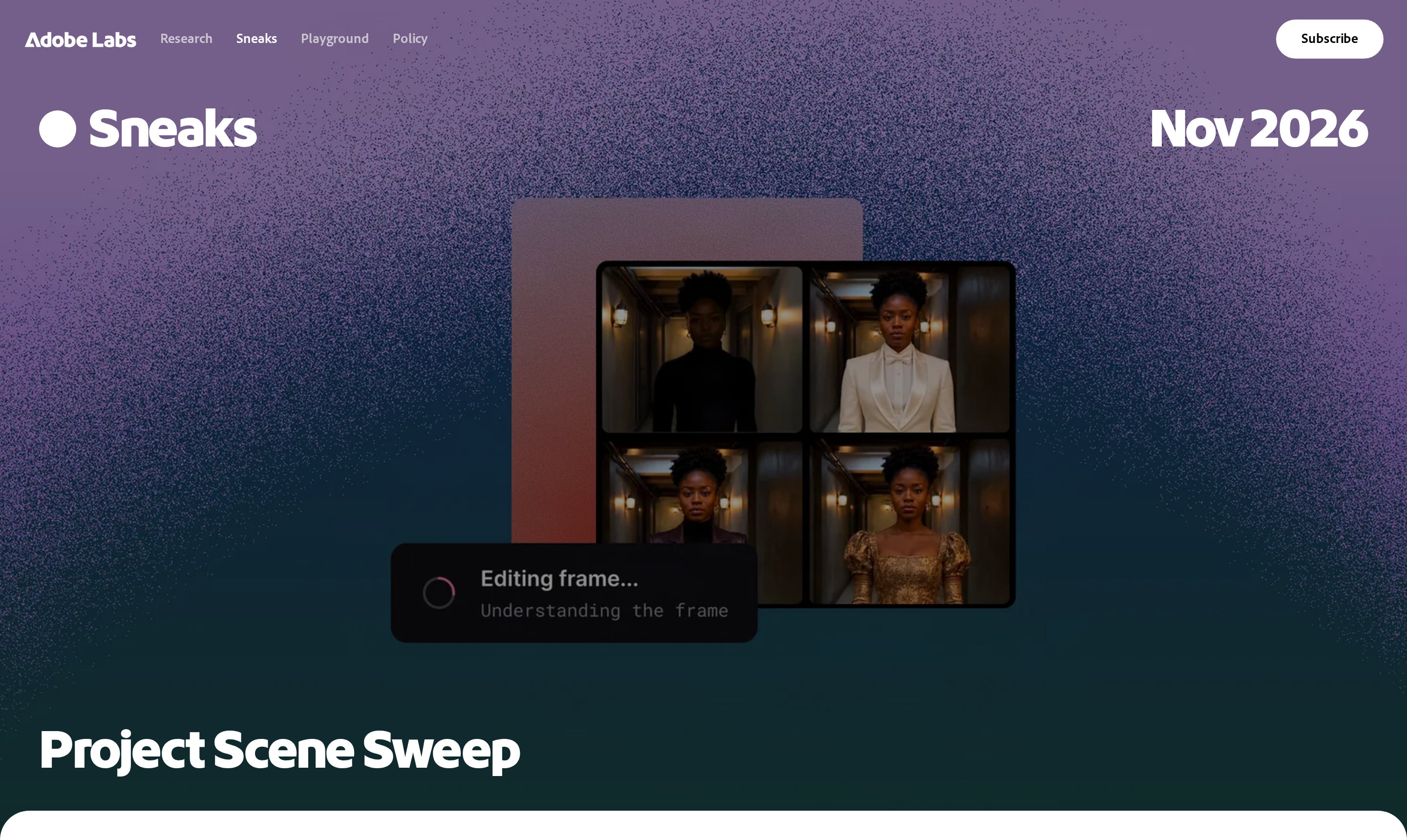
Adobe’s Scene Sweep illustration shows wardrobe variations for video editing. Company-reported research demonstration. Source: Adobe. Source: Adobe.
Adobe's announcement describes the following capabilities. These are company descriptions and demonstrations, rather than independently measured performance results:
| Project | What Adobe demonstrated or described |
|---|---|
| Sight Span | Explore an environment derived from one image and compose new viewpoints. |
| Deep Brush | Paint along surface contours, change color while preserving shadows, and paint light into an image. |
| Hands On | Generate controls directly on an image so users can reshape objects by dragging. |
| Rinse Repeat | Adapt edits from one image region to another, recreating them with editable native Photoshop tools. |
| Link Up | Fit a dragged design element to a scene's perspective, scale and style, preserving editable vector artwork. |
| Scene Sweep | Apply an edit consistently across shots, cuts and camera angles. |
| Live Set | Change a subject, environment or camera direction while a video continues playing. |
| On Cue | Specify the timing of events in generated video using a signal drawn by hand or extracted from video or music. |
| Screen Test | Develop a fictional character's appearance, voice and personality, then converse with it to explore responses. |
| Sound Bender | Extract a described sound from a finished mix and shape variations on an interactive canvas. |
Some demonstrations addressed familiar manual work. In the on-site account, Deep Brush followed folds in fabric as lettering was painted onto it. Hands On reshaped a square perfume bottle into a diamond and stretched a sofa. Rinse Repeat transferred blemish-removal work from one face to three others, adapting the changes to different blemish locations.
The significance of Rinse Repeat and Link Up is also in what remains afterward: native Photoshop edits and vector artwork can be refined further. That preserves a route for correction rather than making the generated result the endpoint.
The brush and drag controls have a research rationale. Adobe's research, described in the session report, draws on eight studies involving 82 working and aspiring creative professionals from 2024 to 2026, plus a review of research papers. The researchers argue that creators often discover their intent through making and revising work rather than fully describing it beforehand. They acknowledge that the sample leans toward visual disciplines and is not representative of all creative workers. Those findings do not establish a productivity gain from the Sneaks tools.
Hands On also builds on an existing Adobe effort. According to the report, Adobe says it grew out of the Edit object tool in Firefly, its generative AI offering, and that models were initially too slow for the idea. Adobe's announcement describes the current approach as combining object segmentation with vision-language models to create controls on the canvas. Adobe also says, as relayed in the session report, that its team trained its own editing model for Scene Sweep's multi-shot video edits. The sources do not supply hardware requirements or latency measurements to show how these systems would perform in production.
There is a path from Sneaks to commercial software. The demonstration report traces Photoshop's Harmonize feature, introduced in 2025, to Project Perfect Blend at the October 2024 Sneaks. The on-site account also relays Adobe's statement that Relight, shown at the previous year's Sneaks, is now a standard Photoshop feature. Those precedents explain why the experiments matter to existing users, without guaranteeing a release for this year's projects.
The Playground extends that feedback process beyond the stage. Alongside the two Sneaks previews, Adobe offers Project Custom Filters, a separate research preview of a possible Photoshop capability. The session report describes it as turning a text description into a live filter with adjustable sliders. It is not an eleventh project in the Sneaks lineup.
The outstanding questions are practical: how reliably edits hold across difficult shots, how quickly object controls respond, and how much correction a generated viewpoint requires. The Sneaks announcement and reports provide no comparable quality benchmarks, measured time savings, pricing or production-cost figures for the lineup. They cannot yet support a cost or performance comparison with alternatives.
Adobe's next decision is which experiments merit product integration, and on what terms. Feedback from Deep Brush and Hands On can test a narrower question now: whether direct manipulation helps creators reach and refine an intended edit. Broader claims about faster or cheaper production will require evidence beyond the stage demonstrations.
Japan is considering safety and reporting duties backed by enforceable orders for advanced AI. The proposal would strengthen its nonbinding framework, but capability thresholds, covered businesses and penalties remain unresolved.
Google says its new fast AI model is reaching Search users worldwide, improving complex answers and source discovery. The rollout expands access to Gemini 4, but its effect on answer quality and website traffic remains unmeasured.
Four nonprofits are asking a California court to stop five AI developers from building or deploying more capable systems. The case seeks enforceable limits even as OpenAI has previously reported a training pause and is launching defensive AI tools.
Expo Simulators gives coding agents remote iOS and Android environments with recordings for reviewers. The launch extends Expo's cloud development services into verification, with per-minute charges and shared capacity limits.
Kleiner Perkins and Clearlake Capital led Mirendil’s $1 billion Series A. Its agent-led model-building experiment points to smaller research teams, but company benchmarks, substantial compute costs and a private beta qualify the promise of wider access.
Mount Thor raised $45 million in equity, alongside separate hardware financing, to expand Apple infrastructure for AI agents and model inference. Existing Mac clouds and workload-specific performance limits put its demand and cost claims to the test.
Salesforce Ventures led a Series C that values Q-CTRL above $1 billion. The funding backs GPS-free navigation and quantum computing software, while undisclosed revenue and contested performance benchmarks leave the commercial case open.
House Foreign Affairs Committee Chairman Brian Mast says outgoing Nvidia chief Jensen Huang has agreed to questioning, with a date still under negotiation. Speaker Mike Johnson says support for limiting chip exports to China is growing as lawmakers examine allegations involving Huang and a cloud partner.
Leaked correspondence and a reconstructed publishing program expose John Mark Dougan’s use of AI to stock imitation news sites with pro-Russian material. The records illuminate funding and working methods, while his claims of influencing other AI systems remain unproven.
William Blair raised AMD to Outperform as server-chip prospects and valuation improved. AMD already expects revenue growth above 80% in 2027, but customer incentives, custom accelerators and weaker quarterly cash generation complicate the investment case.
Apple’s $299 first smart display earns praise for fast home controls and useful kitchen features, but reviewers found gaps in how it keeps family members’ messages separate. Its strongest advantages also depend on owning compatible Apple devices and accessories.
Donald Trump proposed Apple executive chairman Tim Cook to succeed Jensen Huang at Nvidia. Cook’s interest and the seriousness of the suggestion remain unclear, while finance chief Colette Kress has taken interim charge.
Norwest’s largest fund is a third bigger than its predecessor, giving the Wells Fargo-backed investor more capital for AI alongside healthcare, consumer and industrial businesses. The firm has not disclosed how much will go to AI.
Nebius raised its 2026 capital spending forecast to about $27 billion while steering revenue to the low end of guidance. Better customer prepayments support expansion, but delayed capacity and a $325 million non-recurring contribution complicate its quarterly revenue beat.
Megaspeed founder Alice Huang is reportedly living in Beijing, but her activities and the espionage allegations remain unresolved. Jensen Huang’s resignation changes Nvidia’s leadership without settling questions about her business connections and access to its chips.
Singapore says it barred former Megaspeed chief Alice Huang after she gave inaccurate information about her role, while finding insufficient evidence against her over server declarations. The wider investigation still depends on tracing shipments beyond Malaysia.
Nvidia’s longtime finance chief takes over from its co-founder as the board promises continuity, searches for a permanent CEO and faces unresolved questions over security and executive conduct.
Chicago Public Schools is seeking a way to preserve Google Search without its generative AI features as parents, educators and students press for stronger district rules. Google’s planned access changes turn an AI safety dispute into a test of who controls classroom technology.
Warby Parker scheduled November 12 preorders and holiday deliveries for its first Android XR glasses. Google’s backing combines development funding with a conditional equity investment, while the retailer expects only a modest initial sales contribution.