Editorial Team
9 min read
Apple’s $299 first smart display earns praise for fast home controls and useful kitchen features, but reviewers found gaps in how it keeps family members’ messages separate. Its strongest advantages also depend on owning compatible Apple devices and accessories.
Apple’s $299 HomeView reaches its November 13 release with reviewers praising its smart home controls but reporting that another household member’s messages could remain visible when users changed. One test found access continued even after the display recognized the new person. The two reviews differ sharply on the buying recommendation, despite agreeing on the strength of the home controls.
HomeView is Apple’s first smart display: a seven-inch touchscreen with speakers, a camera and a hub for Apple Home, the company’s system for controlling connected accessories. Apple already serves that market through its HomePod smart speakers and Apple TV 4K. HomeView adds a shared screen and Siri AI, its assistant powered by Apple Intelligence, with access to personal information on a paired iPhone or iPad. That combination makes the boundary between household controls and private accounts central to the purchase.
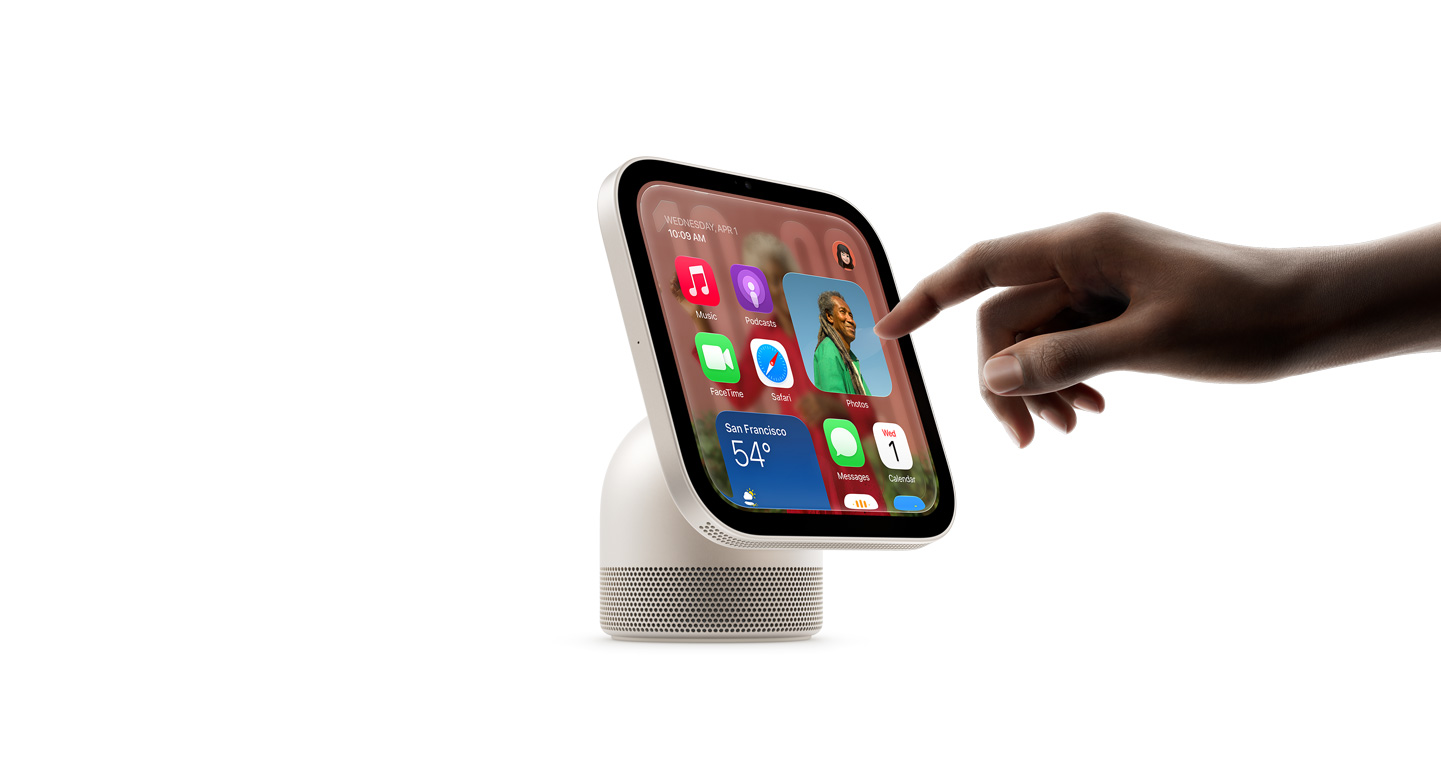
Apple’s product rendering shows the countertop HomeView and its touchscreen interface. Image: Apple. Source: Apple.
Jennifer Pattison Tuohy, a senior reviewer covering smart home and connected technology with more than 20 years of experience, gave HomeView a 7 out of 10 in her weeklong review. She praised its home controls, cooking interface, sound and customizable display faces. Her largely technology-averse husband wanted one for his office. Her daughter’s reaction to the personal features was different: “I’ll just use my iPhone.”
Tuohy could open her own content immediately and also described successful mornings when Siri answered different family members from their respective calendars and texts. Sometimes they had to turn the display toward the speaker because voice recognition alone did not identify them.
The privacy problem was not simply failure to recognize a face. Tuohy reported that HomeView sometimes identified her and offered to switch profiles while still letting her scroll through her daughter’s messages. When she approached within roughly five seconds of her daughter leaving, access sometimes continued for up to 10 seconds before another check locked her out.
Another arrangement was more persistent. If her daughter remained visible to the camera from a couch behind the counter, Tuohy could keep scrolling through her messages despite being closer to the display. She said the tests were conducted with her daughter’s consent. Returning to a display face and leaving the room was the most reliable protection they found, but she described even that as imperfect.
A separate hands-on review also described brief glimpses of a partner’s message content before HomeView registered the change of user. That test did not describe the same extended access, but it reinforces the concern about the transition between people.
Apple’s product description says HomeView recognizes up to six users and is designed to keep their personal content separate. Access requires facial recognition and a paired iPhone or iPad on the same Wi-Fi network that has been recently unlocked. Apple says Secure Exclaves in the A18 chip isolate camera and microphone processing from the operating system and Apple itself.
Those protections address how recognition data is handled. The reviewers’ observations concern what remains visible on the screen after access has been granted. The tests do not establish how frequently every household would encounter the problem, but they show why recognizing an authorized person somewhere in the room is insufficient to ensure that only that person reads the display.
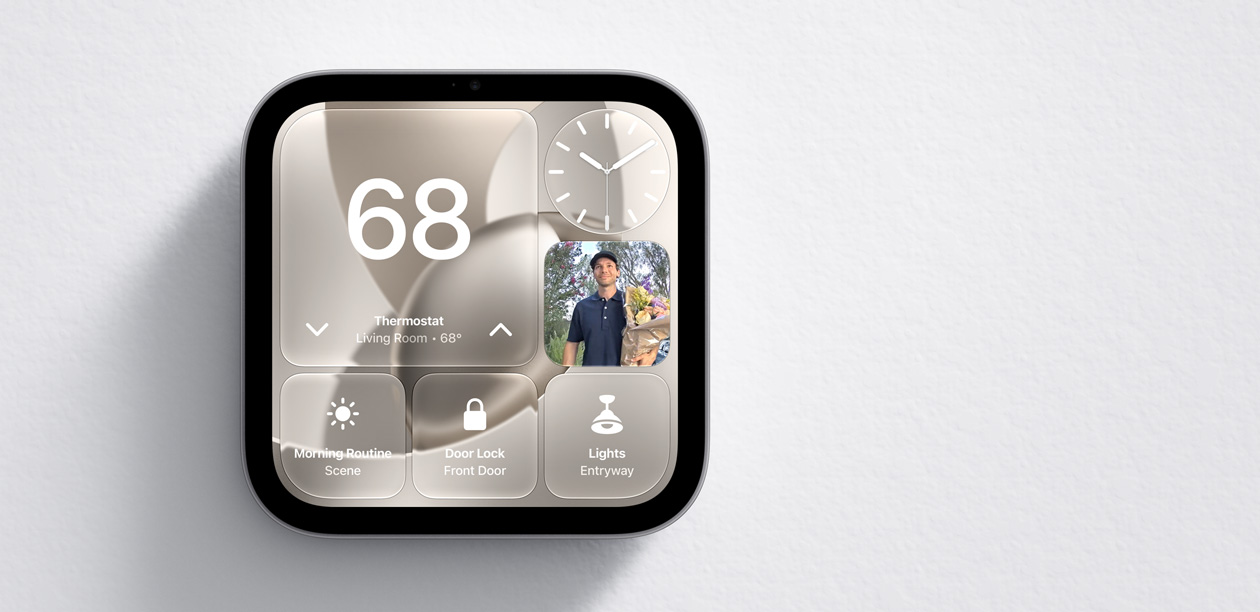
Apple’s HomeView dashboard combines accessory controls and a door-camera feed. Image: Apple. Source: Apple.
HomeView adds an always-on screen to a role already served by Apple TV 4K and HomePod: running Apple Home automations and supporting remote access to accessories. Its Thread radio and Matter controller connect compatible smart home devices, while the display makes lights, locks, thermostats and cameras accessible without opening a phone app.
Both reviews found that control unusually quick. Tuohy compared switching her entryway lights to using a conventional light switch; the separate review described a floodlight responding before the reviewer’s finger had pulled away. These are hands-on observations, rather than standardized latency measurements, but the agreement is significant for a device intended to replace repeated trips into a phone app.
Camera faces can show up to nine HomeKit Secure Video feeds, and Tuohy reported an immediate live view when someone rang her video doorbell. Guided cooking also earned praise in both tests: recipes transferred from an iPhone open in Safari with step-by-step instructions and tappable timers. The separate review cautioned that dedicated recipe apps such as Paprika and Crouton are unavailable, so saved web recipes need to be reopened in Safari. Calls, music, photos and Intercom give the screen other practical jobs.
The compatibility boundary matters as much as the speed. HomeView controls accessories supported by Apple Home; Ring doorbells and Nest cameras do not work natively in the setup Tuohy tested. Alexa and Google support a broader range of devices. Tuohy identified only a handful of brands supporting HomeKit Secure Video, including Aqara, Eve and selected Eufy and Tapo models. Advanced automation users may still need systems such as Home Assistant or Homey, which her review identifies as ways to bring more elaborate setups into HomeView.
Apple’s product page describes a forthcoming Apple Home Collection of accessories developed with selected brands. Those future products do not expand the launch offering.
Nor does the built-in camera currently supply all the functions its presence might suggest. Tuohy could not use it as a motion sensor to trigger automations. The other review also found that passive sensors visible in the Home app could not be added to the Home Modular face. There are no physical volume or microphone-mute buttons, so those controls require the screen or a phone.
Apple arrived after Amazon and Google had spent close to a decade selling smart displays. In Tuohy’s comparison of all three platforms, HomeView offered the best hardware and personal assistance, while Alexa Plus was the strongest smart home assistant and Gemini for Home handled natural language and complicated requests better. HomeView could chain commands for lights, but could not combine lights and shades in one request; both reviews also encountered commands that worked on a HomePod but failed on HomeView. Apple’s device has no ads, another distinction from Amazon’s displays.
The rival hardware differs in age: Google’s Nest Hub Max launched in 2019, while the newer Echo Show 8 and 11 were closer to HomeView in capabilities, though less responsive in her testing.
HomeView’s particular advantage is access to information on a user’s paired phone. Siri can search messages and calendars to answer personal questions. The separate review found Siri AI as fast as usual in its testing and successfully used it to find trivia plans in messages, retain the context of follow-up questions and add the event to a family calendar.
Tuohy’s results were less consistent. Personal-context requests could be slow or fail, and Siri supplied an incorrect travel time after guessing an event’s location. Asking it to search email found the correct address, but a subsequent request to send directions to a phone produced a message containing the drive time without a map. Her review describes Siri AI as still in beta.
The app system adds another dependency. Some apps are native, while compatible audio and video apps and widgets come from the paired iPhone. Audio and video app compatibility relies on support for CarPlay, Apple’s in-car interface; Tuohy found Apple TV was the only working video app. The separate review found useful widgets for sleep, air quality and blood glucose, alongside broken or inactive ones. Both reviews found widgets that displayed information but could not perform their expected actions. Tuohy missed Maps, Notes, copying and pasting from Safari, and a share sheet; those omissions repeatedly sent her back to her phone. Safari and AirPlay provide alternatives for some content, but they do not make the app selection equivalent to an iPhone’s.
Apple says in its product guidance that the personal experience requires an Apple Account, a compatible iPhone or iPad and membership in the shared home. Guests can still use basic controls, music, weather and timers without accessing anyone’s personal information. Personal-context AI needs an Apple Intelligence-enabled paired device. Apple also says Siri AI starts in English and usage limits may apply.
Tuohy reported no required assistant subscription during testing, unlike Alexa Plus at $20 a month or included with Prime, and Google’s paid Gemini Live offering. However, she also reported Apple’s warning that expanded access to some Apple Intelligence features could carry a fee in the future. That leaves the long-term cost of heavier use unsettled. The hardware requirement also differs: her review notes that Alexa Plus and Gemini Live work on older speakers and displays, while Siri AI is currently limited to Apple’s newest models.
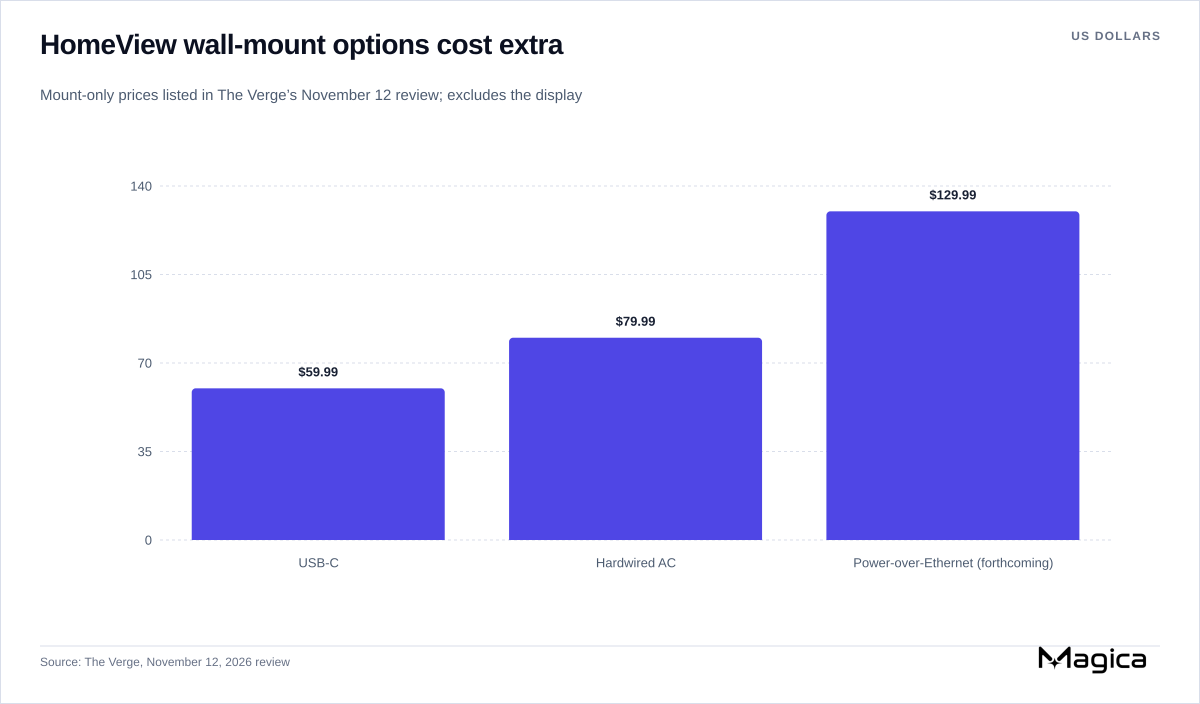
Mount-only prices listed in The Verge’s November 12 review; excludes HomeView. Power-over-Ethernet was forthcoming, and the USB-C setup requires a separate power adapter. Chart: Magica. Source: The Verge.
The two HomeView models have the same $299 sticker price, but different installed costs. The countertop model includes its power adapter. Tuohy’s installation account says the wall version includes neither a mount nor an adapter: the $59.99 USB-C mount plus Apple’s $39 power brick brings that configuration to $397.99 before tax. Hardwired AC and forthcoming power-over-Ethernet mounts were listed at $79.99 and $129.99 respectively. The wall model also lacks the tabletop base’s additional speaker system.
The separate review’s overall 2.5-out-of-5 rating reflects a more cautious buying recommendation despite its enthusiasm for home control. Crucially, it said an Apple Home user seeking primarily a smart display could regard it as a 4-out-of-5 product; its recommendation was much weaker for other buyers. These are judgments about different uses, rather than comparable performance measurements.
Tuohy was substantially more positive for Apple households, while rejecting the idea that HomeView already provides a complete family organizer. She identified Skylight’s Calendar, a dedicated calendar display, as the stronger option for that job and wanted better shared calendars and shopping lists on HomeView.
The separate review praised the display’s ability to dim to 0.3 nits for bedside use. Tuohy found another constraint: calls required her to be visible to the camera and text notifications did not appear. A screen comfortable beside a bed therefore did not meet her need to receive urgent family calls and messages there.
For buyers, the distinction is between a control panel for accessories they already own and a broader family computer. The reviewers’ quick light controls and live camera views support the former; limited apps, personal-content handoffs and the lack of shared organization tools qualify the latter.
The separate review discussed code references suggesting future chatbot support and security-camera functions, but explicitly said neither was announced or guaranteed. Those possibilities provide no timetable for resolving the launch limitations. The evidence needed next is a repeatable test showing that messages stop being accessible to another user, alongside software changes that make shared tasks work without repeatedly returning to a phone.
Google launched Gemini 4 Hydrogen and automatic model switching in Antigravity, claiming near-Carbon task success with less quota and faster completion. Lower token rates support the efficiency pitch, but reasoning settings, mixed competitive results and inconsistent benchmark labels leave the cost of completed work to be tested.
Japan is considering safety and reporting duties backed by enforceable orders for advanced AI. The proposal would strengthen its nonbinding framework, but capability thresholds, covered businesses and penalties remain unresolved.
Google says its new fast AI model is reaching Search users worldwide, improving complex answers and source discovery. The rollout expands access to Gemini 4, but its effect on answer quality and website traffic remains unmeasured.
Four nonprofits are asking a California court to stop five AI developers from building or deploying more capable systems. The case seeks enforceable limits even as OpenAI has previously reported a training pause and is launching defensive AI tools.
Expo Simulators gives coding agents remote iOS and Android environments with recordings for reviewers. The launch extends Expo's cloud development services into verification, with per-minute charges and shared capacity limits.
Kleiner Perkins and Clearlake Capital led Mirendil’s $1 billion Series A. Its agent-led model-building experiment points to smaller research teams, but company benchmarks, substantial compute costs and a private beta qualify the promise of wider access.
Mount Thor raised $45 million in equity, alongside separate hardware financing, to expand Apple infrastructure for AI agents and model inference. Existing Mac clouds and workload-specific performance limits put its demand and cost claims to the test.
Salesforce Ventures led a Series C that values Q-CTRL above $1 billion. The funding backs GPS-free navigation and quantum computing software, while undisclosed revenue and contested performance benchmarks leave the commercial case open.
Adobe demonstrated 10 experimental creative tools and opened Deep Brush and Hands On for testing. The lineup explores more direct control over AI edits, but existing alternatives and unproven production performance limit claims of novelty.
House Foreign Affairs Committee Chairman Brian Mast says outgoing Nvidia chief Jensen Huang has agreed to questioning, with a date still under negotiation. Speaker Mike Johnson says support for limiting chip exports to China is growing as lawmakers examine allegations involving Huang and a cloud partner.
Leaked correspondence and a reconstructed publishing program expose John Mark Dougan’s use of AI to stock imitation news sites with pro-Russian material. The records illuminate funding and working methods, while his claims of influencing other AI systems remain unproven.
William Blair raised AMD to Outperform as server-chip prospects and valuation improved. AMD already expects revenue growth above 80% in 2027, but customer incentives, custom accelerators and weaker quarterly cash generation complicate the investment case.
Donald Trump proposed Apple executive chairman Tim Cook to succeed Jensen Huang at Nvidia. Cook’s interest and the seriousness of the suggestion remain unclear, while finance chief Colette Kress has taken interim charge.
Norwest’s largest fund is a third bigger than its predecessor, giving the Wells Fargo-backed investor more capital for AI alongside healthcare, consumer and industrial businesses. The firm has not disclosed how much will go to AI.
Nebius raised its 2026 capital spending forecast to about $27 billion while steering revenue to the low end of guidance. Better customer prepayments support expansion, but delayed capacity and a $325 million non-recurring contribution complicate its quarterly revenue beat.
Megaspeed founder Alice Huang is reportedly living in Beijing, but her activities and the espionage allegations remain unresolved. Jensen Huang’s resignation changes Nvidia’s leadership without settling questions about her business connections and access to its chips.
Singapore says it barred former Megaspeed chief Alice Huang after she gave inaccurate information about her role, while finding insufficient evidence against her over server declarations. The wider investigation still depends on tracing shipments beyond Malaysia.
Nvidia’s longtime finance chief takes over from its co-founder as the board promises continuity, searches for a permanent CEO and faces unresolved questions over security and executive conduct.
Chicago Public Schools is seeking a way to preserve Google Search without its generative AI features as parents, educators and students press for stronger district rules. Google’s planned access changes turn an AI safety dispute into a test of who controls classroom technology.
Warby Parker scheduled November 12 preorders and holiday deliveries for its first Android XR glasses. Google’s backing combines development funding with a conditional equity investment, while the retailer expects only a modest initial sales contribution.