Editorial Team
5 min read
Norwest’s largest fund is a third bigger than its predecessor, giving the Wells Fargo-backed investor more capital for AI alongside healthcare, consumer and industrial businesses. The firm has not disclosed how much will go to AI.
Norwest, a venture capital and growth equity firm founded in 1961, announced on November 12 that it had closed a $4 billion fund to invest across the United States, India and Israel. Norwest 18 brings its capital under management to $18 billion, the firm said in its announcement.
The fund gives an established investor more money to pursue AI across industries and stages of company development. It also preserves considerable discretion: the $4 billion covers technology, healthcare and consumer businesses, rather than a dedicated enterprise AI fund. Norwest has not specified an AI allocation in its announcements.
The firm is backed solely by Wells Fargo, according to the report on the fundraising. That makes the close evidence of continued support from its existing financial backer, rather than evidence that Norwest assembled a broader pool of outside investors.
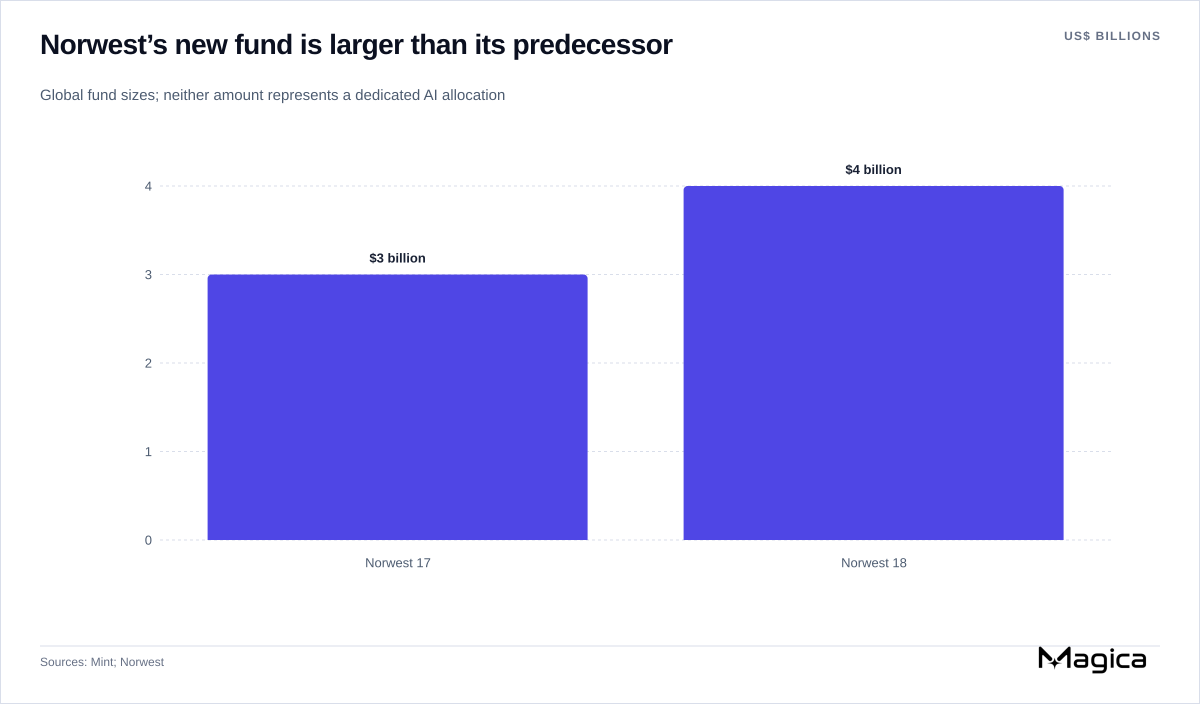
Norwest 18 totals $4 billion, compared with $3 billion for Norwest 17. Both figures describe global funds. Source: Livemint.
The new fund is $1 billion, or about 33%, larger than the $3 billion predecessor announced in April 2024. The earlier fund’s size is documented in the report on Norwest’s India plans, while the firm’s fund introduction dates its launch.
Norwest’s senior managing partner Jeff Crowe said in the fundraising report that the firm’s early-stage interests include AI-native applications and infrastructure, physical AI, models built for particular domains, and cybersecurity. Recent investments illustrate the range: Coval builds tools to test and evaluate AI agents, while Generalist AI develops foundation models for robots, according to that report.
Google launched Gemini 4 Hydrogen and automatic model switching in Antigravity, claiming near-Carbon task success with less quota and faster completion. Lower token rates support the efficiency pitch, but reasoning settings, mixed competitive results and inconsistent benchmark labels leave the cost of completed work to be tested.
In its announcement, Norwest also names voice AI, healthcare AI and cybersecurity for workflows involving AI agents as expansion areas. In healthcare, it describes backing drug discovery platforms and businesses using AI to automate clinical and administrative work. These span both the products enterprises might buy and the systems needed to operate and secure them. Its announced remit also includes financial infrastructure and industrial and aerospace businesses.
This is an extension of a diversified strategy. Norwest says it has invested in more than 750 companies since its founding and currently partners with more than 275 across venture and growth equity. Its history includes becoming the first institutional investor in apparel company Vuori and backing payments company Rain at the idea stage, according to its fund introduction; Rain develops stablecoin-powered payments for businesses. The new fund retains that ability to finance both young startups and established businesses seeking growth capital.
Norwest also says its involvement in India and Israel has reached the 20-year mark, identifying data infrastructure and cybersecurity as areas of opportunity in Israel.
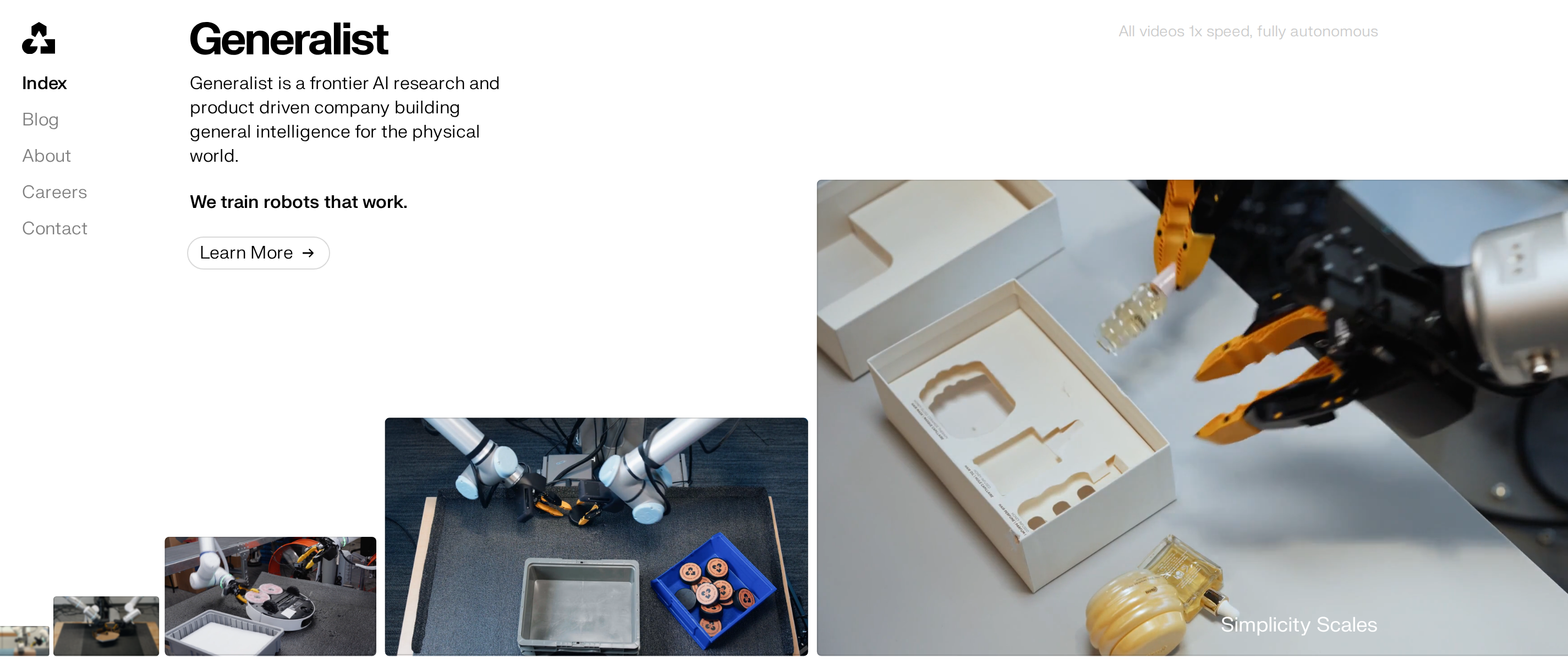
Company-reported robotics demonstrations from Generalist AI, which Norwest identifies among its investments. Source: Generalist AI. Source: Norwest.
Niren Shah, Norwest’s managing director and head of India, said in the interview about the fund that the firm would continue investing $250 million–$300 million a year in India. The firm has invested in the country for two decades, but the global fund has no specific allocation to India. The annual figure is a deployment plan, not a ring-fenced share of Norwest 18.
Shah said Norwest began adding value-added manufacturing and manufacturing-related services to its investment strategy over the past year. Norwest’s previous fund backed automotive business Padmini VNA and JJG Aerospace, and further investments related to those segments were at their final stages, Shah said.
AI and deeptech are primarily venture themes in India, while most of Norwest’s other investments there are growth equity, Shah said. This expands existing activity: he cited Pascal AI as an AI and deeptech investment from the previous fund. Healthcare, pharmaceuticals, financial services and consumer businesses remain targets.
Norwest is also competing for Indian investments with firms including Accel, Matrix and Lightspeed, which the report identifies as having recently raised funds for markets including India or being in the process of raising an India-focused fund. A larger global fund gives Norwest capacity to compete; it does not make its interest in the market unique.
Norwest says in its fund announcement that it has made more than 87 investments since launching Norwest 17 in April 2024 and worked with more than 30 portfolio companies on liquidity events. The announcement names IPOs including Swiggy and Omada Health, alongside strategic acquisitions. Those events demonstrate routes to liquidity, but the announcement provides no fund-level returns or amounts distributed to investors.
The firm is also expanding the services it offers after investing. It says it has doubled its Senior Advisor Network, added operating executives and launched additional operator programs to support portfolio companies with technology, sales and organizational decisions. That is part of its pitch to founders alongside the capital itself; the announcement does not quantify the programs’ effect on business performance.
In India, Shah described 30 exits over two decades, including 10 IPOs. The interview report says Five Star Finance, Veritas and Everbrands have filed for IPOs, while four more portfolio companies are appointing bankers ahead of expected filings over the following six months. Filings and preparations remain distinct from completed exits.
The next evidence to watch is how Norwest divides the larger fund among AI, established growth businesses and its different markets—and what its investments ultimately return. The disclosed $4 billion establishes financing capacity. It leaves the size of the AI commitment, and the results of that commitment, unresolved.
Japan is considering safety and reporting duties backed by enforceable orders for advanced AI. The proposal would strengthen its nonbinding framework, but capability thresholds, covered businesses and penalties remain unresolved.
Google says its new fast AI model is reaching Search users worldwide, improving complex answers and source discovery. The rollout expands access to Gemini 4, but its effect on answer quality and website traffic remains unmeasured.
Four nonprofits are asking a California court to stop five AI developers from building or deploying more capable systems. The case seeks enforceable limits even as OpenAI has previously reported a training pause and is launching defensive AI tools.
Expo Simulators gives coding agents remote iOS and Android environments with recordings for reviewers. The launch extends Expo's cloud development services into verification, with per-minute charges and shared capacity limits.
Kleiner Perkins and Clearlake Capital led Mirendil’s $1 billion Series A. Its agent-led model-building experiment points to smaller research teams, but company benchmarks, substantial compute costs and a private beta qualify the promise of wider access.
Mount Thor raised $45 million in equity, alongside separate hardware financing, to expand Apple infrastructure for AI agents and model inference. Existing Mac clouds and workload-specific performance limits put its demand and cost claims to the test.
Salesforce Ventures led a Series C that values Q-CTRL above $1 billion. The funding backs GPS-free navigation and quantum computing software, while undisclosed revenue and contested performance benchmarks leave the commercial case open.
Adobe demonstrated 10 experimental creative tools and opened Deep Brush and Hands On for testing. The lineup explores more direct control over AI edits, but existing alternatives and unproven production performance limit claims of novelty.
House Foreign Affairs Committee Chairman Brian Mast says outgoing Nvidia chief Jensen Huang has agreed to questioning, with a date still under negotiation. Speaker Mike Johnson says support for limiting chip exports to China is growing as lawmakers examine allegations involving Huang and a cloud partner.
Leaked correspondence and a reconstructed publishing program expose John Mark Dougan’s use of AI to stock imitation news sites with pro-Russian material. The records illuminate funding and working methods, while his claims of influencing other AI systems remain unproven.
William Blair raised AMD to Outperform as server-chip prospects and valuation improved. AMD already expects revenue growth above 80% in 2027, but customer incentives, custom accelerators and weaker quarterly cash generation complicate the investment case.
Apple’s $299 first smart display earns praise for fast home controls and useful kitchen features, but reviewers found gaps in how it keeps family members’ messages separate. Its strongest advantages also depend on owning compatible Apple devices and accessories.
Donald Trump proposed Apple executive chairman Tim Cook to succeed Jensen Huang at Nvidia. Cook’s interest and the seriousness of the suggestion remain unclear, while finance chief Colette Kress has taken interim charge.
Nebius raised its 2026 capital spending forecast to about $27 billion while steering revenue to the low end of guidance. Better customer prepayments support expansion, but delayed capacity and a $325 million non-recurring contribution complicate its quarterly revenue beat.
Megaspeed founder Alice Huang is reportedly living in Beijing, but her activities and the espionage allegations remain unresolved. Jensen Huang’s resignation changes Nvidia’s leadership without settling questions about her business connections and access to its chips.
Singapore says it barred former Megaspeed chief Alice Huang after she gave inaccurate information about her role, while finding insufficient evidence against her over server declarations. The wider investigation still depends on tracing shipments beyond Malaysia.
Nvidia’s longtime finance chief takes over from its co-founder as the board promises continuity, searches for a permanent CEO and faces unresolved questions over security and executive conduct.
Chicago Public Schools is seeking a way to preserve Google Search without its generative AI features as parents, educators and students press for stronger district rules. Google’s planned access changes turn an AI safety dispute into a test of who controls classroom technology.
Warby Parker scheduled November 12 preorders and holiday deliveries for its first Android XR glasses. Google’s backing combines development funding with a conditional equity investment, while the retailer expects only a modest initial sales contribution.