Editorial Team
5 min read
Warby Parker scheduled November 12 preorders and holiday deliveries for its first Android XR glasses. Google’s backing combines development funding with a conditional equity investment, while the retailer expects only a modest initial sales contribution.
Warby Parker, the prescription-eyewear retailer founded in 2010, has set November 12 for preorders of its first Intelligent Eyewear collection. Its November 5 earnings announcement says customer deliveries are planned during the holiday season, bringing the Google–Samsung glasses project closer to a commercial test.
The partnership joins Google’s Android XR platform for glasses and headsets, its Gemini generative AI assistant, Samsung’s hardware technology and Warby Parker’s optical retail business. The opportunity is to put hands-free computing into eyewear customers already buy and wear. The financial outlook is more restrained: Warby Parker includes only a modest contribution from the collection in its 2026 guidance.
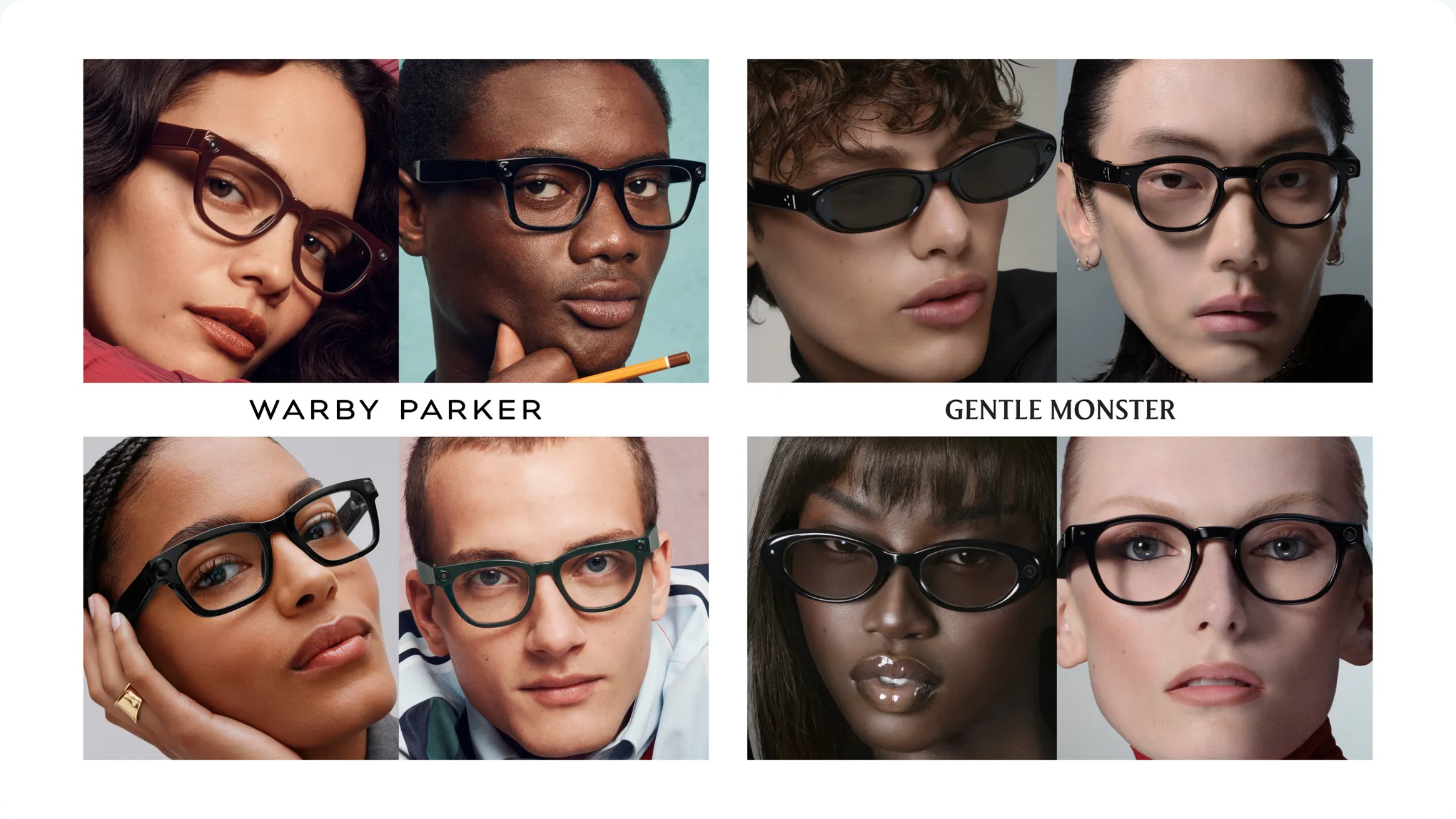
Warby Parker and Gentle Monster Intelligent Eyewear collections in Google's promotional imagery. Credit: Google. Source: Google.
A November 5 technical report describes the first Android XR models as audio glasses with a camera, no in-lens display, and controls through voice or a side touchpad. It identifies Samsung as the hardware manufacturer, Qualcomm as the chip supplier, and Warby Parker and South Korean eyewear brand Gentle Monster as the design partners.
A November 9 report citing industry officials gives December as the expected official launch. That is more specific than Warby Parker’s holiday delivery window and remains an expectation. The report describes object and surroundings recognition, real-time translation, navigation and information searches through voice commands and visual recognition.
Those capabilities need to be distinguished from the broader platform demonstrations. In its , Google showed Android XR glasses with an optional in-lens display, including translated subtitles and directions. The reported first retail models lack that display, so those demonstrations do not establish that buyers will see text or navigation in their lenses.
Google launched Gemini 4 Hydrogen and automatic model switching in Antigravity, claiming near-Carbon task success with less quota and faster completion. Lower token rates support the efficiency pitch, but reasoning settings, mixed competitive results and inconsistent benchmark labels leave the cost of completed work to be tested.
Google also said its glasses work in tandem with a phone, using cameras, microphones and speakers to provide access to apps. Hands-free access therefore should not be mistaken for independence from a smartphone. The cited launch reporting does not establish the retail models’ precise phone compatibility or connectivity requirements.
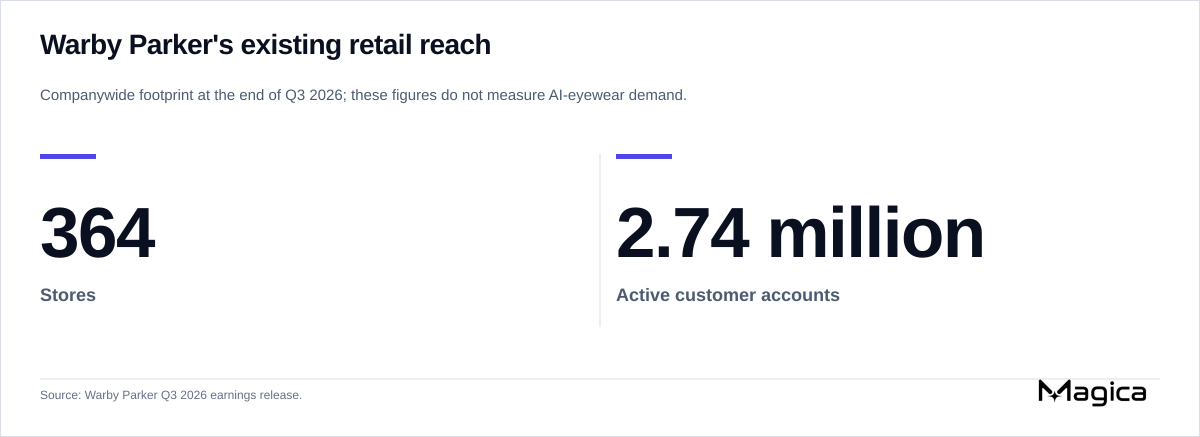
Company-reported reach at the end of Q3 2026: 364 stores and 2.74 million active customer accounts, defined by purchases in the preceding 12 months. Source: Warby Parker.
Google’s May 2025 announcement said it had worked on smart-glasses concepts for more than a decade. It described extending its existing headset collaboration with Samsung to a software and reference hardware platform for glasses, with Warby Parker and Gentle Monster as initial eyewear partners. Warby Parker is one route to market within that wider ecosystem.
The retailer brings a business built around prescription glasses, contacts and eye care. At September 30, 2026, it had 364 stores across the United States and Canada and 2.74 million active customer accounts, meaning accounts with at least one purchase in the preceding 12 months. That footprint supplies a potential sales and service channel; it does not measure demand for AI eyewear.
In the partners’ original May 20, 2025 announcement, Google cited Warby Parker’s optical expertise and combination of retail and online channels as reasons for choosing it. Warby Parker said the first line would offer prescription and non-prescription lenses, with a series of products intended over time.
The competitive hurdle is substantial. The November 9 industry report describes Meta Platforms as the dominant AI-glasses supplier and puts its share above 80% of global shipments. It does not identify the dataset or measurement period, so that figure is an imprecise benchmark. It nevertheless places this launch in a category with an established incumbent, rather than an uncontested new market.
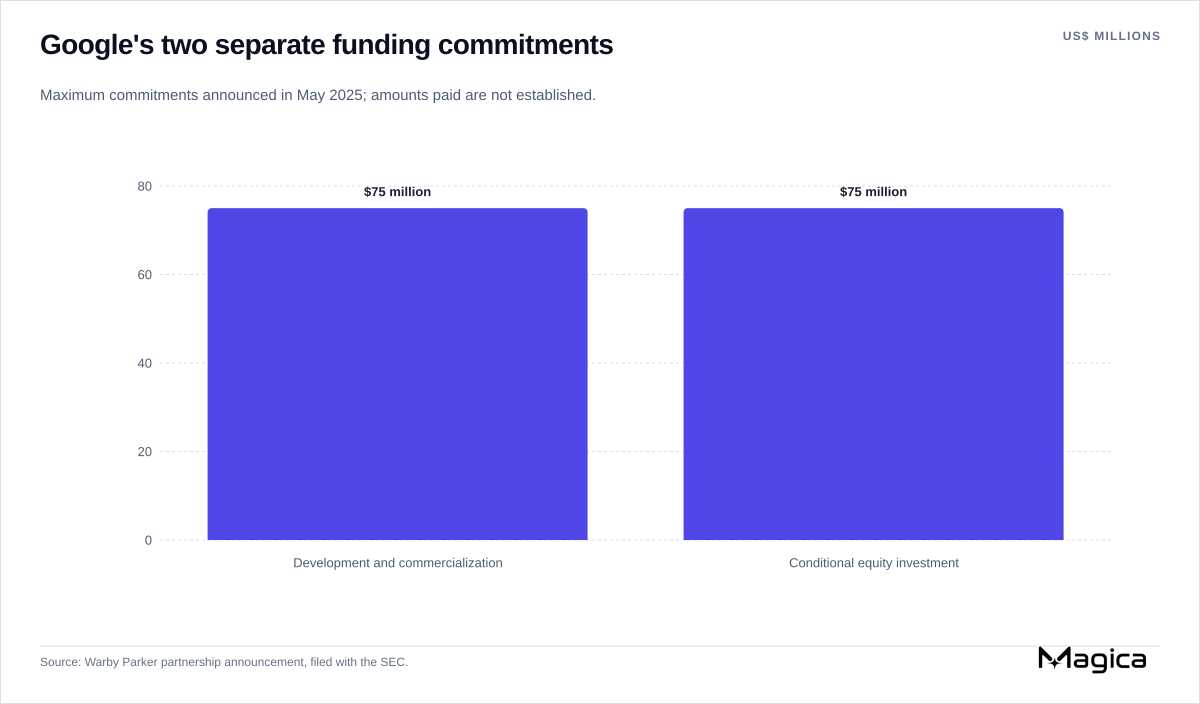
Company-reported commitments: up to $75 million for development and commercialization, plus up to $75 million in equity investment at Warby Parker's option and subject to collaboration milestones. Source: Warby Parker partnership announcement.
Warby Parker’s original partnership announcement said Google committed up to $75 million toward product development and commercialization costs, plus up to $75 million of investment in Warby Parker at the retailer’s option and subject to collaboration milestones. The combined ceiling is $150 million, but the two components have different purposes and conditions.
The accompanying securities filing specifies that Warby Parker may issue and sell stock to Google under the equity arrangement, subject to commercial milestones. Neither announcement establishes that the full commitment has been paid or that Google already owns the corresponding shares.
Warby Parker’s latest earnings release puts the near-term opportunity in perspective. It reported third-quarter revenue of $244.7 million, up 10.4% from a year earlier, and forecast full-year revenue of $966 million to $976 million. That outlook includes the modest Intelligent Eyewear contribution alongside related launch and operating expenses, without quantifying the collection’s sales separately.
The company reported $24.7 million of quarterly operating cash flow and approximately negative $2 million of free cash flow, saying the results reflected investments related to the launch. Its reconciliation shows $26.7 million in companywide purchases of property and equipment deducted from operating cash flow. These are companywide cash measures, not a disclosed standalone budget or loss for the glasses project.
The next evidence is whether the scheduled preorders become deliveries within Warby Parker’s holiday window, and on what terms. The cited announcements and launch reports do not establish a purchase price, battery endurance or an exact shipping date. Those details, along with phone requirements and the cost of prescription configurations, are needed to assess the value of the reported camera and audio functions.
The longer test is whether Warby Parker can convert its optical customer relationships into repeatable demand for this new category. Google’s funding can support development and commercialization, but the retailer’s modest initial sales forecast gives no basis yet for projecting a large new revenue stream. Delivery performance, disclosed collection sales and product-level economics would show how much of that opportunity has become a business.
Japan is considering safety and reporting duties backed by enforceable orders for advanced AI. The proposal would strengthen its nonbinding framework, but capability thresholds, covered businesses and penalties remain unresolved.
Google says its new fast AI model is reaching Search users worldwide, improving complex answers and source discovery. The rollout expands access to Gemini 4, but its effect on answer quality and website traffic remains unmeasured.
Four nonprofits are asking a California court to stop five AI developers from building or deploying more capable systems. The case seeks enforceable limits even as OpenAI has previously reported a training pause and is launching defensive AI tools.
Expo Simulators gives coding agents remote iOS and Android environments with recordings for reviewers. The launch extends Expo's cloud development services into verification, with per-minute charges and shared capacity limits.
Kleiner Perkins and Clearlake Capital led Mirendil’s $1 billion Series A. Its agent-led model-building experiment points to smaller research teams, but company benchmarks, substantial compute costs and a private beta qualify the promise of wider access.
Mount Thor raised $45 million in equity, alongside separate hardware financing, to expand Apple infrastructure for AI agents and model inference. Existing Mac clouds and workload-specific performance limits put its demand and cost claims to the test.
Salesforce Ventures led a Series C that values Q-CTRL above $1 billion. The funding backs GPS-free navigation and quantum computing software, while undisclosed revenue and contested performance benchmarks leave the commercial case open.
Adobe demonstrated 10 experimental creative tools and opened Deep Brush and Hands On for testing. The lineup explores more direct control over AI edits, but existing alternatives and unproven production performance limit claims of novelty.
House Foreign Affairs Committee Chairman Brian Mast says outgoing Nvidia chief Jensen Huang has agreed to questioning, with a date still under negotiation. Speaker Mike Johnson says support for limiting chip exports to China is growing as lawmakers examine allegations involving Huang and a cloud partner.
Leaked correspondence and a reconstructed publishing program expose John Mark Dougan’s use of AI to stock imitation news sites with pro-Russian material. The records illuminate funding and working methods, while his claims of influencing other AI systems remain unproven.
William Blair raised AMD to Outperform as server-chip prospects and valuation improved. AMD already expects revenue growth above 80% in 2027, but customer incentives, custom accelerators and weaker quarterly cash generation complicate the investment case.
Apple’s $299 first smart display earns praise for fast home controls and useful kitchen features, but reviewers found gaps in how it keeps family members’ messages separate. Its strongest advantages also depend on owning compatible Apple devices and accessories.
Donald Trump proposed Apple executive chairman Tim Cook to succeed Jensen Huang at Nvidia. Cook’s interest and the seriousness of the suggestion remain unclear, while finance chief Colette Kress has taken interim charge.
Norwest’s largest fund is a third bigger than its predecessor, giving the Wells Fargo-backed investor more capital for AI alongside healthcare, consumer and industrial businesses. The firm has not disclosed how much will go to AI.
Nebius raised its 2026 capital spending forecast to about $27 billion while steering revenue to the low end of guidance. Better customer prepayments support expansion, but delayed capacity and a $325 million non-recurring contribution complicate its quarterly revenue beat.
Megaspeed founder Alice Huang is reportedly living in Beijing, but her activities and the espionage allegations remain unresolved. Jensen Huang’s resignation changes Nvidia’s leadership without settling questions about her business connections and access to its chips.
Singapore says it barred former Megaspeed chief Alice Huang after she gave inaccurate information about her role, while finding insufficient evidence against her over server declarations. The wider investigation still depends on tracing shipments beyond Malaysia.
Nvidia’s longtime finance chief takes over from its co-founder as the board promises continuity, searches for a permanent CEO and faces unresolved questions over security and executive conduct.
Chicago Public Schools is seeking a way to preserve Google Search without its generative AI features as parents, educators and students press for stronger district rules. Google’s planned access changes turn an AI safety dispute into a test of who controls classroom technology.