Editorial Team
8 min read
Leaked correspondence and a reconstructed publishing program expose John Mark Dougan’s use of AI to stock imitation news sites with pro-Russian material. The records illuminate funding and working methods, while his claims of influencing other AI systems remain unproven.
John Mark Dougan, a Moscow-based pro-Kremlin propagandist and former Florida sheriff’s deputy who fled to Russia in 2016 amid a criminal investigation, used AI to help populate imitation news sites with pro-Russian material, newly leaked files show. The archive exposes both the publishing machinery and the relationships behind an operation intended to influence Western audiences and the information encountered by AI systems.
The important distinction is between using AI to produce propaganda and causing other AI systems to repeat it. Investigators found evidence of the first and documents describing the second as an ambition. Dougan also claimed success, but the files do not establish which outside models learned from his articles or how often chatbot answers changed.
Emails, Telegram and Signal messages, documents and chatbot prompts appeared online on November 10, 2026, on a website imitating Dougan’s own. His apparently hacked X account shared the link. In a November 11 Signal response to NewsGuard, which reviewed the documents, Dougan acknowledged the hack and dismissed its consequences.
An investigation using a reconstructed desktop environment described messages, browser data and a simulation of Dougan’s publishing program. Its anonymous source said the dataset was incomplete. Investigators spot-checked records against other information, and one correspondent confirmed sending an email found in the archive. The leak offers substantial operational evidence, but not a complete account of the operation.
In a prompt asking Claude, the AI assistant developed by Anthropic, to prepare expenses, Dougan claimed his operation was writing 43,000 articles a month and could not afford it. The document review also identified operational costs of roughly 2 million rubles, approximately $23,000, a month. Neither figure is an audited total; together they do not establish a reliable cost per article.
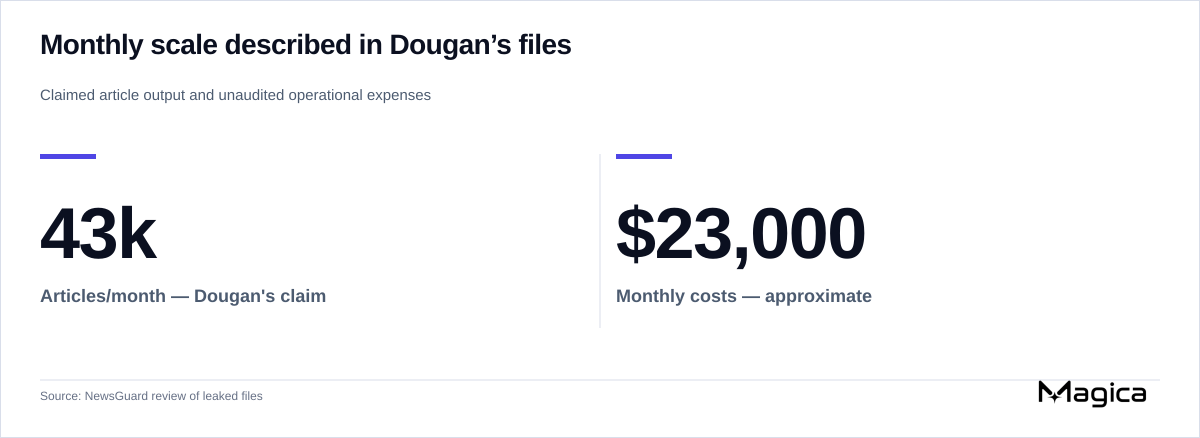
Dougan claimed 43,000 articles a month; NewsGuard reported approximately $23,000 in monthly costs from the files. Neither figure is audited. Source: NewsGuard.
The reconstructed publishing program, apparently created and controlled by Dougan, used AI to populate more than 40 websites with thousands of articles, investigators found. These included purported American local outlets and news sites in French, Ukrainian and Swahili. The program took material from existing publishers, including Fox News, Gazeta.ru and Al Jazeera, and rewrote it under prompts prescribing pro-Russian positions. Fabricated stories could be mixed into the larger supply of rewritten news.
The archive also contains evidence of distribution beyond a proposed tool: in August 2024, a contact asked Dougan to rewrite Polish reports about Ukrainian refugees potentially working for public authorities. Dougan returned more than 100 publication links, including one on the imitation outlet The Boston Times.
This method extended an older practice. A reconstruction of Dougan’s record and correspondence describes how his 2018 autobiography explained automatically filling imitation news sites with other outlets’ stories, then inserting fabrications into that apparently credible background. AI supplied a way to rewrite the material and apply political instructions across the process.
The correspondence traces one fabrication during the 2024 U.S. election campaign. Dougan recruited an assistant to impersonate a former exchange student making false sexual-abuse allegations against Tim Walz, then the Democratic vice-presidential candidate. Investigators identified messages arranging altered documents to support the impersonation. Dougan later boasted about the interview’s reach to a contact they identified as an officer of the FSB, Russia’s domestic security service. His boast does not establish an effect on votes.
Dougan’s technical project helps explain his recruitment. In early 2021, Alexey Kiristaev, a contact who had worked in the media empire of Russian mercenary leader Yevgeny Prigozhin, told him that the Moscow-based Center for Geopolitical Expertise was interested in his server and imitation news site DC Weekly. The center, a think tank co-founded by ultranationalist ideologue Alexander Dugin and led by Valery Korovin, subsequently provided payments and equipment support, the correspondence indicates.
Investigators found payment receipts sent by center employee Yuri Khoroshevsky, including one for 108,000 rubles in August 2022 covering the month and equipment. The reporting identifies him as linked to the GRU, Russia’s military intelligence service. CORRECTIV cited a 2024 Washington Post investigation based on European intelligence documents for his membership in GRU Unit 29155. Dougan acknowledged working for the center as a consultant but denied receiving money to operate DC Weekly or accepting money from someone named Yuri.
The funding mechanism was already the subject of official action. In a December 31, 2024 sanctions announcement, the U.S. Treasury said the center directed and subsidized disinformation targeting that year’s U.S. election. It said the center built a server hosting generative AI tools and content to avoid foreign hosting services that would block its activity.
Treasury said GRU funding supported the center and U.S.-based facilitators in maintaining that server, at least 100 websites and part of the rent for the apartment housing the server. It identified Korovin as a coordinator of that financing. This was an assessment of the wider center-linked infrastructure, not a count of the websites in the newly leaked program.
The Council of the European Union’s December 15, 2025 sanctions decision separately listed Dougan. It cited his alleged operation of CopyCop, a network of fake news sites, and support for Storm-1516, a Russian influence campaign that uses inauthentic outlets to spread fabrications.
The leaked interactions include Claude and Qwen, Chinese technology company Alibaba’s language-model family. Dougan also accessed a Qwen model through Open WebUI, an interface configurable to work with different models. The reporting does not identify a specific Claude version.
A June 8, 2026 interaction shows Claude helping choose names and language for a purported European free-speech site aimed at French speakers. Other prompts show Qwen producing an anti-Democrat Telegram post concerning the 2026 U.S. midterm elections and, in July, advising Dougan on making text harder to detect as AI-generated. These examples show assistance with parts of the operation; they do not establish that Claude generated all his claimed monthly output.
The document review described Anthropic policies prohibiting deceptive information and misleading impersonation, and Alibaba policies prohibiting misinformation. It said neither company responded to its November 11 inquiries.
Dougan also used Qwen to prepare arguments around the false claim that the United States operated weapons laboratories in Ukraine. He sought AI advice on revising his Wikipedia page to cite comments by Tulsi Gabbard, then U.S. director of national intelligence, that appeared to validate the narrative. The document review said the underlying records concerned publicly disclosed U.S. funding for safe storage of Soviet-era pathogens, rather than weapons development.
The documents describe distinct routes for extending the operation. An undated “AI Server” document proposed regularly publishing rewritten news favorable to Russia alongside generated material to improve search visibility. Another draft requested access to archives from Russian state news agency TASS or another Russian outlet to fine-tune an uncensored language model toward Russian perspectives. Investigators could not establish whether that request was sent; Dougan said he did not remember it. A proposed fine-tuning project is different from demonstrating that published articles entered an outside model’s training data or answers.
In a late-November 2024 presentation, Dougan claimed his team had helped develop an AI system capable of spreading ideas aligned with Russian interests and that other AI systems were beginning to learn from its material. That is his assessment, not independent verification of either result.
His ambitions also reached beyond his own network. The document review found an email proposing collaboration with Yevgeny Shevchenko, operator of the separate pro-Russian Pravda network. NewsGuard put that network’s 2025 output at 6.3 million articles across 286 sites. The email establishes an overture, not a completed partnership; that output cannot be credited to Dougan.
The archive complicates any assumption that Dougan retained command of the whole system. In November 2024, he complained that others had taken his ideas and excluded him. He told a contact that his project had ended after Donald Trump’s election victory and its backers wanted their equipment returned. Storm-1516 subsequently targeted Germany’s 2025 federal election, but investigators found no concrete traces in the archive establishing Dougan’s involvement in that effort. Dougan denied connections to election interference and disputed losing hardware.
In April 2025, he complained of a $3,000 monthly budget and sought access to other potential backers. That statement belongs to a different budget context from the roughly $23,000 in operational expenses described elsewhere in the files. In early 2026, he complained that Russian internet restrictions had sharply reduced his ability to publish. He nevertheless told investigators in November that he had not left Russia.
Resolving the AI-influence claim requires evidence beyond publishing volume and an operator’s presentation: identifiable articles, records showing which systems retrieved or learned from them, and reproducible tests of whether those systems repeated the false claims. Establishing who now controls the publishing infrastructure would also determine whose activity those tests measure.
Google launched Gemini 4 Hydrogen and automatic model switching in Antigravity, claiming near-Carbon task success with less quota and faster completion. Lower token rates support the efficiency pitch, but reasoning settings, mixed competitive results and inconsistent benchmark labels leave the cost of completed work to be tested.
Japan is considering safety and reporting duties backed by enforceable orders for advanced AI. The proposal would strengthen its nonbinding framework, but capability thresholds, covered businesses and penalties remain unresolved.
Google says its new fast AI model is reaching Search users worldwide, improving complex answers and source discovery. The rollout expands access to Gemini 4, but its effect on answer quality and website traffic remains unmeasured.
Four nonprofits are asking a California court to stop five AI developers from building or deploying more capable systems. The case seeks enforceable limits even as OpenAI has previously reported a training pause and is launching defensive AI tools.
Expo Simulators gives coding agents remote iOS and Android environments with recordings for reviewers. The launch extends Expo's cloud development services into verification, with per-minute charges and shared capacity limits.
Kleiner Perkins and Clearlake Capital led Mirendil’s $1 billion Series A. Its agent-led model-building experiment points to smaller research teams, but company benchmarks, substantial compute costs and a private beta qualify the promise of wider access.
Mount Thor raised $45 million in equity, alongside separate hardware financing, to expand Apple infrastructure for AI agents and model inference. Existing Mac clouds and workload-specific performance limits put its demand and cost claims to the test.
Salesforce Ventures led a Series C that values Q-CTRL above $1 billion. The funding backs GPS-free navigation and quantum computing software, while undisclosed revenue and contested performance benchmarks leave the commercial case open.
Adobe demonstrated 10 experimental creative tools and opened Deep Brush and Hands On for testing. The lineup explores more direct control over AI edits, but existing alternatives and unproven production performance limit claims of novelty.
House Foreign Affairs Committee Chairman Brian Mast says outgoing Nvidia chief Jensen Huang has agreed to questioning, with a date still under negotiation. Speaker Mike Johnson says support for limiting chip exports to China is growing as lawmakers examine allegations involving Huang and a cloud partner.
William Blair raised AMD to Outperform as server-chip prospects and valuation improved. AMD already expects revenue growth above 80% in 2027, but customer incentives, custom accelerators and weaker quarterly cash generation complicate the investment case.
Apple’s $299 first smart display earns praise for fast home controls and useful kitchen features, but reviewers found gaps in how it keeps family members’ messages separate. Its strongest advantages also depend on owning compatible Apple devices and accessories.
Donald Trump proposed Apple executive chairman Tim Cook to succeed Jensen Huang at Nvidia. Cook’s interest and the seriousness of the suggestion remain unclear, while finance chief Colette Kress has taken interim charge.
Norwest’s largest fund is a third bigger than its predecessor, giving the Wells Fargo-backed investor more capital for AI alongside healthcare, consumer and industrial businesses. The firm has not disclosed how much will go to AI.
Nebius raised its 2026 capital spending forecast to about $27 billion while steering revenue to the low end of guidance. Better customer prepayments support expansion, but delayed capacity and a $325 million non-recurring contribution complicate its quarterly revenue beat.
Megaspeed founder Alice Huang is reportedly living in Beijing, but her activities and the espionage allegations remain unresolved. Jensen Huang’s resignation changes Nvidia’s leadership without settling questions about her business connections and access to its chips.
Singapore says it barred former Megaspeed chief Alice Huang after she gave inaccurate information about her role, while finding insufficient evidence against her over server declarations. The wider investigation still depends on tracing shipments beyond Malaysia.
Nvidia’s longtime finance chief takes over from its co-founder as the board promises continuity, searches for a permanent CEO and faces unresolved questions over security and executive conduct.
Chicago Public Schools is seeking a way to preserve Google Search without its generative AI features as parents, educators and students press for stronger district rules. Google’s planned access changes turn an AI safety dispute into a test of who controls classroom technology.
Warby Parker scheduled November 12 preorders and holiday deliveries for its first Android XR glasses. Google’s backing combines development funding with a conditional equity investment, while the retailer expects only a modest initial sales contribution.