Editorial Team
8 min read
Anthropic is expected to exceed 3.5 GW of computing capacity in 2026 and aims to double it in 2027. Its filing shows $895.4 billion in commitments, substantial financial resources and an immediate cost from scarce capacity.
Anthropic, the San Francisco AI company founded in 2021 behind the Claude models and chatbot, is trying to secure enough computing power for research and customer use ahead of a planned public offering. Its expansion addresses a demonstrated shortage, but contracts, financing and electrical capacity do not by themselves establish how much usable computing power will arrive—or at what cost.
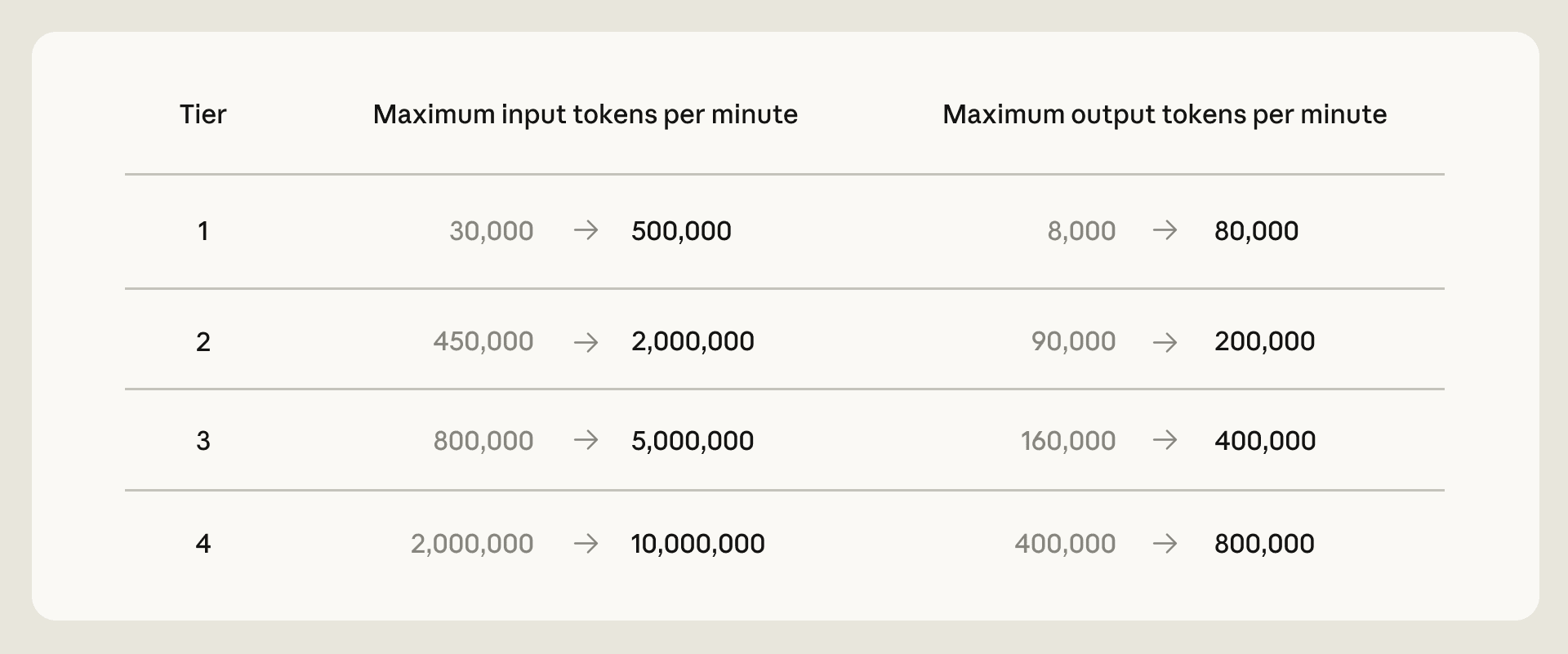
Anthropic’s company-reported Claude Opus API limit increases, announced alongside its May SpaceX compute agreement. Source: Anthropic.
A report based on interviews with people familiar with Anthropic says it is expected to have more than 3.5 GW of computing capacity in 2026 and aims to double that amount next year. Two people with knowledge of its plans supplied those figures; Anthropic declined to comment on the record. They are expectations and a target, rather than confirmation that the capacity is operating. Gigawatts describe electrical power, not a standardized measure of AI output across different chips and workloads.
Anthropic began commercializing Claude in 2023 and introduced Claude Code, its software-writing agent, in preview in February 2025. The coding tool's subsequent popularity exposed capacity shortages: the report says Anthropic restricted free use and raised some prices. The company's prospectus explains that agents performing multistep tasks can require many model calls, increasing computing demand per user.
Some expansion has already brought customer benefits. In its May announcement, Anthropic said a deal for all capacity at SpaceX's Colossus 1 data center would provide more than 300 MW within the month. Alongside other agreements, the company said it had doubled Claude Code's five-hour usage limits for Pro, Max, Team and seat-based Enterprise plans, removed peak-hour reductions for Pro and Max customers, and raised limits for developers using Claude Opus through its API.
The same announcement described an agreement with cloud provider Amazon for up to 5 GW, including nearly 1 GW of new capacity by the end of 2026, and a separate 5 GW agreement with Google and chip supplier Broadcom beginning to come online in 2027. These are different delivery schedules, not capacity that can all be counted as available today.
Anthropic's amended public-offering prospectus reports approximately $895.4 billion in aggregate committed spending under purchase commitments and lease agreements, substantially all for compute and infrastructure. Anthropic expects to incur about $447.5 billion before December 31, 2030, with substantially all the remainder in 2031–2045.
The nearer-term requirement is $69.8 billion during the 12 months following September 30, 2026. The total is therefore neither an annual expense nor an immediate cash bill.
Nor is every dollar equally binding. The filing says $213.8 billion of the aggregate is subject to exercisable termination rights or conditions that must be satisfied before service begins; $4.3 billion of the next-12-month amount falls into that category. That qualification reduces the scope of unavoidable exposure without making the remaining obligations optional.
Major contracts illustrate the differences:
A separate review of the contracts also identifies the $50 billion infrastructure program with specialist cloud provider Fluidstack. Individual supplier figures are not a clean breakdown of the aggregate: the arrangements differ in duration, equipment ownership, cancellation rights and delivery conditions.
The filing estimates another $150 billion–$175 billion of potential spending under variable compute agreements without fixed dollar commitments, excluded from the $895.4 billion total. That includes estimated spending of $125 billion–$150 billion for additional Google tensor processing unit capacity expected in 2028–2031. This adds potential exposure beyond the fixed dollar commitments.
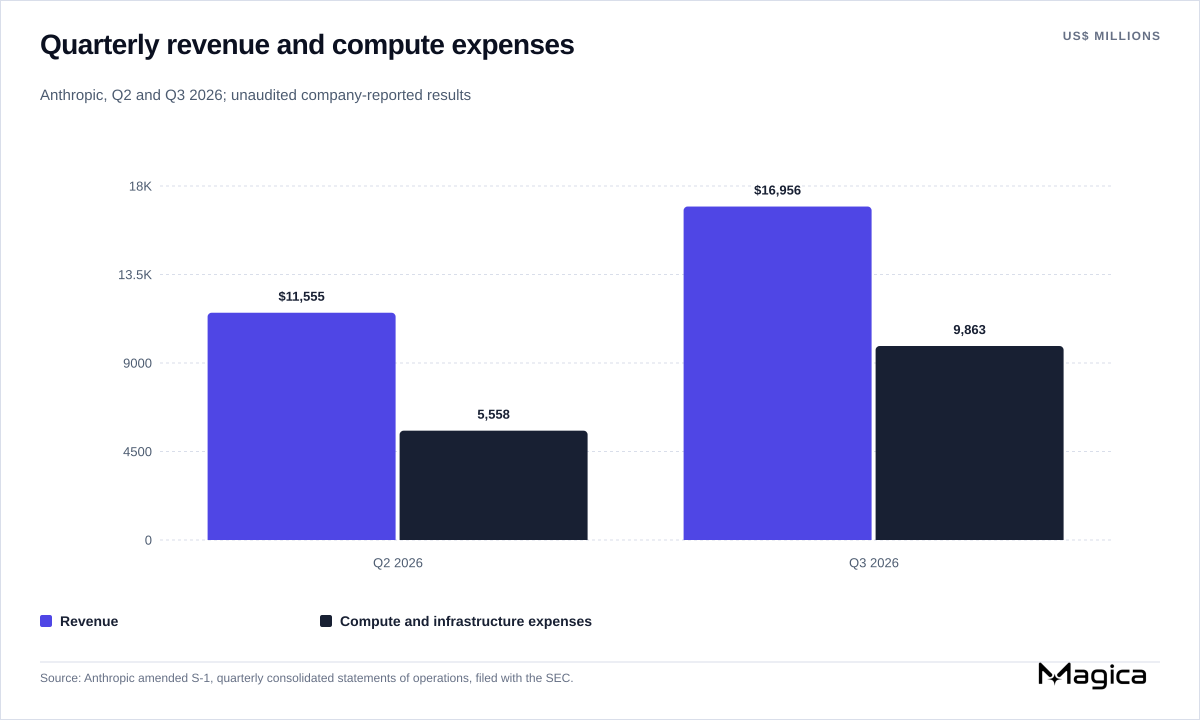
Magica chart of company-reported revenue and compute and infrastructure expenses for Q2 and Q3 2026. Other operating expenses are excluded. Source: Anthropic amended S-1.
The filing reports $18.8 billion in compute and infrastructure expenses for the nine months ended September 30, up $14.4 billion from the comparable 2025 period.
The latest two quarters show why the price of securing capacity matters alongside its availability. These figures are from the company's quarterly financial statements, rounded to billions of dollars:
| Measure | April–June 2026 | July–September 2026 |
|---|---|---|
| Revenue | $11.56 billion | $16.96 billion |
| Compute and infrastructure expenses | $5.56 billion | $9.86 billion |
| Compute and infrastructure expenses as a share of revenue | 48% | 58% |
| Operating income / (loss) | $0.97 billion | ($0.57 billion) |
Revenue increased 47% between those quarters, while compute and infrastructure expenses rose about 77%. Anthropic says short-term arrangements are significantly more expensive than comparable capacity under long-term contracts. Roughly $5 billion of its third-quarter compute and infrastructure expense came from short-term arrangements, and it expects their continued use to pressure near-term margins. The operating result also included $2 billion in noncash donation-matching charges. On Anthropic's adjusted measure, operating income rose from $2.2 billion to $2.5 billion, while the corresponding margin fell from 19% to 15%.
Its $23.29 billion third-quarter net loss should not be mistaken for operating cash consumption: that result included a $21.94 billion charge from revaluing convertible notes. The company reported positive operating cash flow of $6.6 billion over the first nine months of 2026.
There are substantial resources against the future bills. Cash, cash equivalents and short-term investments totaled $131.8 billion on September 30. The filing also describes up to $77 billion of undrawn partner financing capacity, subject to conditions; that is separate from cash on hand. But that dated balance is not a guarantee that revenue, capital raising and spending will align over the life of the contracts. The filing warns that upfront infrastructure costs and rising requirements could necessitate additional financing sooner than anticipated.
The interview-based report describes a possible $100 billion public offering; the preliminary prospectus does not establish the offering's proceeds. Infrastructure financing also needs to be distinguished from cash raised directly by Anthropic. An October 26 financing announcement describes a $63 billion transaction through a separate vehicle purchasing Broadcom accelerators and networking equipment to lease to Anthropic. That structure finances equipment access rather than depositing $63 billion in Anthropic's cash account.
Anthropic's original infrastructure relationships combined investment and supply. The interview-based report says Amazon and Google agreed to invest a combined $6 billion in 2023, much of which Anthropic then spent on their cloud services. The filing identifies large cloud companies as investors, distribution channels and, in some cases, competitors. Using more providers reduces dependence on any one supplier without removing those overlapping interests.
The alternatives are consequential. The report says specialist clouds and former cryptocurrency miners such as TeraWulf and Hut 8 can offer access to land and power sooner than backlogged cloud giants. Anthropic is also helping design facilities, buying chips and cooling equipment, and leaving operation to partners.
That approach creates its own timing exposure. The filing describes $161.2 billion in Broadcom equipment-lease commitments excluding interest, and warns that some equipment payments can start before a delayed facility is ready. Securing chips separately from buildings can preserve flexibility over chip selection, but a mismatch can mean paying before useful capacity arrives.
Hardware diversification also brings alternatives to Nvidia GPUs: Anthropic uses Amazon's Trainium chips and Google's TPUs, and has an agreement for chipmaker AMD's GPUs. AMD's associated investment of up to $5 billion in Anthropic shares is conditional on delivery and deployment milestones, rather than cash already available. Meanwhile, competitors including OpenAI and Google, and cheaper or open-weight models, limit how confidently future capacity costs can be passed on to customers.
Delivery depends on more than financing. The interview-based report describes a Fluidstack design dispute over power fluctuations that was subsequently resolved, and a TeraWulf project in upstate New York that needed traveling electricians at extra cost. It also says Anthropic has become willing to consider sites as small as 50 MW, supplemented by batteries and natural gas, to assemble capacity faster.
Location matters too. Anthropic says regulated customers need regional infrastructure for compliance and data residency, and its Amazon expansion includes inference capacity in Asia and Europe. It has also pledged to cover consumer electricity-price increases caused by its US data centers. Those requirements constrain which capacity meets demand and who bears part of its cost.
The next evidence needed is how much contracted capacity enters service on schedule, how much costly short-term supply it replaces, and whether customer spending supports the resulting payments. A reported doubling of electrical capacity would be significant; the financial test is whether it delivers usable computing power at a cost Anthropic's business can sustain.
SK hynix bought existing Penguin Solutions preferred shares from an SK Telecom investment vehicle. The deal brings director nomination rights and a convertible stake in an existing AI infrastructure partner, while sending the purchase price to the seller.
Google plans to switch off Gemini and Search for school-managed K–12 student accounts unless administrators enable them. Schools will gain control over access, but Google says keeping Search without its AI features will not be an option.
Independent tests reproduce MIT researchers’ repair of Qwen’s repetitive reasoning. The edited model still beats a stronger unedited configuration, but by much less; broader claims about creating capabilities remain unproven.
Gartner forecasts that open-weight models will execute 90% of enterprise operational agent steps by 2030. Its cost estimates favor routine, high-volume work, but infrastructure costs and the choice of comparison model leave enterprise savings to be proved.
FTAI Aviation is financing a planned 100-turbine production run in 2027, while ProEnergy has a 650 MW equipment order from Crusoe. Converted aircraft engines offer another supply route for data-center power, but delivery targets, affiliated financing and unproven operating economics qualify the opportunity.
Meta is marketing dollar bonds in a plan to borrow at least $20 billion, including an expected euro offering. Capital spending exceeded operating cash flow last quarter, but the debt is part of a wider financing strategy that also includes equity offerings and a proposed non-voting share-sale program.
A nonbinding opinion targets real-time retrieval and recognisable reuse of journalism, while rejecting a monopoly over news facts and recommending that questions about model training be dismissed as hypothetical.
A study of Lovable projects found passport details, customer records and private messages accessible without login, raising questions about database permissions and the limits of automated security checks. Its sample does not establish a platform-wide leak rate.
CrowdStrike is extending Falcon Guardian into Claude Cowork’s virtual machine and AWS’s AI guardrail layer. The Cowork beta addresses a visibility gap, while existing AWS safeguards and unfinished acquisitions limit what buyers can infer about the broader platform’s capabilities.
Oman and UK-founded Yamna have agreed to cooperate on a Salalah AI data centre whose first phase is expected to exceed £1 billion. The developer brings a hydrogen-project foothold and an earlier Brazilian data-centre proposal, but financing, customers and delivery dates remain undisclosed in the announcements.
War Thunder will add Nvidia’s DLSS 5 neural rendering in mid-November. The upgrade changes lighting and materials, with access and performance depending on hardware, streaming and other rendering features.
Samsung’s planned second Taylor fab reportedly has its output booked for AI-memory base dies, mostly for AMD, with production targeted for 2030. The orders could underpin investment, but Nvidia’s reported TSMC sourcing requirement limits the case for a broader foundry breakthrough.
Nordic Semiconductor is sampling nRF71 chips combining Wi-Fi, Bluetooth LE and Thread, with an AI accelerator in the higher-end variant. Its claimed standby-power improvement targets battery devices, but software maturity and real-world energy use remain key tests.
The operator of ao3.life says authors submitted more than 2,000 takedown requests after the site repackaged fanfiction and sold AI audiobooks during AO3’s outage, exposing the gap between restoring access and obtaining permission.
CrowdStrike has added an AI Kill Switch to Falcon Guardian that blocks agents’ model access through connected gateways. Broader containment across endpoints, identities and applications remains planned, making deployment coverage the key test of the new control.
DigitalOcean raised its 2026 revenue forecast to $1.208–$1.211 billion after third-quarter sales grew 40%. Larger customers are driving the expansion, while falling operating margins and rising equipment obligations complicate the earnings beat.
A leaker claims Intel may retire the B580, launched at $249, to favor professional AI products. Shared chips make reallocation possible, but no discontinuation notice has been reported, and the hardware can serve both markets.
The independent games marketplace is widening mandatory AI declarations and search filtering after reporting a surge in new game pages. But filtered results and deleted terabytes do not establish how much of its catalog is AI-generated.
A false authority appeared in a senior prosecutor’s reasons for continuing a child’s prosecution. The High Court rejected the challenge, while criticising the explanation for the citation and other aspects of the CPS’s handling of the case.
DeepSeek’s reported eight-trillion-parameter model plan accompanies a push toward Huawei hardware. Joint software tools and a larger reported fundraising show progress, but chip supply, training performance and deployment costs remain unresolved.