Editorial Team
9 min read
Anthropic says cash, growing revenue and multiyear payment schedules support its vast compute commitments. Its filing shows why flexibility matters: short-term capacity costs more, while major cloud contracts require payment regardless of usage.
Dario Amodei, Anthropic’s co-founder and chief executive and a former vice president of research at rival AI developer OpenAI, defended roughly $901 billion in future compute and infrastructure commitments on November 19. Speaking to CNBC on Anthropic’s public-market debut day, he argued that cash, growing revenue and payments spread over many years make the obligations manageable. He also said Anthropic hopes eventually to obtain an investment-grade credit rating and use debt.
Founded in January 2021, Anthropic develops Claude, a family of AI models and applications used for tasks including coding and business knowledge work. Its spending supports both research into more capable models and the computing capacity needed to serve customers. The financing question therefore extends beyond paying for the next model: Anthropic must secure capacity early enough to meet demand without paying excessively for capacity it cannot use.
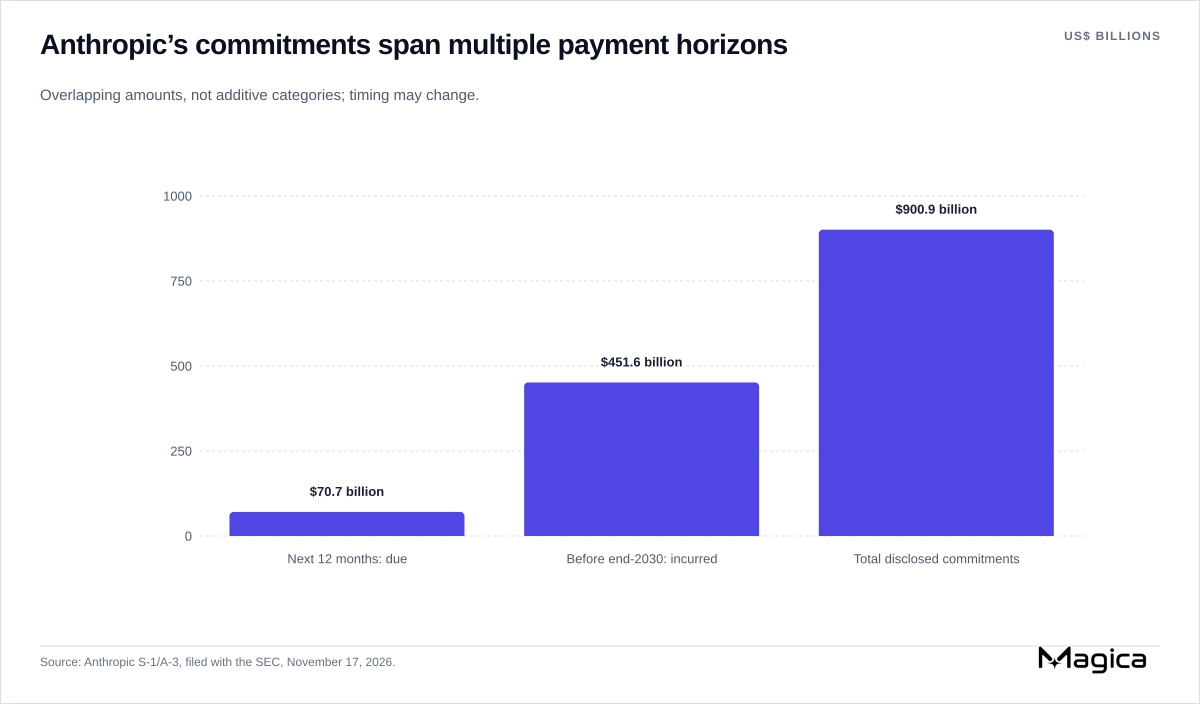
Company-reported commitments span different horizons. The $70.7 billion due within 12 months after September 30, 2026, and $451.6 billion expected to be incurred before end-2030 overlap within the $900.9 billion total. The bars are not additive. The total excludes arrangements without fixed dollar commitments. Source: SEC — Anthropic S-1/A-3.
A report on the financing describes an $81.34 billion IPO alongside a $26 billion private placement backed by Google, Nvidia and Microsoft—roughly $107 billion combined. But that headline total includes sales by existing shareholders and precedes offering expenses.
Anthropic’s pricing announcement says 956,351,354 of the IPO’s 980 million shares are being sold by the company at $83 each. That implies about $79.4 billion in gross IPO proceeds for Anthropic, before fees and expenses. The company receives none of the proceeds from the remaining shares sold by existing holders. The offering priced on November 18; pricing is distinct from closing and receiving the money.
Before the offering, Anthropic held $131.8 billion in cash, cash equivalents and short-term investments at September 30, according to its November 17 registration filing. The financing would add substantial resources, but cannot by itself establish that the compute spending will earn an adequate return.
Nor would future borrowing be Anthropic’s first debt. The filing records $6.2 billion in outstanding convertible promissory notes issued to Amazon at September 30, expected to settle in shares rather than cash. Amodei’s investment-grade ambition concerns future financing capacity; he provided no date, amount or terms for a new debt issue, and did not say a rating had been secured.
The filing’s $900.9 billion aggregate consists of approximately $320 billion in scheduled contractual obligations, $451.2 billion in leases signed but not yet commenced, and $129.7 billion in short-term and subsequent commitments. Substantially all relates to compute and infrastructure.
Anthropic estimates another $150 billion to $175 billion in payments under arrangements without fixed dollar commitments. These depend on capacity delivered, timing, pricing and deployment conditions. Including those estimates takes the total above $1 trillion, but does not make every dollar an unconditional liability payable now.
About $186.2 billion of the $900.9 billion aggregate is subject to exercisable termination rights or conditions before commencement, including counterparties obtaining financing, facilities or regulatory approvals. That flexibility is unevenly distributed: only $4.2 billion of the $70.7 billion expected to be paid in the 12 months after September 30 falls into that category.
The company expects $451.6 billion of the aggregate commitments to be incurred before December 31, 2030, with substantially all the remainder between 2031 and 2045. Payments may shift as capacity delivery changes. Anthropic also expects to enter further arrangements, so the disclosed aggregate is not a ceiling on future spending.
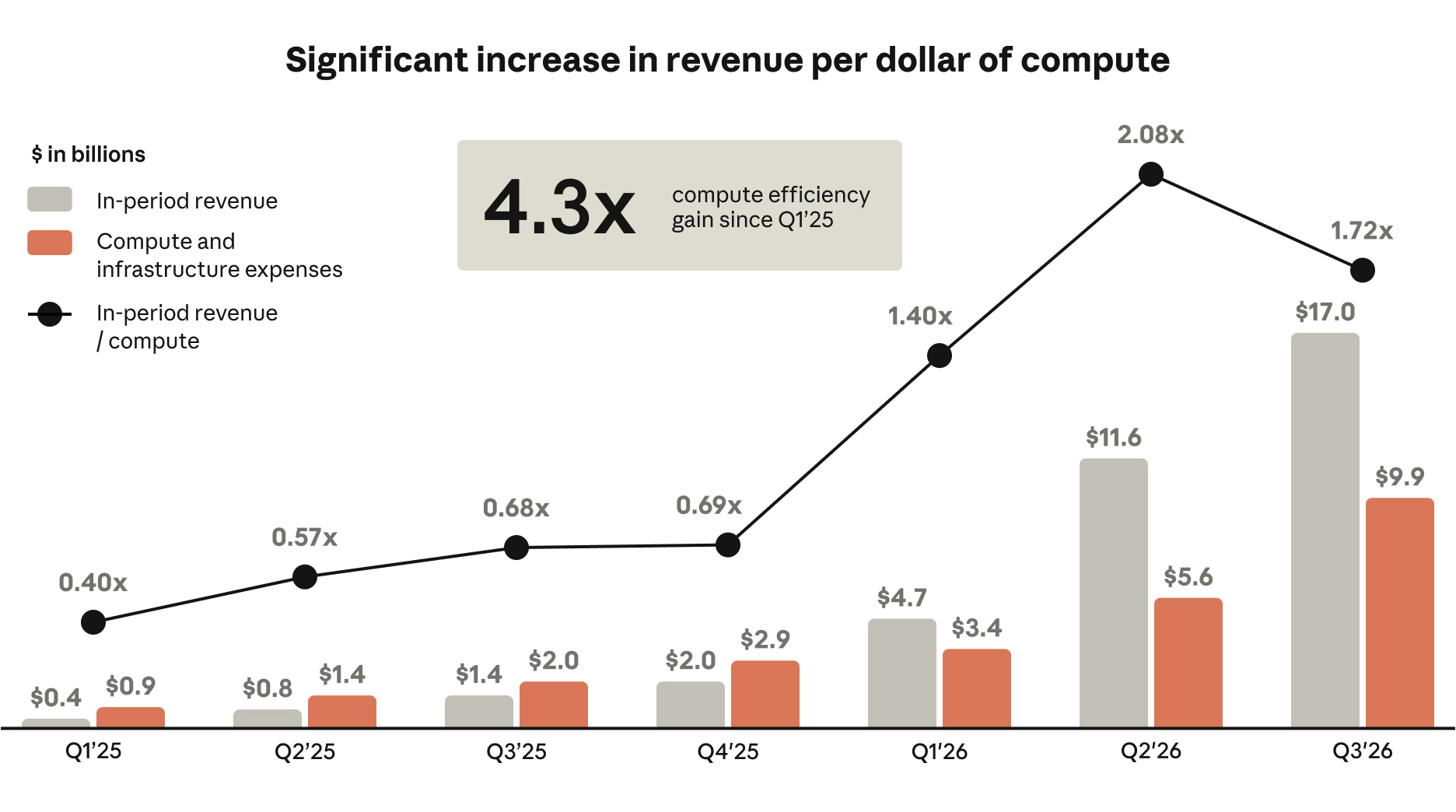
Company-reported revenue and compute and infrastructure expenses through Q3 2026. Revenue per dollar of compute declined from 2.08 in Q2 to 1.72 in Q3. Graphic: Anthropic, S-1/A-3. Source: SEC — Anthropic S-1/A-3.
In the interview transcript, Amodei said forecasting compute demand remains difficult. Anthropic tries to commit conservatively and buy more on the spot market when necessary, he said, while defending large research expenditures on the grounds that past investment in more capable models had paid off.
The filing supplies a concrete cost trade-off. Anthropic incurred $6.5 billion in compute expense under short-term commitments during the first nine months of 2026. The company says that capacity currently costs significantly more than comparable compute obtained through multiyear commitments.
Longer contracts can reduce that premium while creating another exposure. Anthropic committed to at least approximately $121.3 billion with cloud provider Google between April 2026 and July 2033, and at least $110 billion with Amazon between May 2026 and April 2036, regardless of actual usage. Spending shortfalls require true-up payments, subject to specified adjustments and exceptions. These commitments generally cannot be canceled except for the providers’ uncured material breach.
SpaceX.AI, the wholly owned AI subsidiary of Space Exploration Technologies, supplies a different form of flexibility. Its agreements provide for spending up to $120.5 billion into 2029, but permit either party to cancel on 90 days’ notice after initial noncancelable periods ending in January and March 2027. Asked about speculation that Anthropic might scale back that relationship, Amodei declined to predict its future and said the company was enjoying working with SpaceX.
These relationships extend beyond supplying capacity. Google agreed to buy $10 billion of shares in the concurrent private placement. Anthropic also distributes Claude through Amazon Web Services, Google Cloud and Microsoft Azure; the filing says it sets customer pricing while paying the cloud providers fees. Suppliers can therefore help finance the company and reach customers while taking a share of its spending and distribution economics.
A published return-on-capital analysis asks what Anthropic would need to earn over the next five to 10 years to be considered a financial success. It rounds commitments and estimated additional payments to $1 trillion and assumes that is all the capital invested in the business. That assumed capital base differs from the roughly $1.5 trillion equity valuation at the IPO price.
A 20% annual return would require $200 billion in operating profit after tax. Applying a 17% effective tax rate and a 40% operating margin produces about $602 billion in annual revenue: $200 billion divided by 0.83, then by 0.40. The assumptions draw on large technology companies, rather than Anthropic’s established earnings record.
This is a scenario, not Anthropic guidance or a revenue threshold imposed by its contracts. It treats future compute purchases and leases as a proxy for invested capital; changing that base, the required return or the margin changes the answer. Amodei’s interview did not directly address the calculation.
The analysis also cites accounting specialist Zion Research Group’s estimate that $700 billion comes due over the next five years. It does not reconcile that estimate with the filing’s schedule, which uses a different end-2030 cutoff. The figures should not be treated as interchangeable.
Anthropic’s reported operating results show both rapid improvement and the distance from the scenario’s assumed margin:
| Metric, in millions of dollars | Nine months ended Sept. 30, 2025 | Nine months ended Sept. 30, 2026 |
|---|---|---|
| Revenue | 2,545 | 33,242 |
| Compute and infrastructure expense | 4,381 | 18,808 |
| Operating loss | (5,224) | (1,260) |
| Operating cash flow | (2,024) | 6,569 |
Revenue increased about thirteenfold while compute and infrastructure expense increased about fourfold, reducing that expense from roughly 172% to 57% of revenue. Anthropic attributes the improvement to revenue growth against a compute base largely committed in advance, partly offset by additional capacity, including the costlier short-term supply.
The operating-loss comparison also benefits from the absence of a $1.5 billion litigation-settlement charge recorded in the 2025 period. Operating margin remained approximately negative 4% in the 2026 period. The much larger $104 billion net loss included $94.3 billion in fair-value charges on convertible notes, derivative liabilities and similar financing instruments, primarily driven by the company’s rising valuation; it is not a measure of cash consumed.
Positive operating cash flow is a material counterweight. Anthropic says the improvement primarily reflected better results after noncash adjustments, while warning that collections and vendor-payment timing affect working capital. A positive nine-month operating cash-flow total does not establish how the company will fund years of escalating commitments.
Amodei’s defense depends on customers continuing to pay for better capabilities. The interview explicitly raised cheaper tokens from OpenAI, open-weight models and Microsoft’s ability to distribute Claude while offering its own competing models. Amodei argued that quality drives demand and that frontier research also makes smaller models cheaper, citing a fourfold price reduction for Haiku 5.5 compared with Haiku 4.5. Those are management’s arguments for competing on capability and cost, rather than evidence that future margins are assured.
Capacity also requires power and permission. The filing warns of intense competition for electricity and suitable data-center sites. Some planned facilities rely on on-site natural-gas generation, exposing Anthropic to fuel-price and supply risks, including pipeline constraints, with fuel costs passed through to it.
Anthropic president and co-founder Daniela Amodei, previously an OpenAI vice president of safety and policy, said in the interview that the company had committed to covering electricity-grid price differences rather than leaving consumers to bear them. That pledge adds a community-facing cost consideration to the expansion. She also described Anthropic’s public-benefit-corporation structure as requiring a balance between shareholder interests and the public good.
The IPO is expected to close on November 20, subject to customary conditions. Beyond that financing milestone, the decisive evidence will be whether delivered capacity supports enough paying demand to improve margins while meeting the payment schedule.
Investors will need to distinguish growth funded by operating cash generation from growth requiring further equity, supplier financing or debt. Any future investment-grade borrowing will have its own price and conditions. The commitments’ duration helps explain why Anthropic need not finance the whole total today; capacity utilization, realized costs and sustained cash generation will determine how much more financing it needs.
Epic says it is using AI to rewrite parts of Unreal Engine and plans to let developers connect their preferred models to UE6. The strategy combines claimed maintenance gains with a broader overhaul of programming, distribution and portable game assets, while rival Unity already offers outside-model connections.
At Ignite, Nvidia and Microsoft are expanding local coding AI, cloud desktop streaming and Azure infrastructure. The announcements build on an existing Windows AI strategy, with AMD alternatives, staggered availability and no comparable deployment-cost results in the announcements.
Microsoft and Nvidia are expanding Azure’s Vera Rubin virtual-machine preview, with systems already running in its data centers. Microsoft’s separate confidential-AI showcase covers four GPUs, while the announcements leave pricing, regions and general availability unspecified.
Meta is reconsidering its 2030 climate deadline after net emissions reached 11.8 million tonnes in 2025. Hardware and infrastructure purchases dominate its reported footprint, while new gas generation adds a longer-term challenge.
Three House committee chairs want the Remote Access Security Act in the annual defense bill as scrutiny of Nvidia intensifies. The available Senate text would authorize controls on specified foreign users’ remote access, with computing limits left to Commerce.
Google Quantum AI reports tests of quantum contextuality spanning up to 105 qubits on Willow processors. The experiments expose hardware errors and beat restricted classical strategies, while the largest task relies on an unproven classical benchmark.
A bipartisan House disclosure shows requests to sell 3.4 million AI chips to China and approvals for more than 879,000. The oversight question is whether Commerce verified the buyers, supply protections and access restrictions behind those authorizations.
OpenAI says its internal Performance Factory tracked more than 1,700 investigations in just over three months. About 400 cases reached proposed fixes, but far fewer shipped repairs used Codex’s code unchanged, and engineers retain approval.
Activists protested Anthropic’s stock-market debut outside Nasdaq, with at least one arrest and conflicting accounts of the total. Their campaign targets retirement-fund exposure to AI shares, alongside concerns about jobs, data centers and public accountability.
OpenAI is rolling out live transcription for dictated ChatGPT prompts across free and paid plans. Users can see words as they speak and review the text before sending, but the company has not supplied performance measurements or a replacement recording maximum.
Boltz has raised a Bessemer-led $110 million Series A to expand molecular-design tools sold by usage. Its open-source research brought broad adoption; the commercial test is whether paid computation delivers repeatable gains in laboratory discovery.
Donald Trump said he and Xi Jinping supported minimal AI guardrails but had not discussed definitions. Their Shenzhen meeting leaves unresolved how bilateral safety cooperation would coexist with U.S. opposition to global regulation.
Gemini can now click and type across Mac apps and websites in a background window, Google says. The paid rollout expands its desktop automation, but app permissions expose active accounts and file changes that backups cannot always undo.
The House AI Safety and Innovation Caucus promises legislative advocacy and rapid incident briefings. Its members already have bipartisan safety proposals in play, making the choice of safeguards its next test.
Binance Wallet says it will return all subscription commitments, distribute roughly 2,957 Anthropic tokenized shares free and add a $1 million token giveaway after demand far exceeded its allocation.
Early Anthropic investor Dustin Moskovitz is urging frontier AI developers to slow down. He and Cari Tuna moved their stake to a nonprofit in early 2025, directing potential returns toward philanthropy while leaving questions about the holding's value and governance rights.
A national study finds higher odds of hosting data centers in majority-Black, Hispanic and Asian neighborhoods. Facility types, zoning rules and unequal access to public hearings complicate who bears the costs and receives the benefits.
A debut-day estimate values the Anthropic shares FTX sold in 2024 at $49.7 billion. The comparison exposes the scale of subsequent paper gains, but contrasts cash raised for bankruptcy repayments with a hypothetical stock-market valuation.
Anthropic raised $81.3 billion in a record IPO and opened 34% above its offer price before retreating. Rapid revenue growth and adjusted operating profits sit alongside vast computing commitments and limited investor control.
The Kimi developer reportedly abandoned planned Nvidia B300 capacity for 2027 after new US restrictions. The deal exposes financing risks for overseas AI clouds, but neither a model delay nor a $150 million cash loss is established.