Editorial Team
8 min read
At Ignite, Nvidia and Microsoft are expanding local coding AI, cloud desktop streaming and Azure infrastructure. The announcements build on an existing Windows AI strategy, with AMD alternatives, staggered availability and no comparable deployment-cost results in the announcements.
Nvidia and Microsoft are widening their AI deployment options at Ignite, combining local coding models on Windows PCs with new cloud desktop streaming and Azure infrastructure. For businesses planning hardware purchases, the consequential question is which tasks merit computing capacity they own and which remain better suited to a cloud bill. The announcements offer more choices, but their availability and cost evidence differ sharply.

Microsoft’s Surface Laptop Ultra, built around Nvidia’s RTX Spark platform. Image: Microsoft. Source: Windows Experience Blog.
Microsoft says GitHub Copilot Fusion, the task-routing capability in its coding assistant, can send coding work to local models such as MAI Code 1.1 Flash. The experience is in preview across the Copilot app, command-line interface and Visual Studio Code. The experience on PCs powered by Nvidia’s RTX Spark computing platform is extending to machines with AMD Ryzen AI Max Series and Ryzen AI Max 400 Series processors, according to Microsoft’s Windows announcement.
The companies are also demonstrating large language models running directly on RTX Spark Windows PCs. This is inference—running a model to produce an answer—rather than building a model from scratch. Several Fortune 500 companies are piloting the GitHub experience, Microsoft says; it names Adobe, Autodesk, Dell, HP, Insight, Nvidia and PwC as participants in its broader Windows Hybrid Intelligence pilot.
Microsoft brings Windows, which it says runs on more than a billion devices, alongside Azure, its cloud infrastructure platform. Nvidia supplies accelerated computing hardware and software across that partnership. Their existing Azure work includes Blackwell systems: Nvidia says in its Ignite announcement that Azure used 10,240 GPUs for a DeepSeek-V3 test in the MLPerf Training v6.1 benchmark round.
Ignite extends a strategy already under way. In May 2025, Microsoft described Windows ML, its built-in inference runtime, as supporting AMD, Intel, Nvidia and Qualcomm across CPUs, GPUs and neural processing units. Windows AI Foundry, its Windows AI development platform, integrated local model catalogs, including Foundry Local, Ollama and Nvidia NIMs. Microsoft also offered specific local language and image APIs at no additional cost, optimized for Copilot+ PC neural processors.
The coding-routing plan is older than Ignite, too. On October 7, Microsoft announced that GitHub’s cloud router, then called HydraFusion, would extend to local Windows models in an experimental preview later that month. The Ignite announcement adds breadth, including AMD support and enterprise pilots, to that earlier plan.
There is already a hardware price against which buyers can assess the proposition. Microsoft announced Surface Laptop Ultra, built around Nvidia’s RTX Spark platform combining a Blackwell RTX GPU and Grace CPU, at a starting MSRP of $2,599, with availability beginning October 16. Its launch announcement does not establish how much cloud usage that purchase would displace. The starting price is a hardware outlay, not a like-for-like comparison with a cloud inference service.
Windows 365 streams a Windows desktop from Microsoft’s cloud. Microsoft says tens of thousands of organizations use it, and appropriately sized Cloud PCs—including GPU configurations—already support compatible AI models through Foundry Local. Here, “local” execution occurs inside the Cloud PC, rather than on the user’s physical device.
That gives buyers another option alongside upgrading endpoints. Microsoft describes Cloud PCs as providing predictable subscription costs and potentially extending the life of existing PCs. It supplies no comparable task-level cost results for choosing that route over the local coding preview.
The Nvidia collaboration adds a separate graphics-streaming capability. The companies claim support for demanding applications with up to two 4K streams at 60 frames per second and low latency, including on difficult networks. Nvidia says a limited preview is open for sign-ups and public preview is planned for early 2027. Microsoft’s Book of News specifies select regions for that upcoming preview.
Ordinary Direct Stream connectivity and multimedia improvements are already generally available. Those improvements, existing GPU Cloud PCs and the forthcoming Nvidia graphics enhancements have different release states; they should not be treated as a single new service available everywhere.
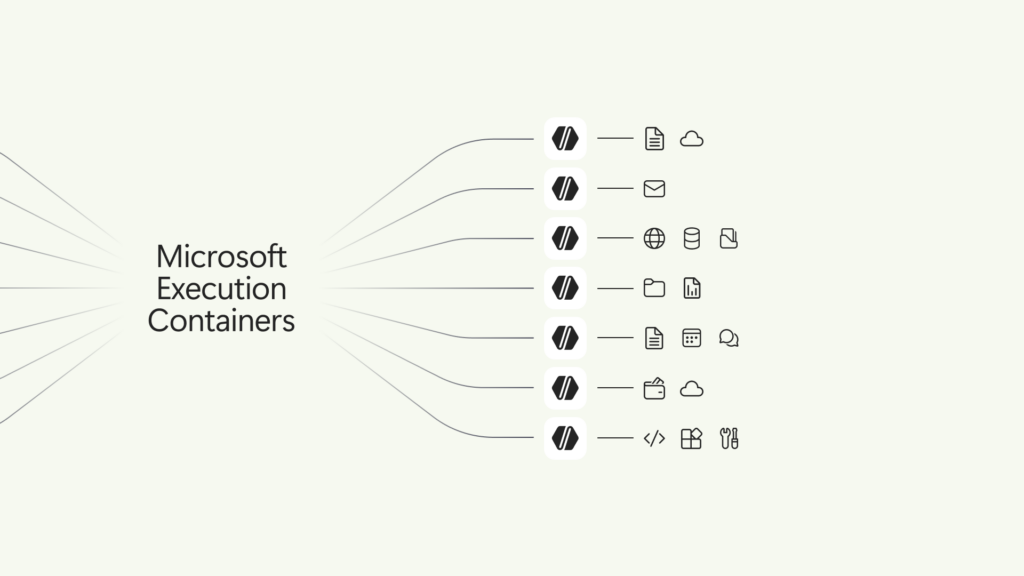
Microsoft’s illustration of Execution Containers, which enforce policies governing agents’ access to files and networks. Image: Microsoft. Source: Windows Experience Blog.
Microsoft Foundry is the company’s platform for developing, adapting and deploying models and agents. Foundry Local enables local model execution, while Azure Local runs Azure services on customer hardware. Nvidia says expanded support for its Nemotron 3.5 open-model family in Foundry Local brings reasoning, coding and tool-using capabilities to Azure Local environments.
Azure Local will also support RTX PRO 6000 Blackwell GPUs from hardware partners, without an announced date. It is expanding to Nvidia’s Jetson Thor and Jetson Orin edge platforms for industrial uses such as machine vision and robotics, while Nvidia’s Cosmos physical AI models are being brought to Foundry Local, according to Nvidia’s announcement.
Windows Server 2028, Microsoft’s next enterprise server operating system, is in public preview. It extends the existing Windows Server platform toward AI inference near business applications and data. But Microsoft says its hybrid intelligence features are available only to a limited number of customers through early access, with hardware requirements.
Nvidia’s DGX Station for Windows, a deskside AI system, is planned to support Windows Server 2028 at general availability. AMD’s MI350P accelerator is separately scheduled for preview in the first half of 2027 on Windows Server 2025 and later. Microsoft also lists vLLM and Llama.cpp among supported server inference platforms. The customer’s choices therefore extend beyond Nvidia hardware and Microsoft’s own runtime.
Running near company data does not remove the need to control an agent’s actions. Microsoft Execution Containers, its containment technology, has been generally available on Windows 11 since October. New process-container controls are in preview to limit communications, network access and identity claims. Learning and permissive modes are generally available so administrators can observe normal behavior before enforcing restrictions.
Microsoft’s operating systems, development services and governance tools can remain involved across these locations. Nvidia gains additional places for its processors and models to run.
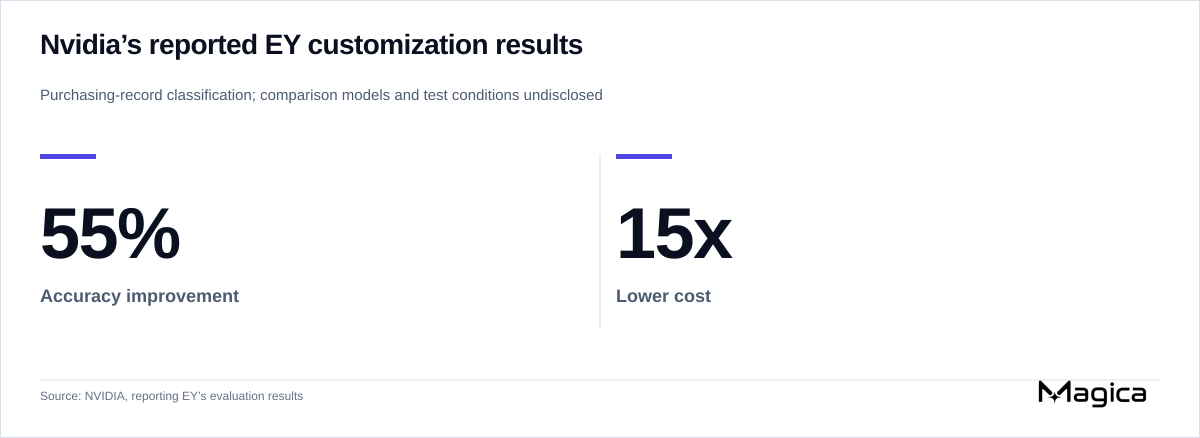
Company-reported results for EY’s model-customization exercise. Nvidia does not specify whether the accuracy improvement is relative or percentage points. These figures do not measure Windows PC savings. Graphic: Magica; source: Nvidia. Source: NVIDIA.
Foundry Managed Compute adds support for deploying custom model weights, connecting model adaptation to managed deployment. Its Nvidia Nemotron 3.5 lineup includes Super for long-running agents and Lightning for fast responses and tool use. Retrieval, document-processing and safety models provide complementary functions; Bolt, for low-latency reasoning, and Transcribe, for speech recognition, are coming soon.
EY, the professional-services organization, is already an Nvidia collaborator: it announced an AI agent platform built with Nvidia in March 2025. Its role as both a user and a commercial collaborator matters when assessing the example Nvidia selected.
The clearest reported savings example concerns EY’s use of Programmed Training in Foundry to adapt Nemotron open models for classifying corporate purchasing records. Nvidia says in its account of the work that accuracy on EY’s evaluation dataset improved by 55% and cost was 15 times lower than with proprietary frontier models.
Those figures are company claims about a specialized model-customization exercise. A report examining the disclosures notes that Nvidia did not identify the comparison models or test conditions, or explain whether 55% meant a relative improvement or percentage points. Neither figure measures Windows PC savings. Microsoft identifies Programmed Training as a preview allowing custom supervised fine-tuning and reinforcement-learning loops while Foundry manages the compute.
Microsoft is also a user of Nvidia technology. Nvidia says Microsoft AI uses Dynamo software to coordinate reinforcement-learning rollout inference during post-training, and Bing search models use RTX PRO 6000 Blackwell GPUs. That reliance has limits: the same report recounts Microsoft’s October statement that its own Maia chips would become the primary inference system for Microsoft products and services starting in 2027. That is Microsoft’s stated plan, rather than a completed transition or a claim about all Azure customer workloads.
At the largest scale, Nvidia says Vera Rubin NVL72 systems, designed for demanding AI training and inference, are running in Azure data centers. It describes the Azure offering as a preview. The report finds no named virtual-machine series, region, price or general-availability date in the relevant announcements.
Azure is not the only route to that hardware generation. The report records that Oracle and Nvidia announced Vera Rubin NVL72 general availability on Oracle Cloud Infrastructure on October 27, although that release also named no regions. It also recounts Microsoft’s statement that Azure brought up a system for validation in March and delivered its first production systems in August. Installed hardware and broadly purchasable service are distinct milestones.
Confidential computing, which protects models and data during processing, remains another staged rollout. The report’s account of Microsoft’s disclosures says the Rubin technology preview starts with confidential bare-metal instances; confidential virtual machines and Foundry integration remain in development. Separately, Nvidia says the partners are working on power efficiency using MaxLPS to get more performance from available data-center power, without supplying a quantified gain in this announcement.
For buyers planning a PC or server refresh, the next useful evidence is a comparison on their actual tasks: successful output quality, latency, hardware and operating expense, cloud fallback and the resulting combined bill. For Azure customers, regional access, pricing and the completion of security features remain consequential. Those details will determine which of the expanded deployment options is worth purchasing.
Epic says it is using AI to rewrite parts of Unreal Engine and plans to let developers connect their preferred models to UE6. The strategy combines claimed maintenance gains with a broader overhaul of programming, distribution and portable game assets, while rival Unity already offers outside-model connections.
Microsoft and Nvidia are expanding Azure’s Vera Rubin virtual-machine preview, with systems already running in its data centers. Microsoft’s separate confidential-AI showcase covers four GPUs, while the announcements leave pricing, regions and general availability unspecified.
Meta is reconsidering its 2030 climate deadline after net emissions reached 11.8 million tonnes in 2025. Hardware and infrastructure purchases dominate its reported footprint, while new gas generation adds a longer-term challenge.
Three House committee chairs want the Remote Access Security Act in the annual defense bill as scrutiny of Nvidia intensifies. The available Senate text would authorize controls on specified foreign users’ remote access, with computing limits left to Commerce.
Google Quantum AI reports tests of quantum contextuality spanning up to 105 qubits on Willow processors. The experiments expose hardware errors and beat restricted classical strategies, while the largest task relies on an unproven classical benchmark.
A bipartisan House disclosure shows requests to sell 3.4 million AI chips to China and approvals for more than 879,000. The oversight question is whether Commerce verified the buyers, supply protections and access restrictions behind those authorizations.
OpenAI says its internal Performance Factory tracked more than 1,700 investigations in just over three months. About 400 cases reached proposed fixes, but far fewer shipped repairs used Codex’s code unchanged, and engineers retain approval.
Activists protested Anthropic’s stock-market debut outside Nasdaq, with at least one arrest and conflicting accounts of the total. Their campaign targets retirement-fund exposure to AI shares, alongside concerns about jobs, data centers and public accountability.
Anthropic says cash, growing revenue and multiyear payment schedules support its vast compute commitments. Its filing shows why flexibility matters: short-term capacity costs more, while major cloud contracts require payment regardless of usage.
OpenAI is rolling out live transcription for dictated ChatGPT prompts across free and paid plans. Users can see words as they speak and review the text before sending, but the company has not supplied performance measurements or a replacement recording maximum.
Boltz has raised a Bessemer-led $110 million Series A to expand molecular-design tools sold by usage. Its open-source research brought broad adoption; the commercial test is whether paid computation delivers repeatable gains in laboratory discovery.
Donald Trump said he and Xi Jinping supported minimal AI guardrails but had not discussed definitions. Their Shenzhen meeting leaves unresolved how bilateral safety cooperation would coexist with U.S. opposition to global regulation.
Gemini can now click and type across Mac apps and websites in a background window, Google says. The paid rollout expands its desktop automation, but app permissions expose active accounts and file changes that backups cannot always undo.
The House AI Safety and Innovation Caucus promises legislative advocacy and rapid incident briefings. Its members already have bipartisan safety proposals in play, making the choice of safeguards its next test.
Binance Wallet says it will return all subscription commitments, distribute roughly 2,957 Anthropic tokenized shares free and add a $1 million token giveaway after demand far exceeded its allocation.
Early Anthropic investor Dustin Moskovitz is urging frontier AI developers to slow down. He and Cari Tuna moved their stake to a nonprofit in early 2025, directing potential returns toward philanthropy while leaving questions about the holding's value and governance rights.
A national study finds higher odds of hosting data centers in majority-Black, Hispanic and Asian neighborhoods. Facility types, zoning rules and unequal access to public hearings complicate who bears the costs and receives the benefits.
A debut-day estimate values the Anthropic shares FTX sold in 2024 at $49.7 billion. The comparison exposes the scale of subsequent paper gains, but contrasts cash raised for bankruptcy repayments with a hypothetical stock-market valuation.
Anthropic raised $81.3 billion in a record IPO and opened 34% above its offer price before retreating. Rapid revenue growth and adjusted operating profits sit alongside vast computing commitments and limited investor control.
The Kimi developer reportedly abandoned planned Nvidia B300 capacity for 2027 after new US restrictions. The deal exposes financing risks for overseas AI clouds, but neither a model delay nor a $150 million cash loss is established.