Editorial Team
6 min read
Boltz has raised a Bessemer-led $110 million Series A to expand molecular-design tools sold by usage. Its open-source research brought broad adoption; the commercial test is whether paid computation delivers repeatable gains in laboratory discovery.
Boltz, a London-based artificial intelligence company spun out of the Massachusetts Institute of Technology, has raised $110 million in Series A funding led by venture investor Bessemer Venture Partners. It builds tools that predict molecular interactions and help scientists select or design potential medicines for laboratory testing, selling computational usage while customers retain their discoveries.
The company said in its funding announcement that the money will support compute, data and team expansion. It reports partnerships with six of the world's 20 largest pharmaceutical companies, naming Pfizer, GSK, Takeda and Bristol Myers Squibb. The announcement does not disclose revenue, contract values or a valuation, or define the ranking behind that top-20 comparison.
The financing funds the expansion from widely adopted open research into proprietary commercial products. That research gives Boltz an established audience, but its own open-source models also give scientists an alternative to paying for the newest tools.
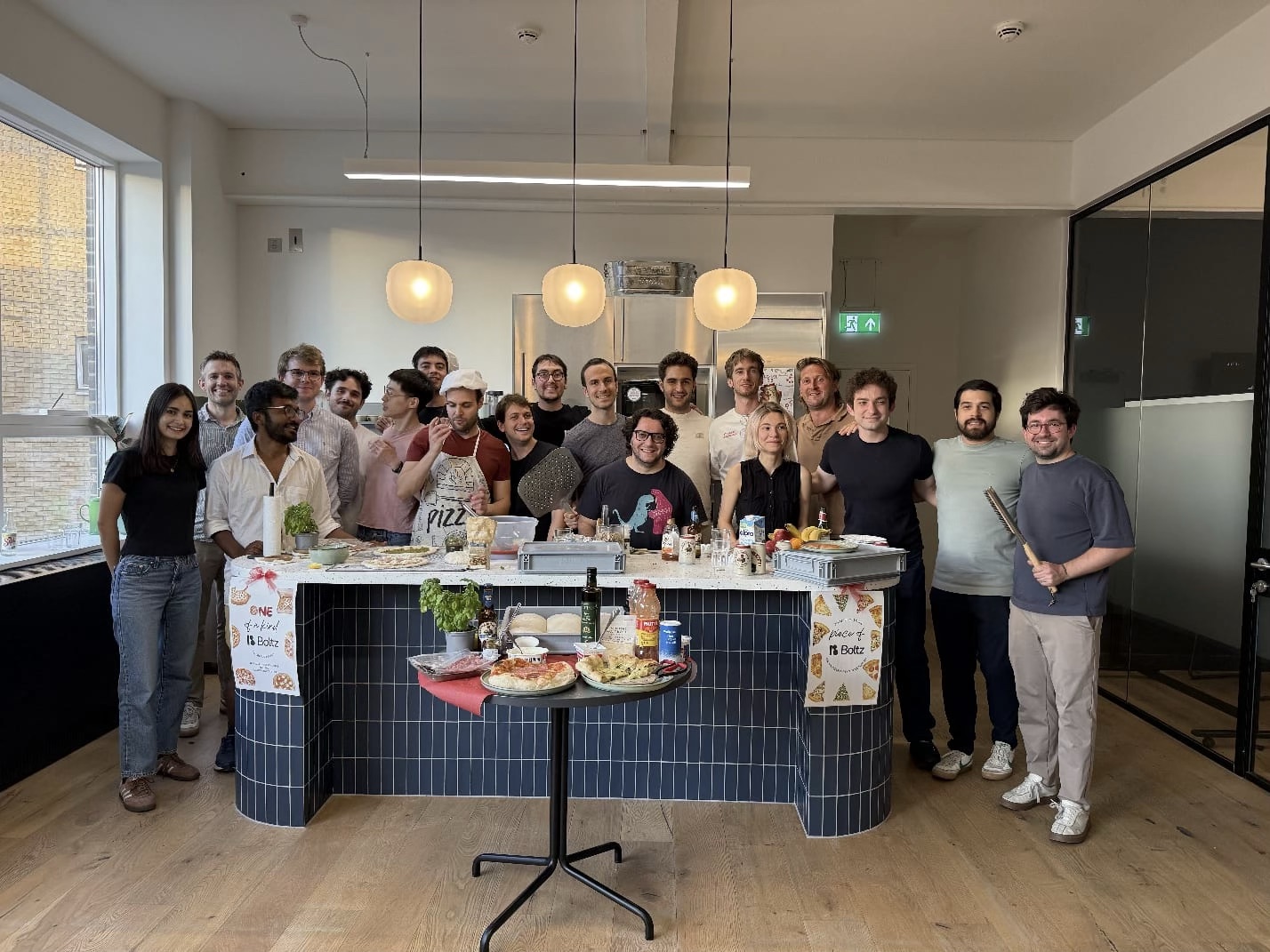
The Boltz team in an office photo published with its Series A announcement. Credit: Boltz. Source: Boltz.
Boltz began as a company in 2025, following work at MIT's Jameel Clinic for Machine Learning in Health. Its co-founders are chief executive Gabriele Corso, whose work includes the DiffDock molecular-docking model; chief technology officer Jeremy Wohlwend, who led the Boltz-1 structure-prediction model; and head of research Saro Passaro, who built Boltz-2 for joint structure and binding-affinity prediction, according to Bessemer's investment explanation.
An MIT account published in December 2024 identified Corso and Wohlwend, then graduate students, as lead Boltz-1 developers, alongside research affiliate Passaro and faculty collaborators. MIT said their experiments matched the accuracy of Google DeepMind's AlphaFold3, a model for predicting molecular structures, on a diverse set of complex biomolecular structure predictions. That comparison concerns structure prediction, rather than drug-development outcomes.
Epic says it is using AI to rewrite parts of Unreal Engine and plans to let developers connect their preferred models to UE6. The strategy combines claimed maintenance gains with a broader overhaul of programming, distribution and portable game assets, while rival Unity already offers outside-model connections.
The researchers released Boltz-1's training and fine-tuning pipeline as well as the model. Bessemer says the team's open-source models have surpassed five million downloads and reached more than 100,000 scientists. Those are investor-reported adoption figures, not counts of paying customers. Bessemer says every Boltz partnership began with inbound interest from computational chemists and biologists already using the models.
Boltz launched its scientist-facing Boltz Lab platform in January 2026, followed in June by its first proprietary models: BoltzMol-1 for small-molecule hit discovery and BoltzProt-1 for protein design.
The software helps researchers predict the structure of interacting molecules, estimate binding strength and propose candidates for laboratory testing. Access comes through the platform and an API, with integrations into coding agents and existing computational workflows. Boltz says its team has grown to 40 scientists and engineers in just over a year.
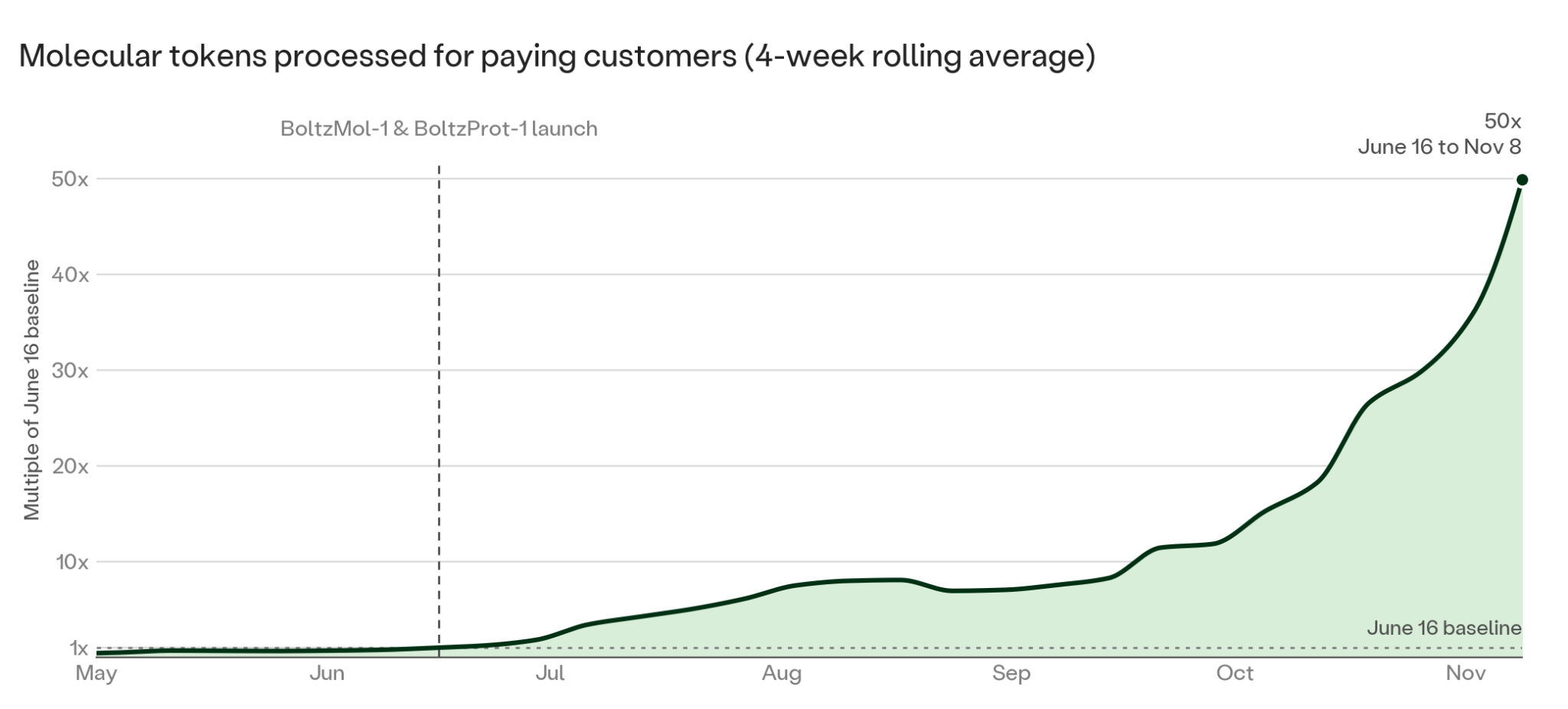
Company-reported molecular-token usage among paying customers, shown as a four-week rolling average relative to June 16. The chart reports 50-fold growth by November 8; it does not show absolute usage or revenue. Source: Boltz. Source: Boltz.
Existing venture investor Andreessen Horowitz, which says it co-led Boltz's seed round, describes molecular tokens as units of molecular information processed by the models. In its investment account, it says customers pay for model usage while retaining ownership of what they create. Boltz can also train exclusive model versions on a pharmaceutical partner's proprietary data.
Boltz advertised API predictions starting at $0.025 in its June 16 launch announcement. That is an entry price for computation, rather than the cost of discovering a validated molecule. A campaign can require many predictions as well as compound procurement and laboratory testing.
That arrangement makes computational consumption central to the business. A prediction and an extended design campaign can require different amounts of work; more tokens need not mean a proportionate increase in customers or successful drug candidates.
Boltz reports a 50-fold rise in molecular-token usage among paying customers since June. Andreessen Horowitz describes roughly the same increase in weekly consumption over four months. The accounts use different time windows and neither provides an absolute starting volume. The figures do not establish how much revenue grew, and the announcements do not disclose campaign-level charges or delivery costs sufficient to assess the economics of that growth.
The investor group is also expanding. Boltz says existing backers Andreessen Horowitz, Amplify Partners, Zetta Venture Partners and Obvious Ventures participated, alongside new investors including Greycroft, F-Prime Capital, Hummingbird and Benchling. A report on the financing puts its earlier seed round at $28 million, says Nvidia invested earlier this year, and describes revenue from partnerships and access to the platform and models.
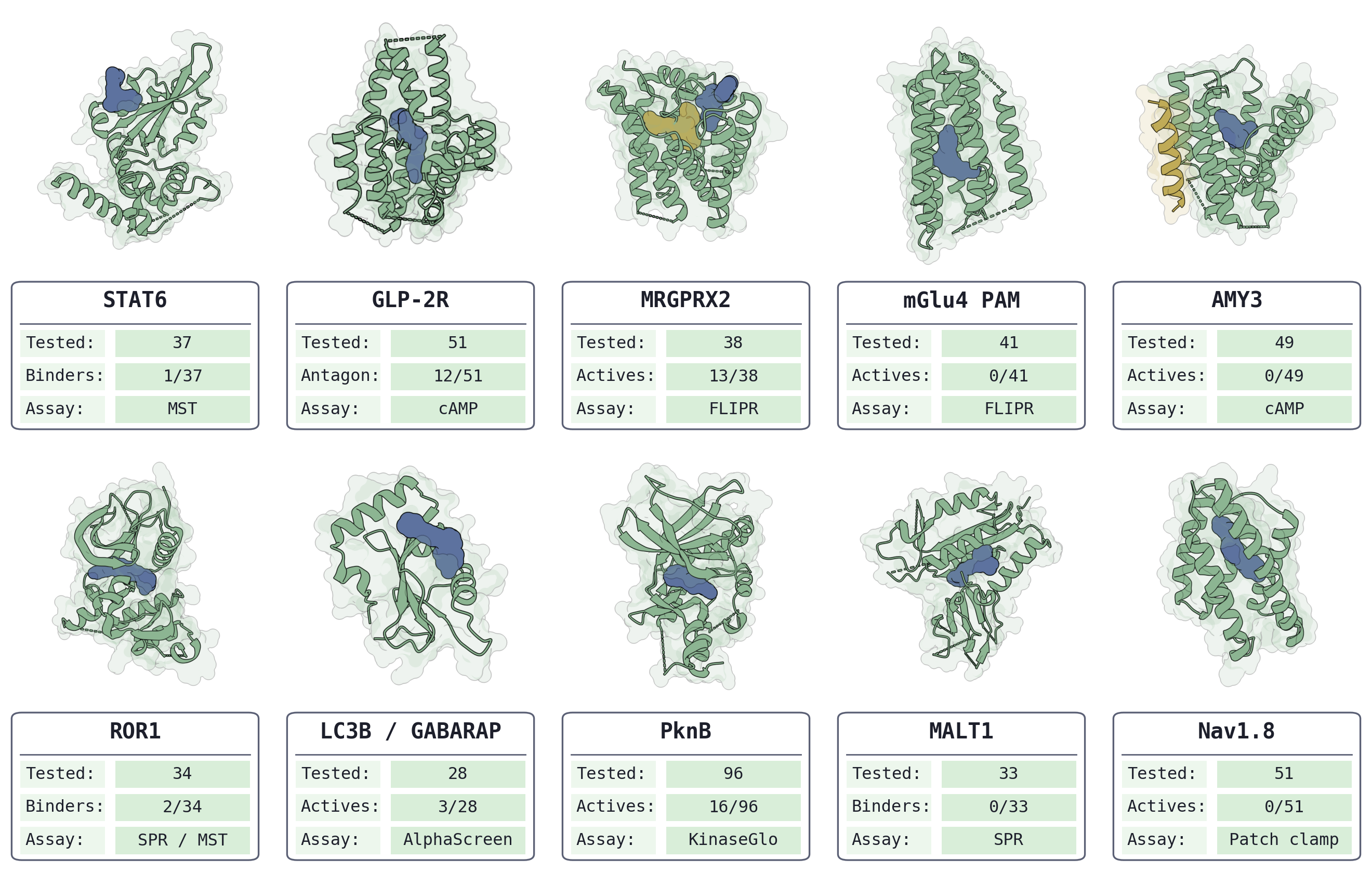
Company-reported BoltzMol-1 results across ten targets, using different binding and functional assays. The figure lists 96 compounds tested for PknB despite the launch prose's stated range of 28–51. These are early discovery results, not clinical outcomes. Source: Boltz. Source: Boltz model and API launch.
Bessemer argues that BoltzMol-1 can reduce the path to a validated hit from months to weeks and costs from hundreds of thousands of dollars to as little as $10,000. Its investment explanation does not give a common target set or a cost breakdown for that comparison, so it cannot establish a general saving across pharmaceutical discovery programs.
A July BoltzMol-1 preprint, whose authors include Boltz's co-founders, offers a more bounded result. Its abstract reports functional active compounds or binders for six of ten targets, with experimental budgets of 28–96 compounds per target. Most targets had no representation in the underlying affinity training data. Six of ten is the share of targets with a successful result, rather than the proportion of tested compounds that worked.
The June launch announcement reported the same six-of-ten result but a narrower testing range of 28–51 compounds per target. The later preprint abstract gives 28–96 without explaining the difference; the figures should not be treated as an identical experimental budget.
The abstract describes a pipeline centered on an optimized Boltz-2 model that ranks compounds for procurement from commercial catalogs, with additional models filtering for properties such as solubility and permeability. These results concern early hit discovery, rather than whether a candidate is safe or effective in people. The preprint has not been peer reviewed.
Bessemer also says BoltzProt-1 achieves nearly three times BoltzGen's hit rate. Boltz's June announcement specifies that the comparison concerns de novo nanobody hits on challenging targets. It is a company-reported improvement against the team's earlier open-source protein-design model, rather than a threefold gain across drug discovery.
Boltz's stated long-term ambition is to move from a therapeutic hypothesis to a molecule ready for humans entirely on a computer. The company acknowledges that this requires further model advances and substantial compute and data investment.
The nearer test is whether customers can reproduce experimental gains across more targets and justify repeat spending. Broader validation, transparent campaign costs and evidence connecting paid usage to useful laboratory results would help resolve that question. The financing and reported adoption give Boltz resources and access to pharmaceutical workflows; they do not yet establish the economics or reliability of computer-led molecular discovery at that scale.
At Ignite, Nvidia and Microsoft are expanding local coding AI, cloud desktop streaming and Azure infrastructure. The announcements build on an existing Windows AI strategy, with AMD alternatives, staggered availability and no comparable deployment-cost results in the announcements.
Microsoft and Nvidia are expanding Azure’s Vera Rubin virtual-machine preview, with systems already running in its data centers. Microsoft’s separate confidential-AI showcase covers four GPUs, while the announcements leave pricing, regions and general availability unspecified.
Meta is reconsidering its 2030 climate deadline after net emissions reached 11.8 million tonnes in 2025. Hardware and infrastructure purchases dominate its reported footprint, while new gas generation adds a longer-term challenge.
Three House committee chairs want the Remote Access Security Act in the annual defense bill as scrutiny of Nvidia intensifies. The available Senate text would authorize controls on specified foreign users’ remote access, with computing limits left to Commerce.
Google Quantum AI reports tests of quantum contextuality spanning up to 105 qubits on Willow processors. The experiments expose hardware errors and beat restricted classical strategies, while the largest task relies on an unproven classical benchmark.
A bipartisan House disclosure shows requests to sell 3.4 million AI chips to China and approvals for more than 879,000. The oversight question is whether Commerce verified the buyers, supply protections and access restrictions behind those authorizations.
OpenAI says its internal Performance Factory tracked more than 1,700 investigations in just over three months. About 400 cases reached proposed fixes, but far fewer shipped repairs used Codex’s code unchanged, and engineers retain approval.
Activists protested Anthropic’s stock-market debut outside Nasdaq, with at least one arrest and conflicting accounts of the total. Their campaign targets retirement-fund exposure to AI shares, alongside concerns about jobs, data centers and public accountability.
Anthropic says cash, growing revenue and multiyear payment schedules support its vast compute commitments. Its filing shows why flexibility matters: short-term capacity costs more, while major cloud contracts require payment regardless of usage.
OpenAI is rolling out live transcription for dictated ChatGPT prompts across free and paid plans. Users can see words as they speak and review the text before sending, but the company has not supplied performance measurements or a replacement recording maximum.
Donald Trump said he and Xi Jinping supported minimal AI guardrails but had not discussed definitions. Their Shenzhen meeting leaves unresolved how bilateral safety cooperation would coexist with U.S. opposition to global regulation.
Gemini can now click and type across Mac apps and websites in a background window, Google says. The paid rollout expands its desktop automation, but app permissions expose active accounts and file changes that backups cannot always undo.
The House AI Safety and Innovation Caucus promises legislative advocacy and rapid incident briefings. Its members already have bipartisan safety proposals in play, making the choice of safeguards its next test.
Binance Wallet says it will return all subscription commitments, distribute roughly 2,957 Anthropic tokenized shares free and add a $1 million token giveaway after demand far exceeded its allocation.
Early Anthropic investor Dustin Moskovitz is urging frontier AI developers to slow down. He and Cari Tuna moved their stake to a nonprofit in early 2025, directing potential returns toward philanthropy while leaving questions about the holding's value and governance rights.
A national study finds higher odds of hosting data centers in majority-Black, Hispanic and Asian neighborhoods. Facility types, zoning rules and unequal access to public hearings complicate who bears the costs and receives the benefits.
A debut-day estimate values the Anthropic shares FTX sold in 2024 at $49.7 billion. The comparison exposes the scale of subsequent paper gains, but contrasts cash raised for bankruptcy repayments with a hypothetical stock-market valuation.
Anthropic raised $81.3 billion in a record IPO and opened 34% above its offer price before retreating. Rapid revenue growth and adjusted operating profits sit alongside vast computing commitments and limited investor control.
The Kimi developer reportedly abandoned planned Nvidia B300 capacity for 2027 after new US restrictions. The deal exposes financing risks for overseas AI clouds, but neither a model delay nor a $150 million cash loss is established.