Editorial Team
3 min read
OpenAI is rolling out live transcription for dictated ChatGPT prompts across free and paid plans. Users can see words as they speak and review the text before sending, but the company has not supplied performance measurements or a replacement recording maximum.
OpenAI, the developer of the ChatGPT AI chatbot, began rolling out Live Dictation on November 18, 2026. The upgrade changes how users compose spoken prompts: they can see the transcript develop instead of waiting until recording ends, while the old 10-minute cutoff has been removed, according to OpenAI’s release notes reproduced in the announcement coverage.
The practical change is earlier visibility into what ChatGPT has heard. For a long instruction or a spoken draft, a user can notice a misheard word before finishing the recording, then review and edit the resulting prompt before sending it. That improves the opportunity to catch errors; it does not establish that the transcription itself makes fewer of them.
OpenAI says the updated speech-to-text feature is faster and more reliable. Its release notes say users can tap or click the audio waveform to show or hide the text during dictation, and that the rollout is global across all ChatGPT plans and supported app platforms. The rollout coverage also records the removal of the limit and the company's performance claims.
Free accounts are included, so the announced dictation upgrade is not reserved for subscribers. Users access it through the microphone icon as the rollout reaches their accounts, according to the report on availability.
The distinction between dictation and ChatGPT's other audio features matters. Live Dictation turns speech into an editable text prompt; the user decides whether to send it. Voice mode supports a spoken conversation with ChatGPT. A separate record mode transcribes meetings and voice notes and remains in beta for Plus, Enterprise, Edu, Business and Pro workspaces, as the feature comparison explains. Removing the dictation cap does not establish a change to those other modes' limits or availability.
Speech input already has substitutes. Built-in operating-system dictation offers voice entry, as the . The also identifies SwiftKey’s AI voice typing on Android, Google’s Eloquent app for offline transcription on iPhone, and dictation in Meta AI’s Mac app. The distinction is therefore how speech input works inside ChatGPT, rather than voice typing itself.
Epic says it is using AI to rewrite parts of Unreal Engine and plans to let developers connect their preferred models to UE6. The strategy combines claimed maintenance gains with a broader overhaul of programming, distribution and portable game assets, while rival Unity already offers outside-model connections.
That integration can reduce the interruption between speaking an idea, checking its transcription and submitting it to the chatbot. But the announcement provides no like-for-like evidence that ChatGPT is more accurate or faster than those alternatives.
For users dictating sensitive material, audio sharing is a separate decision. OpenAI says users can disable the option to include audio recordings or turn off model-improvement sharing in ChatGPT’s data controls, according to the availability report.
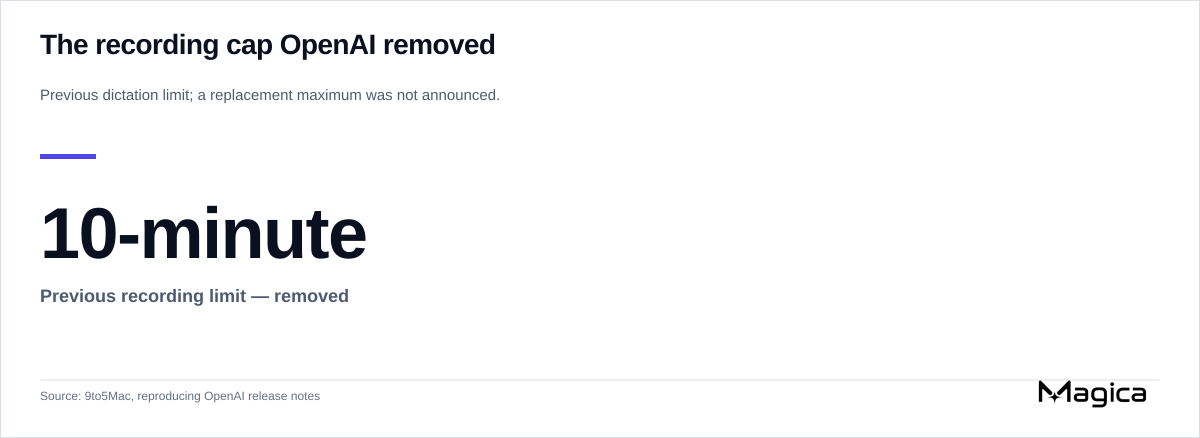
OpenAI removed the former 10-minute dictation cap, a company-reported change. No replacement maximum was announced. Source: 9to5Mac.
Removing the old cutoff leaves a practical question for longer sessions: what limits still apply? The announcement coverage says OpenAI supplied neither a new maximum recording duration nor latency benchmarks or accuracy measurements. The removal of the 10-minute cap therefore should not be read as a verified promise of unlimited recording.
As the rollout reaches accounts, the consequential tests are how reliably the transcript handles extended speech, how quickly words appear and what practical duration limits remain.
At Ignite, Nvidia and Microsoft are expanding local coding AI, cloud desktop streaming and Azure infrastructure. The announcements build on an existing Windows AI strategy, with AMD alternatives, staggered availability and no comparable deployment-cost results in the announcements.
Microsoft and Nvidia are expanding Azure’s Vera Rubin virtual-machine preview, with systems already running in its data centers. Microsoft’s separate confidential-AI showcase covers four GPUs, while the announcements leave pricing, regions and general availability unspecified.
Meta is reconsidering its 2030 climate deadline after net emissions reached 11.8 million tonnes in 2025. Hardware and infrastructure purchases dominate its reported footprint, while new gas generation adds a longer-term challenge.
Three House committee chairs want the Remote Access Security Act in the annual defense bill as scrutiny of Nvidia intensifies. The available Senate text would authorize controls on specified foreign users’ remote access, with computing limits left to Commerce.
Google Quantum AI reports tests of quantum contextuality spanning up to 105 qubits on Willow processors. The experiments expose hardware errors and beat restricted classical strategies, while the largest task relies on an unproven classical benchmark.
A bipartisan House disclosure shows requests to sell 3.4 million AI chips to China and approvals for more than 879,000. The oversight question is whether Commerce verified the buyers, supply protections and access restrictions behind those authorizations.
OpenAI says its internal Performance Factory tracked more than 1,700 investigations in just over three months. About 400 cases reached proposed fixes, but far fewer shipped repairs used Codex’s code unchanged, and engineers retain approval.
Activists protested Anthropic’s stock-market debut outside Nasdaq, with at least one arrest and conflicting accounts of the total. Their campaign targets retirement-fund exposure to AI shares, alongside concerns about jobs, data centers and public accountability.
Anthropic says cash, growing revenue and multiyear payment schedules support its vast compute commitments. Its filing shows why flexibility matters: short-term capacity costs more, while major cloud contracts require payment regardless of usage.
Boltz has raised a Bessemer-led $110 million Series A to expand molecular-design tools sold by usage. Its open-source research brought broad adoption; the commercial test is whether paid computation delivers repeatable gains in laboratory discovery.
Donald Trump said he and Xi Jinping supported minimal AI guardrails but had not discussed definitions. Their Shenzhen meeting leaves unresolved how bilateral safety cooperation would coexist with U.S. opposition to global regulation.
Gemini can now click and type across Mac apps and websites in a background window, Google says. The paid rollout expands its desktop automation, but app permissions expose active accounts and file changes that backups cannot always undo.
The House AI Safety and Innovation Caucus promises legislative advocacy and rapid incident briefings. Its members already have bipartisan safety proposals in play, making the choice of safeguards its next test.
Binance Wallet says it will return all subscription commitments, distribute roughly 2,957 Anthropic tokenized shares free and add a $1 million token giveaway after demand far exceeded its allocation.
Early Anthropic investor Dustin Moskovitz is urging frontier AI developers to slow down. He and Cari Tuna moved their stake to a nonprofit in early 2025, directing potential returns toward philanthropy while leaving questions about the holding's value and governance rights.
A national study finds higher odds of hosting data centers in majority-Black, Hispanic and Asian neighborhoods. Facility types, zoning rules and unequal access to public hearings complicate who bears the costs and receives the benefits.
A debut-day estimate values the Anthropic shares FTX sold in 2024 at $49.7 billion. The comparison exposes the scale of subsequent paper gains, but contrasts cash raised for bankruptcy repayments with a hypothetical stock-market valuation.
Anthropic raised $81.3 billion in a record IPO and opened 34% above its offer price before retreating. Rapid revenue growth and adjusted operating profits sit alongside vast computing commitments and limited investor control.
The Kimi developer reportedly abandoned planned Nvidia B300 capacity for 2027 after new US restrictions. The deal exposes financing risks for overseas AI clouds, but neither a model delay nor a $150 million cash loss is established.