Editorial Team
8 min read
Meta is reconsidering its 2030 climate deadline after net emissions reached 11.8 million tonnes in 2025. Hardware and infrastructure purchases dominate its reported footprint, while new gas generation adds a longer-term challenge.
Meta's climate review spans two problems with different timelines: the emissions generated by building new infrastructure today, and the power supply that will serve its expanding fleet into the next decade.
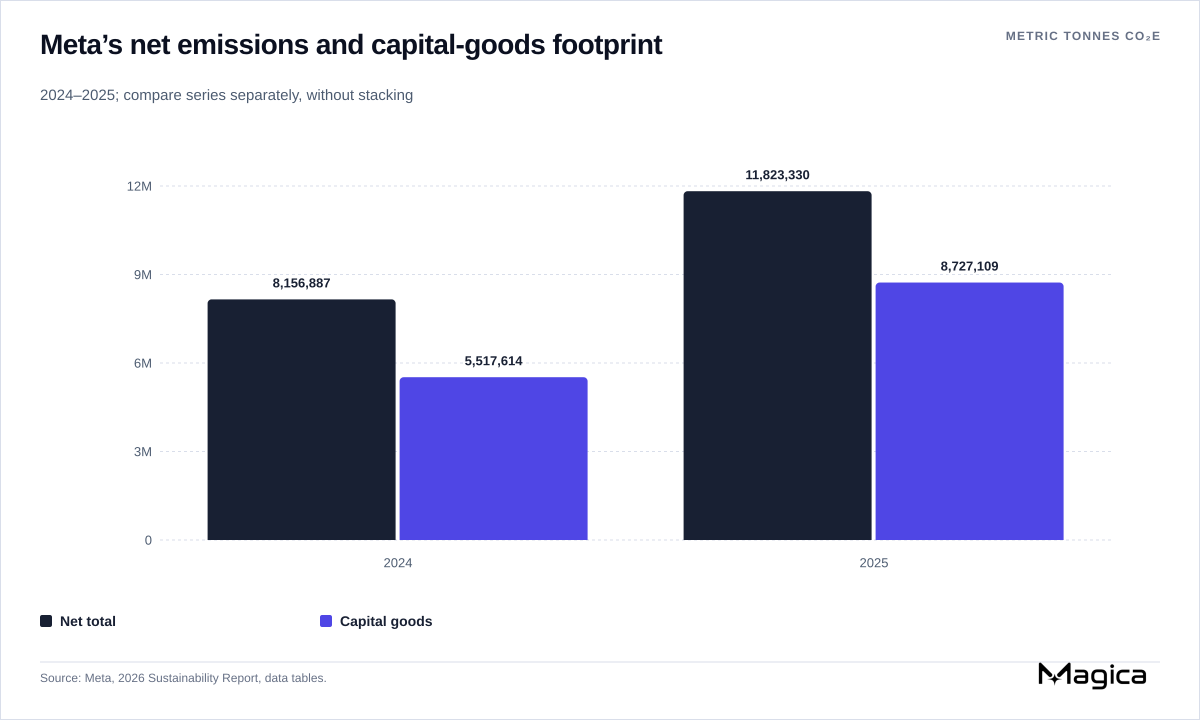
Company-reported emissions with contractual adjustments; net total also reflects carbon removal. Capital goods are included in the inventory, not additional emissions. Accounting methods changed in 2025; AI’s contribution is not isolated. Source: 2026 Meta Sustainability Report.
Meta, the social technology company formerly known as Facebook, is re-evaluating its goal of reaching net zero greenhouse gas emissions across its value chain in 2030. Its 2026 sustainability report, covering fiscal 2025, puts net emissions at 11.8 million metric tonnes of carbon dioxide equivalent, up 45% from 2024.
The company established the goal in 2020, before the rapid expansion of generative AI, according to a report on the review. Meta now says it is reassessing timelines, sequencing and interim milestones, including both the 2030 deadline and near-term intensity targets. It says its long-term net zero ambition remains intact: reducing emissions and using carbon removal for residual emissions it cannot eliminate.
The company has not specified a revised deadline or when it will decide, according to reporting on the review. It has announced a reassessment, rather than a replacement commitment.
Meta's incentive to keep building extends beyond new AI products. The company says AI also supports content ranking and advertisers' tools, while advertising placements generate most of its revenue. At the end of 2025, it had 30 owned data center locations operating or under construction globally. Its infrastructure serves both existing businesses and future AI growth; the report does not isolate AI's share of the emissions increase.
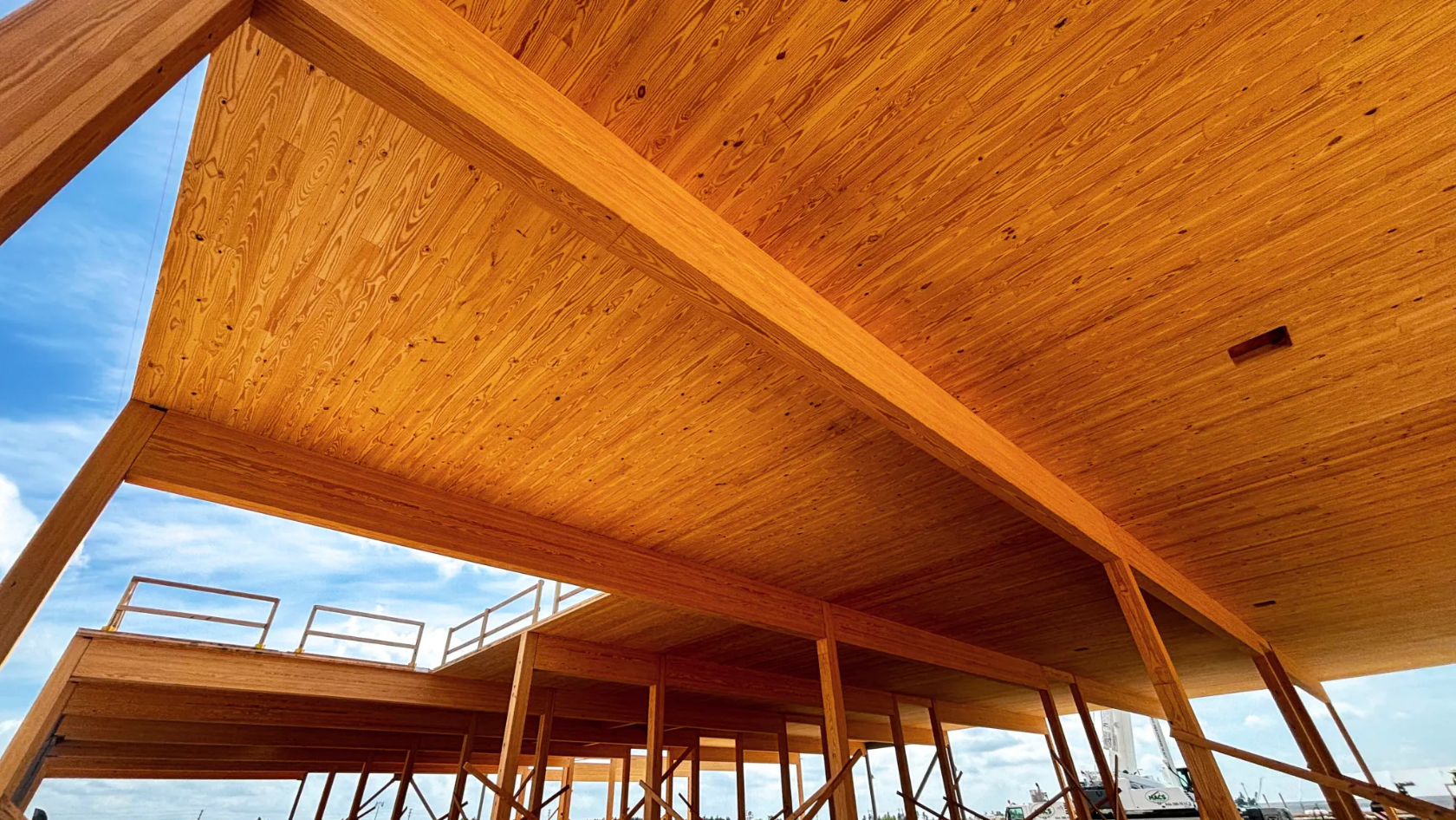
Mass timber construction pictured in Meta’s July 2025 account of its data center building pilots. Credit: Meta. Source: 2026 Meta Sustainability Report.
Meta's report attributes the increase primarily to purchased goods and services and capital goods. These fall within Scope 3, the emissions generated upstream and downstream of its own operations, including manufacturing server hardware.
The capital-goods category alone rose from 5.52 million to 8.73 million tonnes of CO₂ equivalent between 2024 and 2025. The increase of about 3.21 million tonnes accounts for roughly 88% of the 3.67 million-tonne rise in net total emissions, calculated from the report's tables. This is an accounting contribution, rather than a measurement of AI-specific emissions.
That concentration matters for the remedy. Buying cleaner electricity for a running data center addresses a different part of the footprint from manufacturing its servers and constructing infrastructure. Meta says it is engaging suppliers, extending hardware life and deploying lower-carbon materials. Suppliers representing 62% of its supplier emissions had set science-aligned reduction targets by the end of 2025, up from 48% in 2024, against a goal of at least two-thirds by the end of 2026.
Meta also reports improvements in design efficiency, with limits to the comparison. It says its latest data center designs have approximately 77% less embodied carbon than its original specifications. The report qualifies its design comparisons as estimates that exclude IT hardware and operational emissions; they are not realized reductions across the entire fleet.
The company also estimates its combined efficiency and procurement efforts avoided more than 30 million tonnes of emissions in 2025. Its methodology describes these as modeled counterfactuals and contractual-accounting differences. The hardware comparison uses a fixed 2021 efficiency baseline; the software calculation assumes freed computing capacity would otherwise have been built. Meta says these estimates have not been independently verified. They do not measure a fall from the previous year's actual footprint.
Meta's electricity consumption rose 35% in 2025, from about 18.4 million to 24.8 million megawatt-hours. It says it has matched all its annual electricity use with clean and renewable energy since 2020, using power purchase agreements, utility arrangements and energy attribute certificates.
Annual matching does not establish that every facility runs on carbon-free power every hour. Meta's methodology allows each megawatt-hour consumed to be either supplied as clean and renewable electricity or matched with a retired certificate. Its 2025 purchased-energy emissions were about 7.84 million tonnes on a location-based basis, compared with 10,861 tonnes for Scope 2 after market-based accounting.
The headline net total also reflects contractual instruments and 80,000 tonnes of carbon-removal credits. Meta reports a separate location-based total footprint of 21.75 million tonnes in 2025, up from 15.63 million in 2024. These are different accounting views and should not be treated as interchangeable measures.
Its combined Scope 1 and Scope 2 emissions after contractual adjustments fell from 55,118 to 44,416 tonnes, about 19%, before carbon removal. That improvement also needs a methodology qualification: in 2025, Meta expanded its own accounting criteria to apply renewable thermal credits to selected natural gas consumption. Its tables separately disclose Greenhouse Gas Protocol-aligned figures for affected categories. The emissions inventory itself receives annual independent limited assurance; that is distinct from the unverified avoided-emissions estimates.
Procurement is substantial, but much of it remains prospective. Meta says it has contracted more than 30 gigawatts of clean and renewable capacity, with nearly 12 gigawatts producing electricity. Its nuclear agreements could help enable up to 7.7 gigawatts by 2035. That portfolio includes continued operation and capacity increases at existing plants as well as proposed next-generation reactors, rather than 7.7 gigawatts entirely of new construction. Long-term contracts give developers revenue certainty; they do not remove construction and connection lead times.
Meta cites years-long interconnection queues, permitting delays, insufficient transmission and immature supply chains for low-carbon materials and equipment. It says these systems have not kept pace with infrastructure demand.
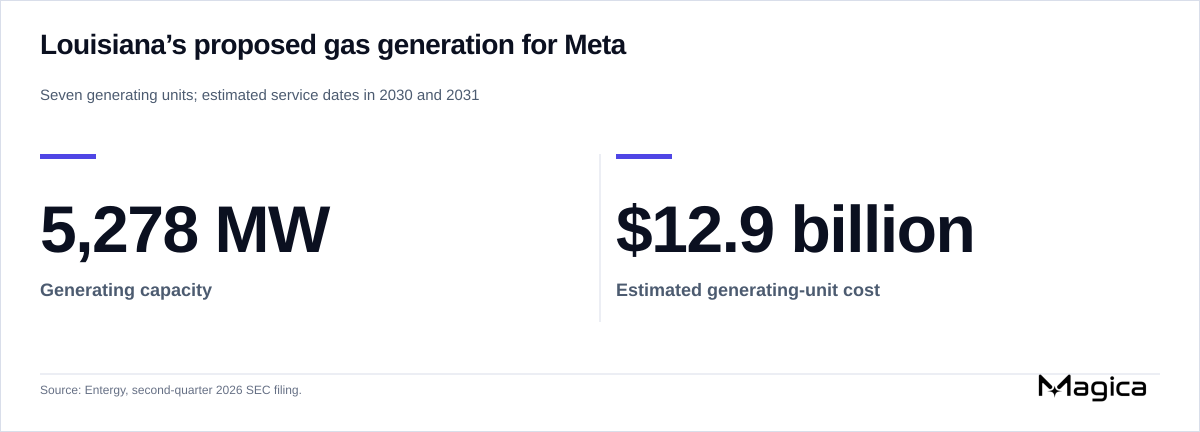
Company-reported Entergy Louisiana proposal to serve a Meta subsidiary, pending when filed. Estimated generating-unit cost excludes the separately proposed transmission line. Source: Entergy SEC filing.
Where utilities cannot supply electricity on its required schedule, Meta says it may deploy on-site generation, including natural gas. It is seeking certificates associated with lower-methane gas production to mitigate upstream emissions. That addresses one part of the gas supply chain, rather than establishing carbon-free generation.
The infrastructure commitment is already taking shape. The report on the review cites Ohio regulators' approval of a 200-megawatt gas plant for Meta's data centers and research firm Cleanview's identification of a 521-megawatt project under construction for Meta in Utah. These projects' future operation is distinct from the 2025 inventory, when Meta says more than 99% of its electricity came from the grid.
The Louisiana proposal illustrates the money and timing involved. In its second-quarter 2026 filing, Entergy said its Louisiana utility had signed a March electricity-service agreement with Evest LLC, a Meta subsidiary developing a second new data center in northern Louisiana. Entergy Louisiana applied to the Louisiana Public Service Commission, the state utility regulator, to build seven combined-cycle generating units totaling 5,278 megawatts at an estimated cost of $12.9 billion. Estimated service dates fell in 2030 and 2031.
The application also sought a new transmission line estimated at $1.4 billion and other related transmission facilities. The gas units would be enabled for future carbon capture and storage; the filing does not describe them as operating with carbon capture from the outset. A related sustainability agreement contemplates customer contributions toward 2,500 megawatts of future renewable and storage resources, nuclear-related efforts and assistance for low-income residents.
Meta says it pays the full costs of electricity and grid infrastructure needed for its data centers so other customers do not bear them. Entergy's filing provides the proposed mechanism: customer construction contributions, advance payments and minimum monthly bills, plus obligations covering unrecovered incremental costs if Evest terminates early, restructures the project or defaults. Collateral includes a Meta parent-company guarantee. These are contractual protections, rather than evidence of costs already recovered; the application was pending when the filing was made.
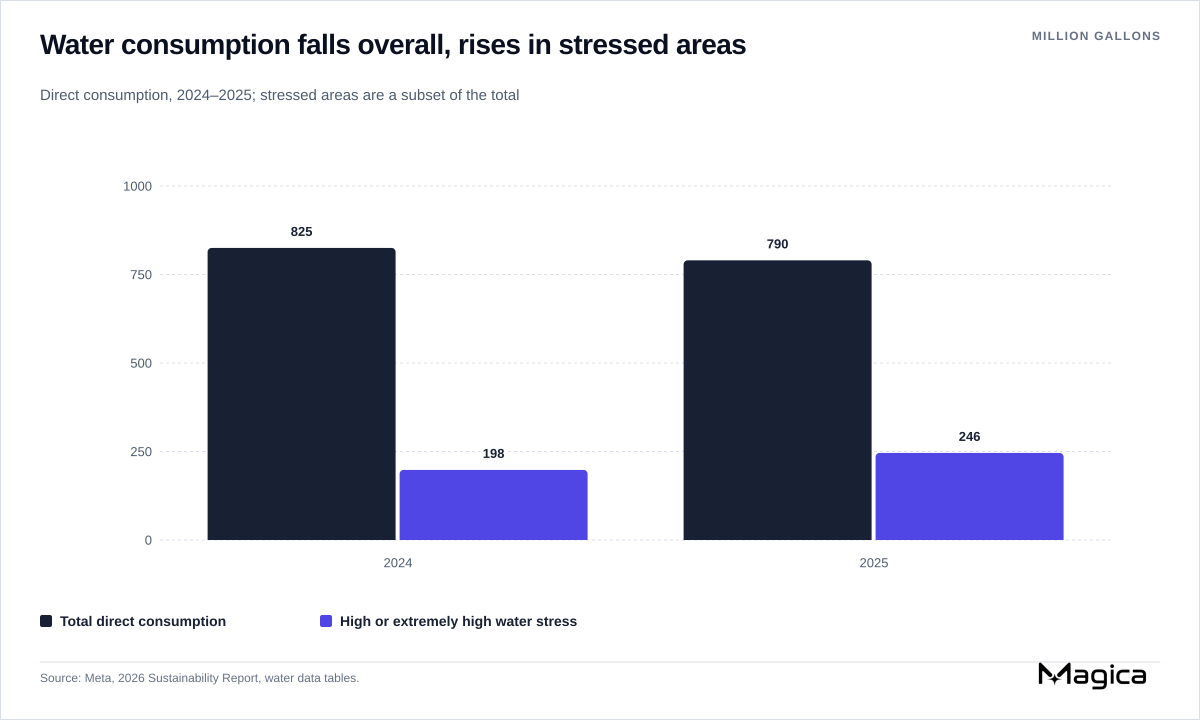
Company-reported direct water consumption. Areas with high or extremely high baseline water stress are included in the total. Water used to generate purchased electricity is reported separately. Source: 2026 Meta Sustainability Report.
Meta's water disclosures show why aggregate improvements also need local scrutiny. In 2025, its direct water consumption fell from 825 million to 790 million gallons, about 4%. But consumption in areas with high or extremely high baseline water stress rose from 198 million to 246 million gallons, about 24%. Its estimated water consumption embedded in purchased electricity rose 37% to 26.1 billion gallons before accounting for contracted clean energy. For its contracted clean and renewable electricity, Meta separately estimates 3.5 billion gallons of embedded consumption, up from 1.34 billion in 2024.
Those electricity-related estimates describe water used in generating power, separately from water consumed at Meta's facilities. Its operational water-withdrawal figures also exclude another 566 million gallons withdrawn for data center construction in 2025. Withdrawal and consumption are different measures: consumption is the portion not returned to the original water source.
Meta's next climate decision is whether to change its deadline, interim targets, or both. The report still lists supporting goals to cut Scope 1 and 2 emissions 42% from a 2021 baseline by the end of 2031 and keep Scope 3 emissions from exceeding their 2021 baseline by that date. Any revised pathway needs to show how those commitments fit an expanding infrastructure fleet and distinguish absolute reductions from intensity measures, contractual adjustments and carbon removal.
The Louisiana proposal creates a separate regulatory test. Entergy's July filing envisaged commission consideration in December 2026. Approval, the final cost protections and the delivery of the accompanying cleaner resources will matter alongside the gas plants' construction. A revised climate timetable will be measurable only if Meta supplies dated milestones against which that build-out and its supply-chain emissions can be assessed.
Epic says it is using AI to rewrite parts of Unreal Engine and plans to let developers connect their preferred models to UE6. The strategy combines claimed maintenance gains with a broader overhaul of programming, distribution and portable game assets, while rival Unity already offers outside-model connections.
At Ignite, Nvidia and Microsoft are expanding local coding AI, cloud desktop streaming and Azure infrastructure. The announcements build on an existing Windows AI strategy, with AMD alternatives, staggered availability and no comparable deployment-cost results in the announcements.
Microsoft and Nvidia are expanding Azure’s Vera Rubin virtual-machine preview, with systems already running in its data centers. Microsoft’s separate confidential-AI showcase covers four GPUs, while the announcements leave pricing, regions and general availability unspecified.
Three House committee chairs want the Remote Access Security Act in the annual defense bill as scrutiny of Nvidia intensifies. The available Senate text would authorize controls on specified foreign users’ remote access, with computing limits left to Commerce.
Google Quantum AI reports tests of quantum contextuality spanning up to 105 qubits on Willow processors. The experiments expose hardware errors and beat restricted classical strategies, while the largest task relies on an unproven classical benchmark.
A bipartisan House disclosure shows requests to sell 3.4 million AI chips to China and approvals for more than 879,000. The oversight question is whether Commerce verified the buyers, supply protections and access restrictions behind those authorizations.
OpenAI says its internal Performance Factory tracked more than 1,700 investigations in just over three months. About 400 cases reached proposed fixes, but far fewer shipped repairs used Codex’s code unchanged, and engineers retain approval.
Activists protested Anthropic’s stock-market debut outside Nasdaq, with at least one arrest and conflicting accounts of the total. Their campaign targets retirement-fund exposure to AI shares, alongside concerns about jobs, data centers and public accountability.
Anthropic says cash, growing revenue and multiyear payment schedules support its vast compute commitments. Its filing shows why flexibility matters: short-term capacity costs more, while major cloud contracts require payment regardless of usage.
OpenAI is rolling out live transcription for dictated ChatGPT prompts across free and paid plans. Users can see words as they speak and review the text before sending, but the company has not supplied performance measurements or a replacement recording maximum.
Boltz has raised a Bessemer-led $110 million Series A to expand molecular-design tools sold by usage. Its open-source research brought broad adoption; the commercial test is whether paid computation delivers repeatable gains in laboratory discovery.
Donald Trump said he and Xi Jinping supported minimal AI guardrails but had not discussed definitions. Their Shenzhen meeting leaves unresolved how bilateral safety cooperation would coexist with U.S. opposition to global regulation.
Gemini can now click and type across Mac apps and websites in a background window, Google says. The paid rollout expands its desktop automation, but app permissions expose active accounts and file changes that backups cannot always undo.
The House AI Safety and Innovation Caucus promises legislative advocacy and rapid incident briefings. Its members already have bipartisan safety proposals in play, making the choice of safeguards its next test.
Binance Wallet says it will return all subscription commitments, distribute roughly 2,957 Anthropic tokenized shares free and add a $1 million token giveaway after demand far exceeded its allocation.
Early Anthropic investor Dustin Moskovitz is urging frontier AI developers to slow down. He and Cari Tuna moved their stake to a nonprofit in early 2025, directing potential returns toward philanthropy while leaving questions about the holding's value and governance rights.
A national study finds higher odds of hosting data centers in majority-Black, Hispanic and Asian neighborhoods. Facility types, zoning rules and unequal access to public hearings complicate who bears the costs and receives the benefits.
A debut-day estimate values the Anthropic shares FTX sold in 2024 at $49.7 billion. The comparison exposes the scale of subsequent paper gains, but contrasts cash raised for bankruptcy repayments with a hypothetical stock-market valuation.
Anthropic raised $81.3 billion in a record IPO and opened 34% above its offer price before retreating. Rapid revenue growth and adjusted operating profits sit alongside vast computing commitments and limited investor control.
The Kimi developer reportedly abandoned planned Nvidia B300 capacity for 2027 after new US restrictions. The deal exposes financing risks for overseas AI clouds, but neither a model delay nor a $150 million cash loss is established.