Editorial Team
7 min read
Three House committee chairs want the Remote Access Security Act in the annual defense bill as scrutiny of Nvidia intensifies. The available Senate text would authorize controls on specified foreign users’ remote access, with computing limits left to Commerce.
Three House committee leaders are pressing to put the Remote Access Security Act, or RASA, into the annual National Defense Authorization Act. Their effort would extend the export-control fight beyond shipping advanced chips to regulating who can use controlled technology remotely. The available Senate text grants conditional authority; it does not itself ban all Chinese access to rented computing.
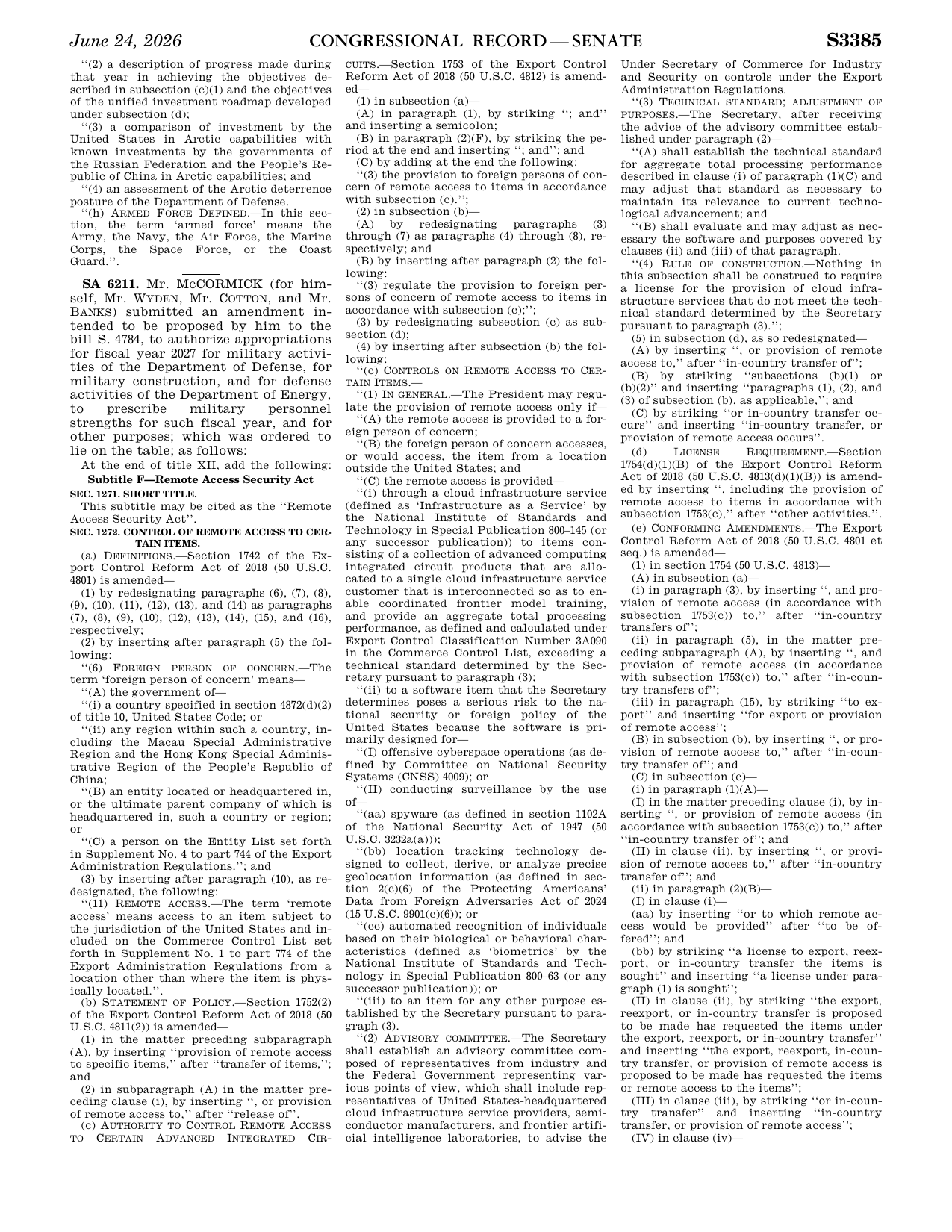
Senate Amendment 6211 contains proposed RASA provisions in the June 24, 2026, Congressional Record. Submission does not establish enactment. Source: US Government Publishing Office. Source: Congressional Record.
House Intelligence Chairman Rick Crawford, Foreign Affairs Chairman Brian Mast and Select Committee on China Chairman John Moolenaar called for RASA and three other export-control bills to be included in the defense legislation in a November 13 joint statement. They also requested congressional appearances by Nvidia’s former chief executive and general counsel, and a senior Commerce Department official.
Nvidia supplies advanced processors widely used to develop leading artificial intelligence models. Washington has sought for years to restrict China’s access because of potential benefits to the Chinese military. Renting computing offers access without importing the chips: Chinese AI companies were seeking Nvidia-powered capacity outside China because they feared tighter remote-access restrictions, according to Reuters reporting carried in a November 13 account.
The immediate pressure follows the reported resignation of Jensen Huang, Nvidia’s founder and now former chief executive, amid scrutiny of his relationship with Alice Huang, a former executive at Singapore-based Nvidia partner and customer Megaspeed. US authorities suspect her of spying for China, an allegation Beijing denies. The US government also suspects Megaspeed of helping China obtain restricted advanced AI chips, according to the same account. Those suspicions do not establish either espionage or a national security breach through the relationship.
Epic says it is using AI to rewrite parts of Unreal Engine and plans to let developers connect their preferred models to UE6. The strategy combines claimed maintenance gains with a broader overhaul of programming, distribution and portable game assets, while rival Unity already offers outside-model connections.
A separate report on the leadership change said Nvidia named its chief financial officer, Colette Kress, interim CEO. Moolenaar, whose committee is seeking answers about possible Chinese influence, has described Huang as a leading opponent of export controls. That characterization and his questions about intelligence influence are lawmakers’ claims, not investigative findings.
The proposal predates the November controversy. RASA appears in Senate Amendment 6211 to the fiscal 2027 defense authorization bill, S. 4784, in the June 24 Congressional Record. The entry records an amendment submitted and ordered to lie on the table. It does not establish enactment or show that negotiators have accepted that language for the final bill.
The amendment would expand the Export Control Reform Act of 2018 to address remote access to items under US jurisdiction and on the Commerce Control List. It defines remote access by the user being somewhere other than the item’s physical location. The relevant boundary is therefore not simply whether a data center is outside China.
The president could regulate access under the provision only when it is supplied to a defined “foreign person of concern” accessing, or expected to access, the item from outside the United States. Covered users include designated countries’ governments, entities located or headquartered there, entities whose ultimate parent is headquartered there, and persons on the Entity List. The geographic definition expressly includes Hong Kong and Macau.
For computing, the text specifies advanced chips allocated to one cloud-infrastructure customer and interconnected to enable coordinated frontier-model training. Their aggregate processing performance would have to exceed a technical standard set by the Commerce secretary. This is a more specific configuration than any use of a remotely hosted Nvidia processor.
The secretary would establish the standard after advice from a new committee and could adjust it as technology advances. The amendment supplies no fixed numerical cutoff. It also says this provision should not be construed to require a license for cloud services that do not meet that standard.
Industry would help advise implementation. The required committee would include US-headquartered cloud providers, semiconductor manufacturers and frontier AI laboratories alongside government representatives. Businesses potentially affected by the controls would thus have an advisory role, while Commerce would retain authority over the standard.
The proposed authority also reaches certain offensive cyber and surveillance software that the secretary determines poses a serious national security or foreign-policy risk. Commerce could evaluate and adjust the covered software and purposes. RASA is consequently broader than an AI-chip measure, even though access to computing is central to the current political push.
The four bills sought by the House chairs address different parts of the supply and access chain:
These efforts were already moving before the Huang controversy. The Foreign Affairs Committee unanimously advanced the Chip Security Act in March, according to a November 12 account of the legislative negotiations and oversight requests. The committee also advanced equipment-control measures and requirements to license or ban exports of certain powerful chips. Versions of those three measures appeared in a proposed Senate manager’s amendment; the House defense bill lacked similar language.
Support for stronger controls extends beyond the three chairs. House Speaker Mike Johnson said a congressional consensus was developing on limiting China’s access to advanced chips. House Democratic Leader Hakeem Jeffries and Senate Democratic Leader Chuck Schumer also urged action. Those bipartisan calls do not establish agreement on RASA’s exact terms.
Commerce’s enforcement record is also under scrutiny. Lawmakers have criticized Commerce Secretary Howard Lutnick over the administration’s refusal to add Chinese companies to a trade blacklist and its oversight of Nvidia’s exports to China, according to the November 13 report. The department that would set RASA’s computing threshold is thus itself facing questions about existing controls.

House lawmakers requested interviews with Huang and Teter and a hearing appearance by Kessler. The dates are requests, not confirmed testimony. Source: Roll Call.
The oversight schedule remains a matter of requests and expectations. The November 13 account described an expectation that Huang would testify before Thanksgiving on November 26. The detailed report on the committee letters instead identified requested House interviews for Huang on December 1 and Nvidia General Counsel Tim Teter on December 2, plus a December 3 hearing appearance sought from Jeffrey Kessler, Commerce’s undersecretary for industry and security. A request is not confirmation that an appearance will occur.
Legislatively, the next test is whether House and Senate negotiators agree to include remote-access controls in a common defense bill, and which text they choose. Both chambers must agree on identical legislation before it can go to the president. The account of the legislative push says Congress hopes to pass the bill before year-end; the current Congress ends January 3, 2027, after which unfinished legislation would have to restart.
If RASA is enacted along the lines of the June amendment, the executive branch would still have to decide how to use the authority, and Commerce would have to set the computing threshold. The text alone does not establish how much rented capacity would be covered, what compliance would cost or how much access would be denied. Those decisions—and evidence from the requested testimony—would be needed to judge whether the proposed controls address the risks lawmakers allege.
At Ignite, Nvidia and Microsoft are expanding local coding AI, cloud desktop streaming and Azure infrastructure. The announcements build on an existing Windows AI strategy, with AMD alternatives, staggered availability and no comparable deployment-cost results in the announcements.
Microsoft and Nvidia are expanding Azure’s Vera Rubin virtual-machine preview, with systems already running in its data centers. Microsoft’s separate confidential-AI showcase covers four GPUs, while the announcements leave pricing, regions and general availability unspecified.
Meta is reconsidering its 2030 climate deadline after net emissions reached 11.8 million tonnes in 2025. Hardware and infrastructure purchases dominate its reported footprint, while new gas generation adds a longer-term challenge.
Google Quantum AI reports tests of quantum contextuality spanning up to 105 qubits on Willow processors. The experiments expose hardware errors and beat restricted classical strategies, while the largest task relies on an unproven classical benchmark.
A bipartisan House disclosure shows requests to sell 3.4 million AI chips to China and approvals for more than 879,000. The oversight question is whether Commerce verified the buyers, supply protections and access restrictions behind those authorizations.
OpenAI says its internal Performance Factory tracked more than 1,700 investigations in just over three months. About 400 cases reached proposed fixes, but far fewer shipped repairs used Codex’s code unchanged, and engineers retain approval.
Activists protested Anthropic’s stock-market debut outside Nasdaq, with at least one arrest and conflicting accounts of the total. Their campaign targets retirement-fund exposure to AI shares, alongside concerns about jobs, data centers and public accountability.
Anthropic says cash, growing revenue and multiyear payment schedules support its vast compute commitments. Its filing shows why flexibility matters: short-term capacity costs more, while major cloud contracts require payment regardless of usage.
OpenAI is rolling out live transcription for dictated ChatGPT prompts across free and paid plans. Users can see words as they speak and review the text before sending, but the company has not supplied performance measurements or a replacement recording maximum.
Boltz has raised a Bessemer-led $110 million Series A to expand molecular-design tools sold by usage. Its open-source research brought broad adoption; the commercial test is whether paid computation delivers repeatable gains in laboratory discovery.
Donald Trump said he and Xi Jinping supported minimal AI guardrails but had not discussed definitions. Their Shenzhen meeting leaves unresolved how bilateral safety cooperation would coexist with U.S. opposition to global regulation.
Gemini can now click and type across Mac apps and websites in a background window, Google says. The paid rollout expands its desktop automation, but app permissions expose active accounts and file changes that backups cannot always undo.
The House AI Safety and Innovation Caucus promises legislative advocacy and rapid incident briefings. Its members already have bipartisan safety proposals in play, making the choice of safeguards its next test.
Binance Wallet says it will return all subscription commitments, distribute roughly 2,957 Anthropic tokenized shares free and add a $1 million token giveaway after demand far exceeded its allocation.
Early Anthropic investor Dustin Moskovitz is urging frontier AI developers to slow down. He and Cari Tuna moved their stake to a nonprofit in early 2025, directing potential returns toward philanthropy while leaving questions about the holding's value and governance rights.
A national study finds higher odds of hosting data centers in majority-Black, Hispanic and Asian neighborhoods. Facility types, zoning rules and unequal access to public hearings complicate who bears the costs and receives the benefits.
A debut-day estimate values the Anthropic shares FTX sold in 2024 at $49.7 billion. The comparison exposes the scale of subsequent paper gains, but contrasts cash raised for bankruptcy repayments with a hypothetical stock-market valuation.
Anthropic raised $81.3 billion in a record IPO and opened 34% above its offer price before retreating. Rapid revenue growth and adjusted operating profits sit alongside vast computing commitments and limited investor control.
The Kimi developer reportedly abandoned planned Nvidia B300 capacity for 2027 after new US restrictions. The deal exposes financing risks for overseas AI clouds, but neither a model delay nor a $150 million cash loss is established.