Editorial Team
8 min read
Employee equity at Anthropic’s IPO price is reportedly worth $232 billion, while book rightsholders await a first settlement installment estimated at $2,203.56 per work. Vesting, shared copyrights and founder voting rights complicate the comparison.
Anthropic’s employee equity was worth an estimated $232 billion at its $83 IPO price, a November 19 report says, while authors and publishers await the first distribution from its $1.5 billion copyright settlement.
The company behind Claude, an AI service built on large language models, was founded by former OpenAI employees in January 2021. It began commercial sales in early 2023. That history matters to the rewards now being priced: Anthropic reports $17 billion in revenue for the three months ended September 30, 2026, and about 5,300 employees at that date, compared with roughly 940 at the end of 2024.
The equity offers continuing participation in the company’s value, subject to its business risks. The settlement compensates specified past claims. Employee holdings and awards per book measure different things; their ratio cannot establish relative contributions to Anthropic’s value.
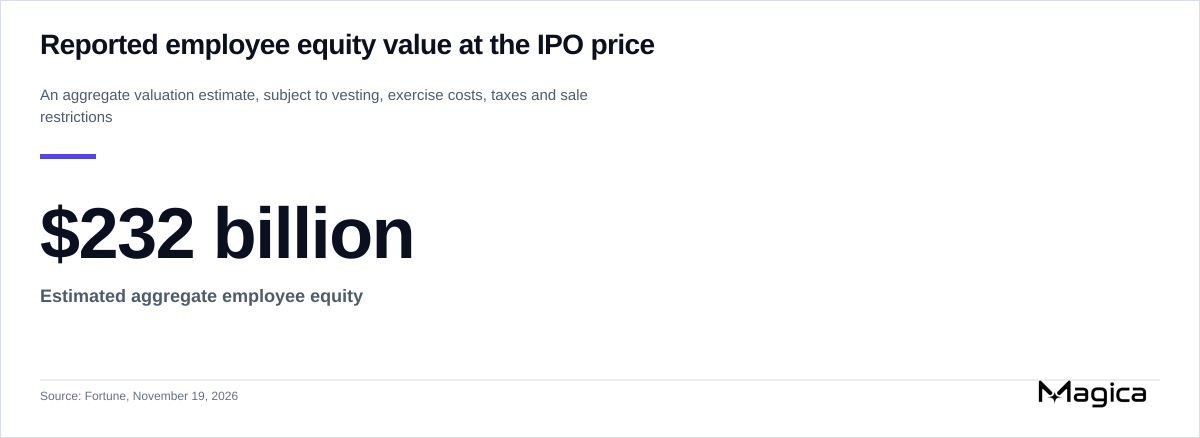
Fortune estimated aggregate employee equity at $232 billion using the $83 IPO price. This is neither cash received nor a typical employee holding. Source: Fortune.
The roughly $44 million figure is an arithmetic average across 5,300 employees, not a median or an account of any particular worker’s wealth. The report also relays CNBC’s estimate that at least 400 early hires would have holdings worth $100 million or more. Neither figure establishes how much employees have already collected.
Anthropic’s final prospectus supplies important qualifications. At September 30, outstanding options covered approximately 1.77 billion shares with a weighted-average exercise price of $2.91. Another approximately 1.03 billion shares under restricted stock units had service conditions that would not be satisfied by November 19. Exercise costs, continued service, taxes and eventual trading prices all affect what holders can realize.
Sale restrictions impose another limit. Non-founder employees and certain other holders can transfer up to 10% of their covered securities from the first trading day. An additional 35% becomes transferable from the second full trading day after publication of full-year 2026 financial results. Permission to sell does not establish that sales occurred.
The offering’s proceeds also belong to different recipients. At the base offering size, the prospectus allocates approximately $78.84 billion to Anthropic and $1.95 billion to selling stockholders, before expenses and after underwriting discounts. It also describes a separate $26 billion private placement from seven technology companies, contingent on completion of the offering and other conditions. Money raised for the company is not an employee payout.
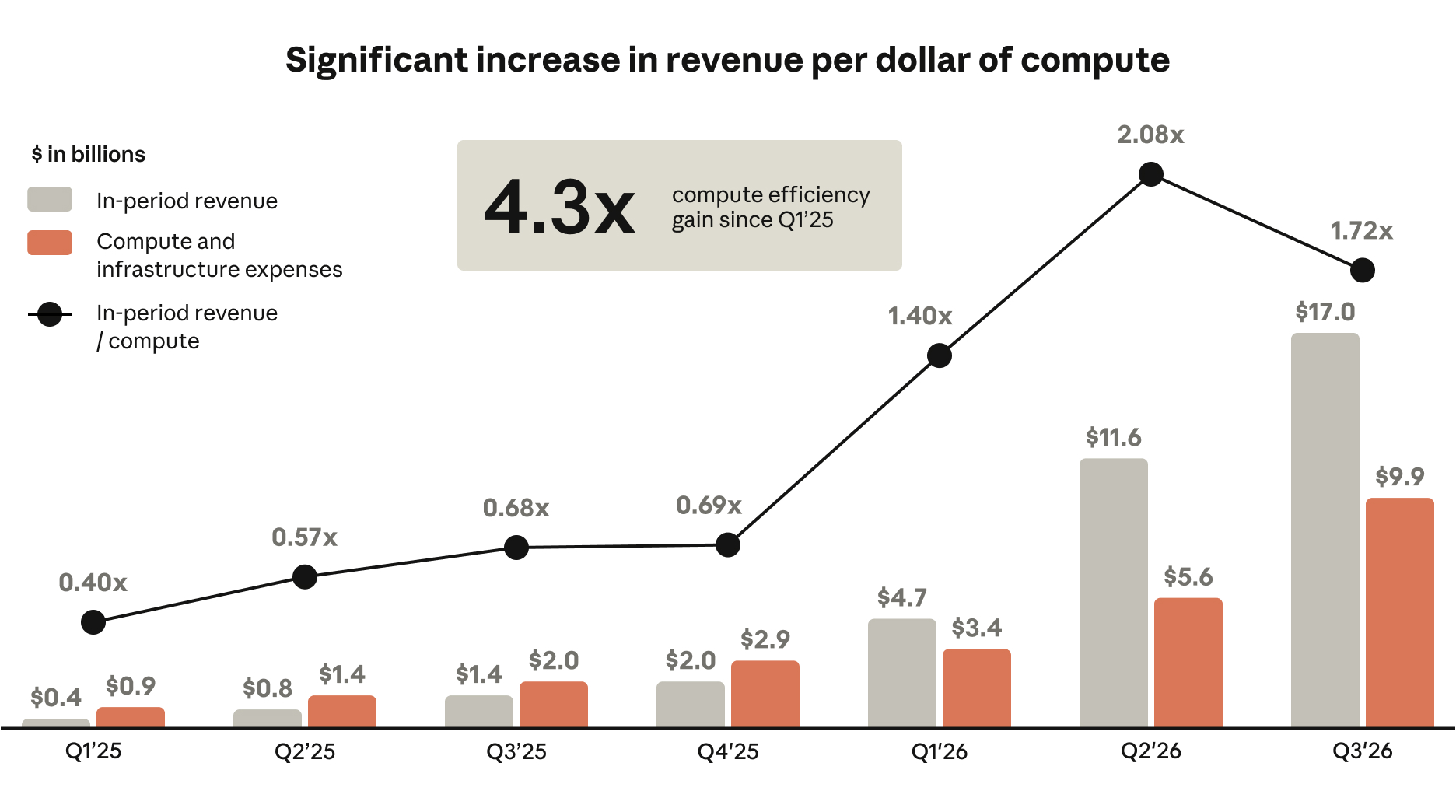
Anthropic’s company-reported quarterly revenue and compute and infrastructure expenses. The ratio measures revenue divided by those expenses, not operating profitability. Source: Anthropic final prospectus. Source: Anthropic, PBC — Final Prospectus (Form 424B4).
The prospectus’s financial statements show the demands behind that equity value. In the nine months ended September 30, 2026, Anthropic reported $33.24 billion in revenue and $18.81 billion in compute and infrastructure expenses—about 57% of revenue over the same period. It recorded a $1.26 billion operating loss. Its much larger $104 billion net loss included $94.3 billion of fair-value changes in financing instruments, primarily driven by higher values of outstanding convertible notes as the company’s enterprise valuation rose.
Its infrastructure obligations extend well beyond one reporting period. The filing puts contractual obligations, including short-term and subsequent commitments and leases not yet commenced, at approximately $900.9 billion, substantially all related to compute and infrastructure. This is a multiyear commitment figure, not current-year spending. Approximately $186.2 billion relates to arrangements with exercisable termination rights or conditions before commencement, such as counterparties securing financing, facilities or approvals. The $900.9 billion excludes arrangements without fixed-dollar commitments, for which Anthropic estimates another $150 billion to $175 billion in payments.
Anthropic also identifies Google and OpenAI as primary competitors for customers, talent, compute and partnerships. Its risk disclosures warn that customers may choose smaller, cheaper or open-source alternatives when additional frontier-model performance does not justify the cost.
Bartz v. Anthropic began with authors’ copyright claims in August 2024. The named plaintiffs—book authors Andrea Bartz, Charles Graeber and Kirk Wallace Johnson—challenged copying of their works. The settlement class concerns legal or beneficial copyright owners of eligible books, including authors and publishers, rather than authors generally.
In a June 23, 2025 order, U.S. District Judge William Alsup of the Northern District of California ruled that the training use was fair use. He also found fair use in converting purchased print books into digital copies, but refused to treat the pirated copies assembled for Anthropic’s central library as training copies automatically protected on the same basis. Those library copies and resulting damages were left for trial.
Anthropic agreed to settle in September 2025 while denying wrongdoing. The court granted final approval on July 20, 2026. The settlement consequently cannot be read as a court-imposed price for training AI on books.
The court-authorized notice identifies downloads from Library Genesis and Pirate Library Mirror as the conduct underlying the claims. Eligibility is limited to downloaded books with an ISBN or ASIN identifier and specified timely U.S. copyright registrations. It releases past claims only and excludes claims concerning AI outputs.
The notice also requires destruction of books downloaded from those datasets and their copies, subject to legal preservation obligations. It records Anthropic’s representation that neither dataset, nor portions of them, was in the training corpus of its commercially released large language models.
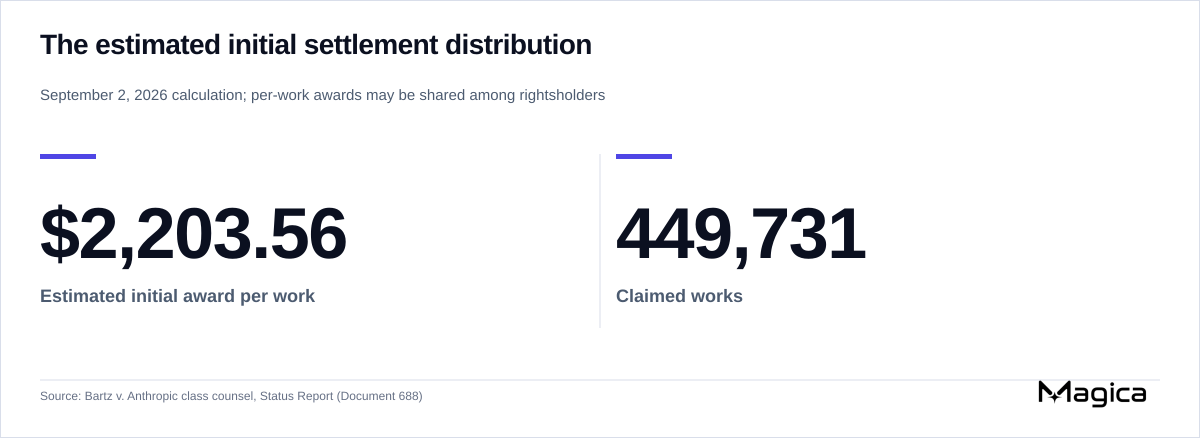
Class counsel’s September 2 calculation estimated an initial distribution of $2,203.56 per work across 449,731 claimed works, subject to further interest and accepted late claims. Awards may be shared among rightsholders. Source: Status Report (Document 688).
The notice’s approximately $3,000 per work was an estimate before costs, fees and expenses. The fund is divided equally among works with valid claims, and the amount depends on the claims submitted. An award for one book can be split among an author, publisher and other rightsholders; a claimant with multiple eligible books may receive shares of multiple awards.
Class counsel’s September 2 status report offers a later, more specific calculation for the initial distribution. It anticipated about $1.083 billion in the account, including interest, and approximately $991 million available after attorneys’ fees, expenses, service awards and reserves. Dividing that estimated distributable balance across 449,731 claimed works produced $2,203.56 per work, subject to additional interest and accepted late claims.
That is an estimated first installment per work, not the final net entitlement of each author. Nor does the settlement give recipients an equity claim on future Claude sales or Anthropic’s appreciation.
Dario Amodei, Anthropic’s cofounder and chief executive, previously served as OpenAI’s vice president of research. He has warned about AI wealth concentration, as described in the November 19 report. He and the other six cofounders have pledged 80% of their personal Anthropic equity to philanthropy.
The prospectus describes those pledges as voluntary, revocable and legally nonbinding, with timing and recipients uncertain. They concern personal economic interests, not the special Class F share through which the founders’ holding company controls 50.1% of voting power on matters submitted to stockholders generally. Donations can reduce founders’ economic stakes while leaving that voting structure intact, subject to minimum retained-ownership conditions.
Anthropic has also contributed shares representing 5% of its fully diluted equity as of June 30, 2026, under the filing’s stated conversion assumptions, to its Public Benefit Fund. That fund is a wholly owned subsidiary dedicated to the company’s public benefit purpose; the issuance is distinct from founders transferring personal shares to outside charities.
Founder voting power operates alongside a separate board-selection mechanism. Anthropic is a Delaware public benefit corporation, whose directors must balance stockholder interests, affected parties’ interests and its stated purpose of responsible advanced-AI development for humanity’s long-term benefit. Its Long-Term Benefit Trust, introduced in 2023 and intended to consist of five financially disinterested trustees, generally can elect and remove a majority of the authorized board. The trust selects directors and provides advice; it does not manage daily operations or set strategy.
The September court report anticipated initial settlement payments by November 15. The administrator’s current notice instead expects the first round during the week of November 23. At the November 21 reporting snapshot, that remains a schedule rather than confirmation of receipt.
The administrator says the first installment will represent about 70% of each work’s total award. The remainder follows Anthropic’s final payment into the fund; the settlement notice sets September 27, 2027, as the deadline for that final $450 million contribution, with interest also required.
Works with unresolved allocation disputes will miss the first distribution and remain eligible for later rounds. Rightsholders who cannot agree can take the dispute to a court-appointed neutral special master. Actual distribution totals and resolved ownership allocations will show what individual claimants receive.
Employee holders face a separate test: the proceeds they can realize after vesting, exercise costs, taxes and sales.
Moore Threads is preparing a December 29 reveal for Lushan, a desktop GPU pitched at gaming and local AI inference. Its claimed memory record remains unquantified, and capacity alone will not establish performance or value.

Amazon is in advanced talks to buy Decart, whose software helps AI models run efficiently across chips. The reported deal could strengthen AWS’s Trainium business, with conditional payments and five-year founder commitments making execution central to its value.
The University of California is expanding ChatGPT and Codex access across 10 campuses, with extra charges for advanced models and an unresolved dispute over faculty authority.
Ray-Ban’s US store cuts the Gen 2 Wayfarer by 25% to $284.25. Buyers still face separate prescription-lens prices, a cheaper Gen 1 option and newer glasses outside Meta’s frame sale.
Ubisoft has made the team behind its Teammates experiment a dedicated subsidiary targeting AI characters with memory and outside game creators. Earlier playtests show both progress and limitations, while commercial plans remain undisclosed amid group cost cuts and refinancing.
Neuralink has shown a trial participant controlling GTA VI through intended movements. Earlier gaming use and company-reported trial results put the demonstration in context, while its reliability across users remains unmeasured in the reports.
SoftBank founder Masayoshi Son reportedly explored financing a $1 trillion acquisition of memory-chip maker SK hynix, but the company says the deal is no longer under active consideration. The target brings surging earnings, existing shareholders and customer commitments that complicate any simple equation between ownership and access to AI-memory supply.
Nvidia reported $115.8 billion in quarterly revenue, but its shares fell 14% Friday amid a wider technology selloff, a leadership transition and a reported accounting investigation. Strong cash generation offers a counterweight to concerns about the durability of AI spending.
The Nasdaq 100 fell 5.6% on November 20 and closed 19.8% below its record after an intraday bear-market breach. Nvidia’s revenue surge and Anthropic’s huge IPO did not halt the rout; infrastructure bills and resilience elsewhere in the market complicate the picture.
OpenAI reports sharply lower reasoning-extraction rates in internal GPT-6.2 tests and backs sanctions against illicit foreign distillation. Its own research and rival Anthropic’s experience show why protecting hidden reasoning leaves capability transfer and customer costs unresolved.
Alberta proposes 600-metre setbacks for large data centres and expanded utility oversight, but exemptions and rules still to be written will determine how much protection communities receive.
President Donald Trump backed Commerce Secretary Howard Lutnick as lawmakers scrutinize alleged delays in restricting a suspected route for AI chips to China. A new congressional inquiry also questions Nvidia’s influence on an existing investigation.

Amazon’s month-old Echo Time is $50 off for Black Friday. Its touchscreen, home hub and optional sleep-aware alarm cost $90 more than the reported Echo Spot price, while Alexa+ access and evidence of better waking remain key buying questions.
Merck will pair its experimental data with Isomorphic Labs’ AI to seek small-molecule cancer drug candidates. The deal follows Isomorphic’s $5 billion financing, but its payments, target and development timetable remain undisclosed.
Thinking Machines Lab released a roughly 20GB open-weights model that reuses its middle layers for reasoning. It brings the Inkling family to local hardware, with competitive coding results but workload-dependent costs and preliminary evidence on oversight.
Apple’s first HomePod mini update since 2020 adds Mac audio and four-speaker surround, but Siri AI remains unavailable, core home-hub features carry over, and reviews disagree on playback reliability.
Treasury Secretary Scott Bessent says an unnamed Anthropic founder will announce a large gift to children's investment accounts within weeks, but the amount, recipients and connection to existing philanthropic pledges remain undisclosed.
Google says air cooling will limit water use at its Visakhapatnam AI hub, but environmental proceedings and residents’ accounts raise broader questions about land, electricity, public incentives and the evidence behind promised benefits.
Nvidia slipped behind Alphabet to fourth in U.S. market value during November 20 trading. The reversal follows a steep selloff despite strong reported revenue growth, with a permanent CEO still to be chosen.
Google will close the Nest app on January 25, 2027 and retire Assistant on home speakers and displays in August. Device transfers are automatic, but continued voice access requires accepting Gemini; basic assistance remains free.