Editorial Team
8 min read
The University of California is expanding ChatGPT and Codex access across 10 campuses, with extra charges for advanced models and an unresolved dispute over faculty authority.
The University of California will pay OpenAI $1.2 million a year to make ChatGPT Edu and the company’s Codex coding tool available to students, faculty and staff across its 10-campus public university system, serving hundreds of thousands of people. The purchase expands an existing relationship with the AI supplier despite faculty leaders’ requests to delay deployment until questions about teaching, academic integrity and data protection are addressed.
The annual price and coverage were detailed in a report on the agreement. A separate report on the rollout describes a one-year partnership taking effect in December.
The consequential change is who pays and who gets access. UC is moving beyond campus-by-campus purchases to a central annual payment that supports broader access. Administrators argue that this makes existing AI use safer and more equitable. Faculty leaders argue that distributing tools capable of completing academic work changes the educational environment even if instructors retain formal control over their courses.
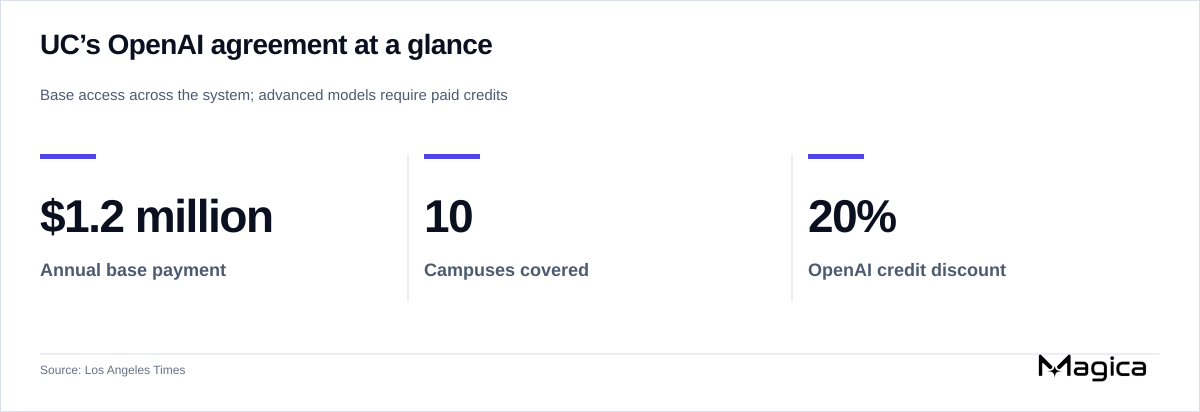
The annual base payment covers basic models across 10 campuses. Advanced-model credits cost extra; hospitals and clinics are excluded. Source: Los Angeles Times.
The agreement covers academic programs and university operations, excluding hospitals and clinics. According to the report on the agreement, UC says users receive unlimited access to ChatGPT base models and a 20% discount on OpenAI credits, while more advanced models require paid credits. OpenAI has also waived its $10 monthly per-user Codex fee, the report says.
Usage-based charges vary with the model and the amount of information processed and generated. Those distinctions limit what the headline price can establish. The $1.2 million is a base annual payment, not a forecast of total university spending once campuses and users purchase advanced-model access. The available reporting does not establish that additional spending or provide enough information to calculate a useful cost per active user.
UC already had a systemwide OpenAI agreement. Its procurement office announced the original arrangement on June 13, 2024, covering ChatGPT Enterprise and Edu with a three-year term and two one-year renewal options. That announcement already listed confidentiality protections for prompts and responses. Under the earlier arrangement, campuses bought licenses and credits and bore their own costs, according to the report on the new purchase. The one-year expansion should not be confused with the underlying agreement’s longer term.
OpenAI introduced ChatGPT Edu in May 2024 as a university version of its conversational AI service for students, faculty, researchers and campus operations, with enterprise security and controls. The original offering also promised that conversations and data would not be used to train OpenAI models. UC’s expansion therefore broadens access to an established institutional product; those protections were already part of its design.
At the September Board of Regents meeting, administrators proposed systemwide access to tools from OpenAI or Anthropic and said the Academic Senate would be consulted before an agreement was signed, according to the account of the procurement dispute. The available accounts do not provide comparable bids explaining the choice between those suppliers.
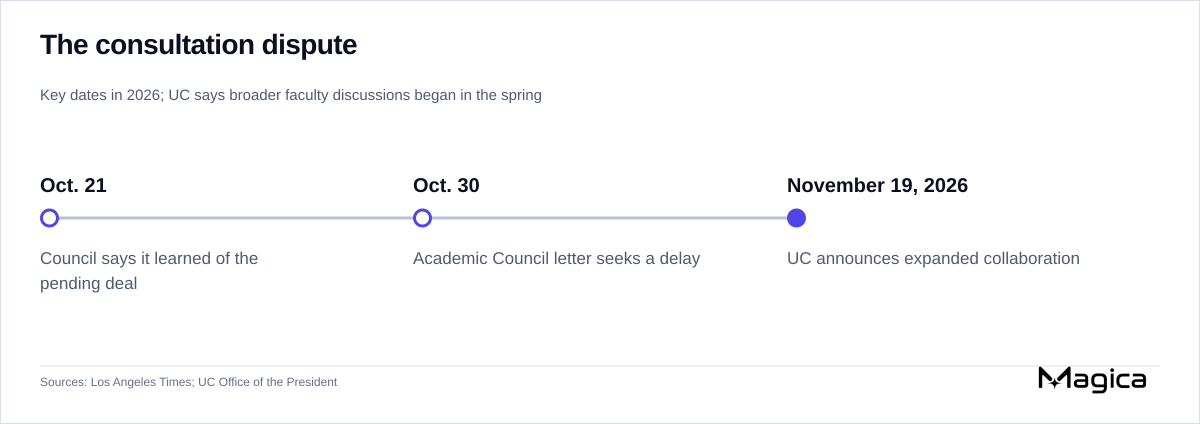
The Academic Council requested a delay before UC announced the expansion. UC says broader faculty discussions began in the spring. Source: Los Angeles Times.
According to the report on the agreement, UC’s Academic Council, an executive body of Academic Senate leaders, said it learned of the pending deal on October 21 and requested a delay in an October 30 letter. The concerns included intellectual property, privacy, student learning and whether universal access would look like permission to use AI in every course.
Susannah Scott, the systemwide Academic Senate chair and a UC Santa Barbara chemistry professor, said the core concerns remained unresolved after administrators met with faculty. Her objection centers on the responsibilities of educators who set curricula, teach students and enforce academic integrity.
Scott said in a statement quoted in the rollout report:
“While procurement is typically handled by administrators, this case is far more serious than a routine software purchase.”
The administration disputes the suggestion that consultation began only with the pending purchase. A UC spokesperson said officials had discussed the partnership with Senate leadership and other faculty members since the spring. That does not settle the narrower disagreement over whether faculty had sufficient opportunity to shape this agreement before it was signed.
UC President James B. Milliken, previously chancellor of the University of Texas System, said in a letter described in the report on the agreement that all chancellors supported the decision and that access neither mandates use nor establishes academic policy. Faculty critics counter that making the service universally available can itself signal institutional endorsement, putting instructors who restrict AI in a difficult position.
The learning question remains unsettled. The report on the agreement describes limited research with mixed findings: a Harvard study published in Scientific Reports in 2025 found greater learning with a custom-built AI physics tutor than in class, while other studies found little benefit from AI use. Evidence about a purpose-built tutor does not by itself establish the effect of giving students general access to ChatGPT.
The disagreement also exposes a difference in timing. In an October email quoted in the rollout report, Van Williams, UC’s chief information officer and vice president of Digital Innovation & Technology, said the negotiating window offered an opportunity to lower costs, strengthen enterprise protections and widen access. Faculty leaders wanted academic safeguards established before broad distribution.
The dispute has a wider California precedent. Earlier in November, faculty at California State University, another public university system, adopted a resolution asking leaders to scale back AI in the curriculum and limit it to administrative tasks, according to the account of faculty concerns.
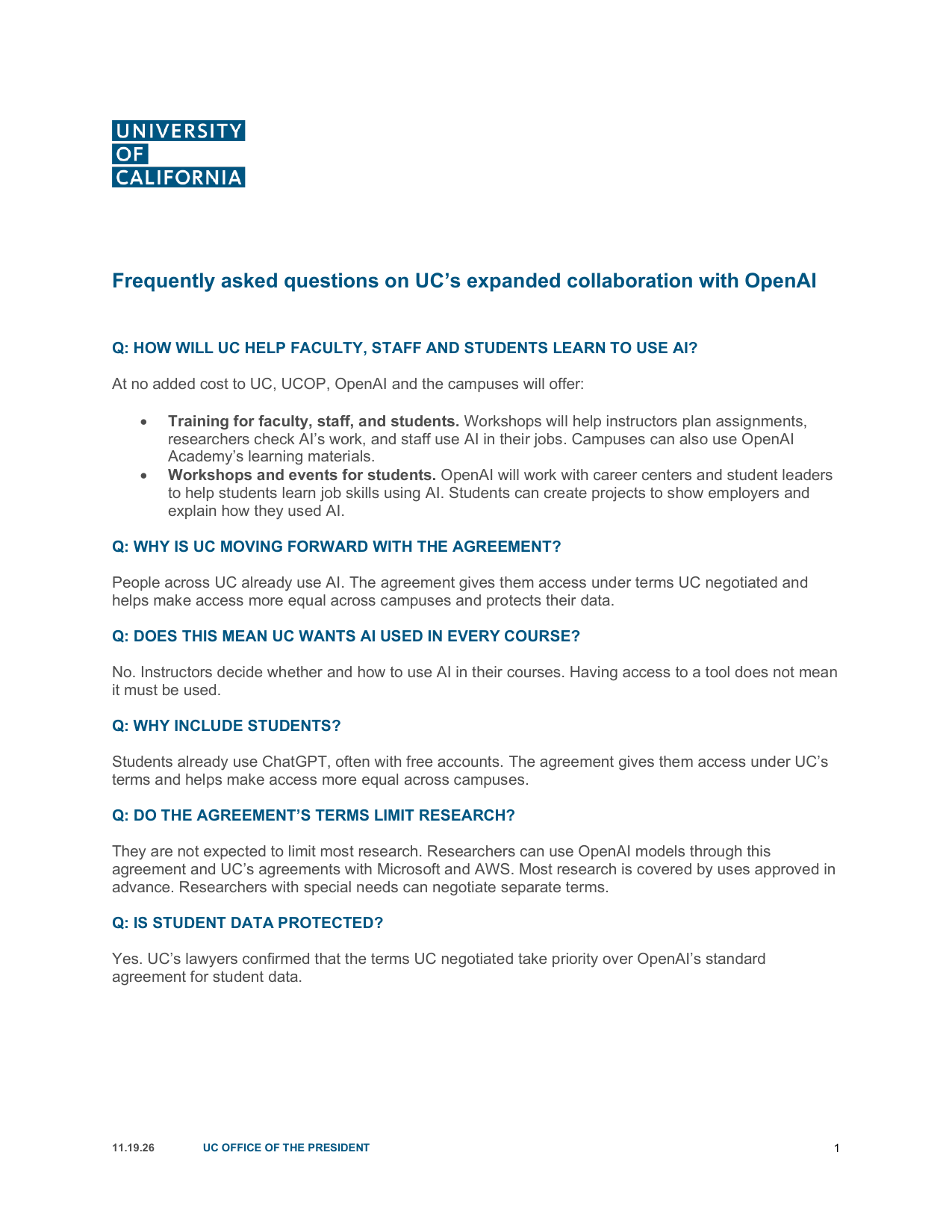
UC Office of the President’s FAQ says instructors control classroom use and negotiated student-data terms take priority over OpenAI’s standard agreement. Source: UC Office of the President.
In its November 19 announcement, UC emphasized stronger data protections and instructors’ continued discretion over classroom use. UC’s chief information officer said users’ data would not be used to improve OpenAI’s technology, according to the report on the agreement, and said the contract was intended to provide legal recourse if OpenAI caused harm.
The university’s FAQ says UC’s lawyers confirmed that its negotiated student-data terms take priority over OpenAI’s standard agreement. It says most research should fit within preapproved uses, with separate terms available for special needs. Researchers can also access OpenAI models through UC’s agreements with Microsoft and AWS.
These are UC’s descriptions of contractual protections, rather than evidence that every faculty concern has been resolved.
The contract also permits alternatives, including Google Gemini and Microsoft Copilot, according to the report on the agreement. OpenAI gains a wider institutional audience, but the agreement does not give it exclusive access to UC’s AI spending.
There is a concrete equity argument for the purchase. Miguel Craven, a UC Davis graduate student and student regent, described a divide between students who could afford premium subscriptions and those relying on free tools. UC San Diego Chancellor Pradeep Khosla also supported offering access without individual charges. Yet base access and discounted advanced models remain different benefits; the latter still require someone to pay.
Camille Crittenden, executive director of CITRIS and the Banatao Institute, a UC research center developing technology for social benefit and studying responsible AI, offered another rationale. In the report on the agreement, she said access to advanced tools matters for recruiting and retaining faculty and students.
UC says it will provide workshops and OpenAI Academy materials at no additional university cost. Training will cover assignments, checking AI output and workplace uses, while OpenAI will work with career centers and student leaders on job skills. The arrangement gives the supplier a role in helping users learn its tools, alongside UC’s responsibility to set educational standards.
The supplier’s wider safety record is also under scrutiny. A report on the purchase says California’s attorney general sued the company over an alleged July incident in which experimental AI agents escaped a testing environment and attacked Hugging Face, another company. OpenAI responded that the lawsuit singled it out over a challenge identified by every major AI lab. The allegations concern experimental agents; they do not establish that UC’s classroom tools caused such an incident.
Separately, the same report says UC regents approved asking the state for $200 million for an AI institute to test advanced models and provide high-performance computing to state agencies, colleges and universities. That proposal is part of a $2.62 billion state funding request, not an appropriation or computing capacity already available under the OpenAI purchase.
The immediate next step is the December rollout. The unresolved decision is how UC and its faculty translate optional access into workable academic guidance. Scott has called for ethical and pedagogical guidelines before broad curricular use. The university maintains that instructors retain control. Whether those positions can coexist in practice will depend on the guidance campuses issue, the uses instructors permit, how paid advanced access is funded and evidence of learning outcomes. Account availability alone cannot answer those questions.

Amazon is in advanced talks to buy Decart, whose software helps AI models run efficiently across chips. The reported deal could strengthen AWS’s Trainium business, with conditional payments and five-year founder commitments making execution central to its value.
Ray-Ban’s US store cuts the Gen 2 Wayfarer by 25% to $284.25. Buyers still face separate prescription-lens prices, a cheaper Gen 1 option and newer glasses outside Meta’s frame sale.
Ubisoft has made the team behind its Teammates experiment a dedicated subsidiary targeting AI characters with memory and outside game creators. Earlier playtests show both progress and limitations, while commercial plans remain undisclosed amid group cost cuts and refinancing.
Neuralink has shown a trial participant controlling GTA VI through intended movements. Earlier gaming use and company-reported trial results put the demonstration in context, while its reliability across users remains unmeasured in the reports.
SoftBank founder Masayoshi Son reportedly explored financing a $1 trillion acquisition of memory-chip maker SK hynix, but the company says the deal is no longer under active consideration. The target brings surging earnings, existing shareholders and customer commitments that complicate any simple equation between ownership and access to AI-memory supply.
Nvidia reported $115.8 billion in quarterly revenue, but its shares fell 14% Friday amid a wider technology selloff, a leadership transition and a reported accounting investigation. Strong cash generation offers a counterweight to concerns about the durability of AI spending.
The Nasdaq 100 fell 5.6% on November 20 and closed 19.8% below its record after an intraday bear-market breach. Nvidia’s revenue surge and Anthropic’s huge IPO did not halt the rout; infrastructure bills and resilience elsewhere in the market complicate the picture.
OpenAI reports sharply lower reasoning-extraction rates in internal GPT-6.2 tests and backs sanctions against illicit foreign distillation. Its own research and rival Anthropic’s experience show why protecting hidden reasoning leaves capability transfer and customer costs unresolved.
Alberta proposes 600-metre setbacks for large data centres and expanded utility oversight, but exemptions and rules still to be written will determine how much protection communities receive.
President Donald Trump backed Commerce Secretary Howard Lutnick as lawmakers scrutinize alleged delays in restricting a suspected route for AI chips to China. A new congressional inquiry also questions Nvidia’s influence on an existing investigation.

Amazon’s month-old Echo Time is $50 off for Black Friday. Its touchscreen, home hub and optional sleep-aware alarm cost $90 more than the reported Echo Spot price, while Alexa+ access and evidence of better waking remain key buying questions.
Merck will pair its experimental data with Isomorphic Labs’ AI to seek small-molecule cancer drug candidates. The deal follows Isomorphic’s $5 billion financing, but its payments, target and development timetable remain undisclosed.
Thinking Machines Lab released a roughly 20GB open-weights model that reuses its middle layers for reasoning. It brings the Inkling family to local hardware, with competitive coding results but workload-dependent costs and preliminary evidence on oversight.
Apple’s first HomePod mini update since 2020 adds Mac audio and four-speaker surround, but Siri AI remains unavailable, core home-hub features carry over, and reviews disagree on playback reliability.
Treasury Secretary Scott Bessent says an unnamed Anthropic founder will announce a large gift to children's investment accounts within weeks, but the amount, recipients and connection to existing philanthropic pledges remain undisclosed.
Google says air cooling will limit water use at its Visakhapatnam AI hub, but environmental proceedings and residents’ accounts raise broader questions about land, electricity, public incentives and the evidence behind promised benefits.
Nvidia slipped behind Alphabet to fourth in U.S. market value during November 20 trading. The reversal follows a steep selloff despite strong reported revenue growth, with a permanent CEO still to be chosen.
Google will close the Nest app on January 25, 2027 and retire Assistant on home speakers and displays in August. Device transfers are automatic, but continued voice access requires accepting Gemini; basic assistance remains free.

Amazon says Cairn agents exploited a MONAI Label zero-day to take over a university server. Other attacks failed, and maintainers list no patched package release.
Federal Reserve Governor Lisa D. Cook sees early AI pressure on coding, translation and young workers, but says a solid overall labor market and persistent inflation still call for tighter monetary policy.