Editorial Team
5 min read
Moore Threads is preparing a December 29 reveal for Lushan, a desktop GPU pitched at gaming and local AI inference. Its claimed memory record remains unquantified, and capacity alone will not establish performance or value.
Chinese graphics-chip maker Moore Threads is preparing to unveil Lushan, its next desktop GPU, with a product manager suggesting it could set a consumer video-memory record. The company's earlier MTT S80 gaming card launched in 2022; Lushan is due to be presented at its MUSA Developer Conference in Beijing on December 29–30, 2026. The report on the teaser gives no confirmed memory capacity, final specifications, price or retail availability.
The positioning spans AAA PC gaming and local AI inference—running models on the buyer's hardware. That makes the memory claim relevant beyond games, but creates two separate tests: whether Lushan can deliver competitive gaming performance, and whether it can run useful AI workloads at an attractive price.
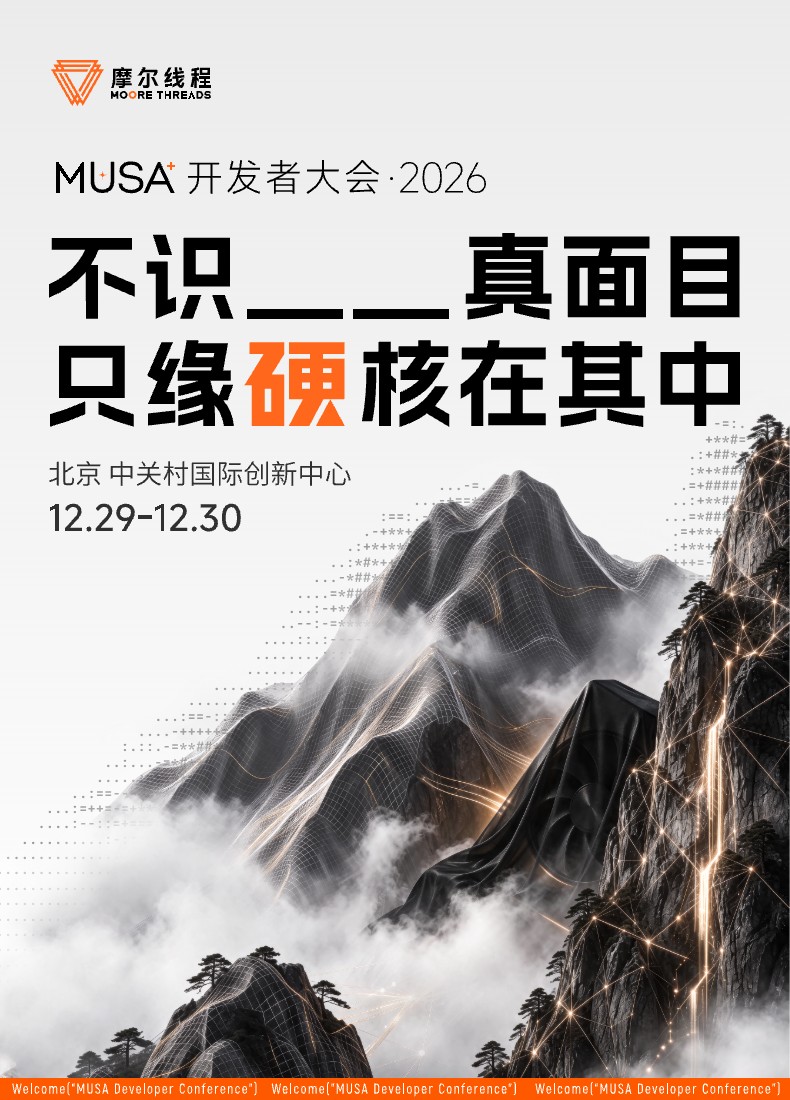
Moore Threads’ conference teaser announces December 29–30, 2026, in Beijing. Image: Moore Threads. Source: Wccftech.
The memory claim comes from a product manager associated with the MTT S80 who posts under the handle AIR_FORCE. A report tracing the teaser says it was highlighted on X from a November 18 social-media post, with IT Home reporting the gaming and local-inference positioning. This is a reported product-manager claim, not a published capacity specification.
The consumer reference point in the coverage is NVIDIA's GeForce RTX 5090, which carries 32GB of GDDR7 video memory. Moore Threads previously claimed four times the memory capacity of its earlier generation. Multiplying the S80's 16GB by four gives 64GB, but the resulting figure is explicitly speculative. The company has not confirmed that the earlier comparison describes this consumer card.
Employee equity at Anthropic’s IPO price is reportedly worth $232 billion, while book rightsholders await a first settlement installment estimated at $2,203.56 per work. Vesting, shared copyrights and founder voting rights complicate the comparison.

The definition of consumer also remains unclear: a gaming-capable card could be aimed mainly at workstation or local-AI users. Professional desktop products already exceed the GeForce benchmark. In its March 2025 announcement, NVIDIA specified 96GB for the RTX PRO 6000 Blackwell Workstation Edition and described up to 96GB across its workstation and server range. Lushan's claimed distinction is therefore a consumer-category record, not an unprecedented memory capacity for desktop GPUs generally.
Neither that announcement nor the Lushan teaser supplies a price comparison. More memory alone cannot establish that Lushan will be the cheaper way to run a particular model.
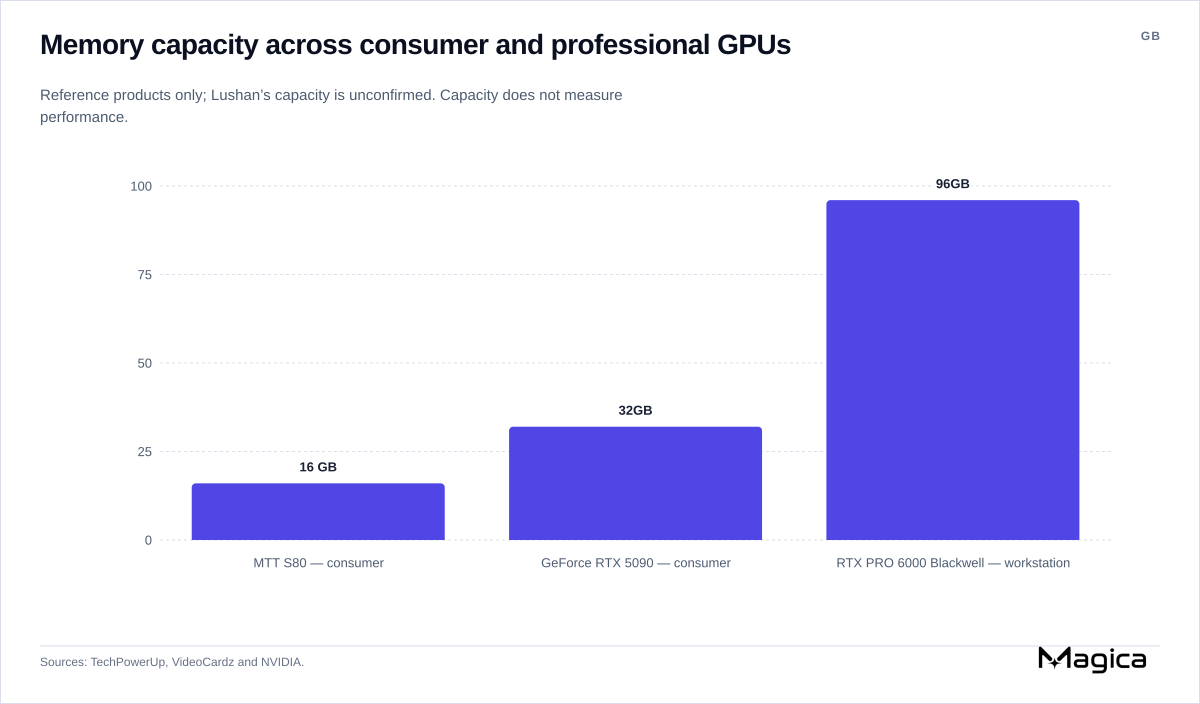
Published memory capacities across consumer and professional GPUs; the NVIDIA workstation specification is company-reported. Lushan’s capacity remains unconfirmed. Source: TechPowerUp.
Lushan uses Huagang, the GPU architecture Moore Threads presented in December 2025. At that presentation, the company claimed 15 times the AAA gaming performance, 50 times the ray-tracing performance and 64 times the AI compute of its previous generation. Coverage also describes a new UNITE rendering architecture, a hardware ray-tracing engine and AI-generated rendering support.
Those are manufacturer claims, not independent Lushan benchmarks. The account of the earlier generation says the S80 gained game compatibility and DirectX support through driver updates but remained well behind modern AMD, Intel and NVIDIA GPUs in gaming. Large gains from that starting point do not establish competitiveness with current rivals.
There is evidence of progress as well as weakness. The coverage of the teaser cites earlier testing in which an optimized MTT S90 beat an RTX 4060, and reports that driver optimization doubled S80 graphics performance. These reports concern earlier cards and selected tests; they do not provide a general performance ranking or measure Lushan.
For local AI, memory bandwidth and software compatibility remain separate from capacity. The analysis accompanying the teaser identifies a working path for tools such as PyTorch and llama.cpp as a condition for attracting inference buyers, rather than an established Lushan capability. NVIDIA's professional alternative also comes with its CUDA-based application ecosystem, according to its announcement. Buyers need evidence that their models and applications run on Lushan, as well as enough memory to hold them.
Moore Threads' development ambitions extend beyond this consumer card. In its 2025 environmental, social and governance report, CITIC Limited said Moore Threads completed a stock-market listing on December 5, 2025, raising 8 billion yuan. The report identifies CITIC Securities as the offering's exclusive sponsor and lead underwriter and says proceeds would primarily support research and development of AI training-and-inference chips, graphics processors and AI system-on-chips.
That is financing for a broader chip programme, not a disclosed Lushan budget. It establishes resources behind continued development without resolving the consumer card's performance, production costs or selling price.
The next decision is whether Lushan offers a practical purchase for either audience. A confirmed memory capacity needs to come with memory type, bus width and bandwidth, followed by application support and independent measurements of games and inference workloads. The 64-times AI claim also needs a disclosed measurement basis before buyers can use it as a speed comparison.
Moore Threads previously indicated that Lushan-based products were expected before the end of 2026. A late-December presentation does not establish retail availability. Its gaming cards have so far been sold almost entirely in China, according to the distribution account, and the teaser provides no evidence of a wider launch. Confirmed sale dates, sales territories and a purchasable price will determine who can actually test the claimed advantage.
Amazon is in advanced talks to buy Decart, whose software helps AI models run efficiently across chips. The reported deal could strengthen AWS’s Trainium business, with conditional payments and five-year founder commitments making execution central to its value.
The University of California is expanding ChatGPT and Codex access across 10 campuses, with extra charges for advanced models and an unresolved dispute over faculty authority.
Ray-Ban’s US store cuts the Gen 2 Wayfarer by 25% to $284.25. Buyers still face separate prescription-lens prices, a cheaper Gen 1 option and newer glasses outside Meta’s frame sale.
Ubisoft has made the team behind its Teammates experiment a dedicated subsidiary targeting AI characters with memory and outside game creators. Earlier playtests show both progress and limitations, while commercial plans remain undisclosed amid group cost cuts and refinancing.
Neuralink has shown a trial participant controlling GTA VI through intended movements. Earlier gaming use and company-reported trial results put the demonstration in context, while its reliability across users remains unmeasured in the reports.
SoftBank founder Masayoshi Son reportedly explored financing a $1 trillion acquisition of memory-chip maker SK hynix, but the company says the deal is no longer under active consideration. The target brings surging earnings, existing shareholders and customer commitments that complicate any simple equation between ownership and access to AI-memory supply.
Nvidia reported $115.8 billion in quarterly revenue, but its shares fell 14% Friday amid a wider technology selloff, a leadership transition and a reported accounting investigation. Strong cash generation offers a counterweight to concerns about the durability of AI spending.
The Nasdaq 100 fell 5.6% on November 20 and closed 19.8% below its record after an intraday bear-market breach. Nvidia’s revenue surge and Anthropic’s huge IPO did not halt the rout; infrastructure bills and resilience elsewhere in the market complicate the picture.
OpenAI reports sharply lower reasoning-extraction rates in internal GPT-6.2 tests and backs sanctions against illicit foreign distillation. Its own research and rival Anthropic’s experience show why protecting hidden reasoning leaves capability transfer and customer costs unresolved.
Alberta proposes 600-metre setbacks for large data centres and expanded utility oversight, but exemptions and rules still to be written will determine how much protection communities receive.
President Donald Trump backed Commerce Secretary Howard Lutnick as lawmakers scrutinize alleged delays in restricting a suspected route for AI chips to China. A new congressional inquiry also questions Nvidia’s influence on an existing investigation.

Amazon’s month-old Echo Time is $50 off for Black Friday. Its touchscreen, home hub and optional sleep-aware alarm cost $90 more than the reported Echo Spot price, while Alexa+ access and evidence of better waking remain key buying questions.
Merck will pair its experimental data with Isomorphic Labs’ AI to seek small-molecule cancer drug candidates. The deal follows Isomorphic’s $5 billion financing, but its payments, target and development timetable remain undisclosed.
Thinking Machines Lab released a roughly 20GB open-weights model that reuses its middle layers for reasoning. It brings the Inkling family to local hardware, with competitive coding results but workload-dependent costs and preliminary evidence on oversight.
Apple’s first HomePod mini update since 2020 adds Mac audio and four-speaker surround, but Siri AI remains unavailable, core home-hub features carry over, and reviews disagree on playback reliability.
Treasury Secretary Scott Bessent says an unnamed Anthropic founder will announce a large gift to children's investment accounts within weeks, but the amount, recipients and connection to existing philanthropic pledges remain undisclosed.
Google says air cooling will limit water use at its Visakhapatnam AI hub, but environmental proceedings and residents’ accounts raise broader questions about land, electricity, public incentives and the evidence behind promised benefits.
Nvidia slipped behind Alphabet to fourth in U.S. market value during November 20 trading. The reversal follows a steep selloff despite strong reported revenue growth, with a permanent CEO still to be chosen.
Google will close the Nest app on January 25, 2027 and retire Assistant on home speakers and displays in August. Device transfers are automatic, but continued voice access requires accepting Gemini; basic assistance remains free.