Editorial Team
9 min read
Anthropic’s debut put multibillion-dollar values on venture investors’ holdings, though estimates disagree. The offering also supplies about $79.4 billion in gross company proceeds as the Claude developer expands its computing infrastructure, while founders and a special trust retain unusual authority.
Anthropic’s November 19 stock-market debut put enormous paper values on venture firms’ investments. Iconiq’s holding alone was estimated at $31.8 billion at the first-day close after investments exceeding $6 billion, according to a report on the company’s financial backers. The gains leave questions about dilution, eventual cash returns and how much influence investors’ shares buy.
Anthropic develops Claude, the AI models and applications used by businesses and individuals. Founded in January 2021, it is led by co-founder and chief executive Dario Amodei, previously vice president of research at OpenAI, the rival AI research lab. Anthropic began commercializing Claude in the first quarter of 2023, according to its amended IPO prospectus.
The listing also brings fresh capital into a business whose computing commitments run far beyond the offering, while preserving special powers for its founders and a mission-oriented trust.
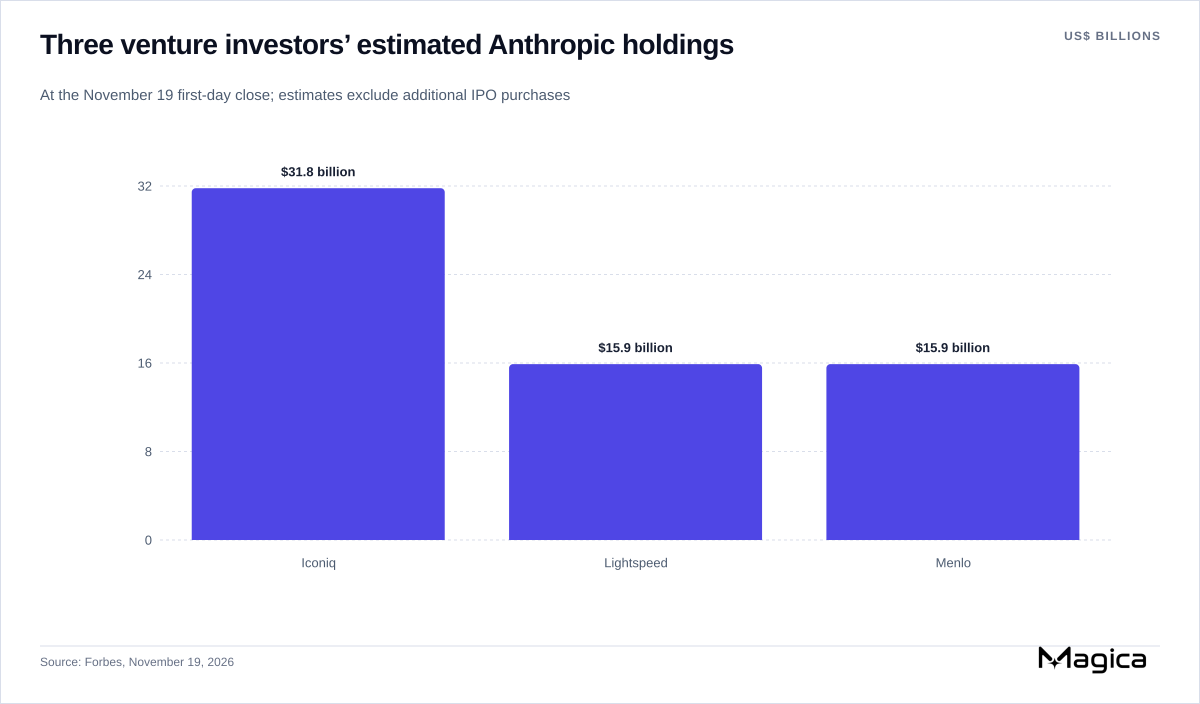
Forbes estimates at the November 19 close, excluding additional IPO purchases. These are paper values; other published estimates use different assumptions and disagree. Source: Forbes.
Iconiq, an investment firm that began by managing wealthy clients’ family offices, approached Anthropic about investing in January 2023. It later introduced the company to prospective customers including pharmaceutical company Amgen and luxury group Kering, according to a person familiar with the relationship cited in the account of its investment.
In 2025, Iconiq led Anthropic’s $13 billion Series F, investing $3 billion—its largest check—and subsequently co-led the next two rounds. The account estimates its holding at 1.8% at the debut. Its contribution thus included potential customer access as well as money.
Other venture firms accumulated positions through successive financings. Lightspeed Venture Partners invested more than $3.5 billion starting in early 2024. Menlo Ventures led the 2024 Series D with $500 million and ultimately invested more than $1 billion. Those investment totals come from Quartz’s account of Bloomberg’s estimates.
The same account shows that billion-dollar commitments were not the only route to large holdings. It puts Spark Capital’s 2023 investment at $75 million and its stake at about $11 billion at the offering price. Spark led the $450 million Series C that valued Anthropic at $4.5 billion in 2023 and is the only venture firm known to hold a board seat, according to the pricing report.
At $83 a share, Anthropic’s roughly $1.5 trillion fully diluted valuation exceeded the $965 billion valuation in its May financing, though it remained below a previously reported $2 trillion ambition. The company increased the offering from 825 million shares to 980 million and priced above the initial $70–$78 range, the pricing report said.
The two published accounts use different price dates and give materially different values for some investors.
| Investor | Estimate at the $83 offering price | Estimate at the $97.17 first-day close |
|---|---|---|
| Iconiq | More than $26 billion | $31.8 billion |
| Lightspeed Venture Partners | Roughly $28 billion | $15.9 billion |
| Menlo Ventures | Nearly $22 billion | $15.9 billion |
The offering-price account, relaying Bloomberg’s estimates, explicitly cautioned that dilution from newly issued shares might not be included. The closing-price analysis described Lightspeed’s and Menlo’s positions as diluted stakes of 0.9% each and excluded additional investments reportedly made in the IPO.
The higher closing share price cannot by itself explain lower estimates for Lightspeed and Menlo. A consistent share-count basis and confirmed allocations are needed before these figures can become a reliable ranking of investment outcomes. They are estimates of holdings, not cash distributed to funds’ investors. The prospectus describes transfer restrictions of up to 180 days, or up to 365 days for co-founders and certain larger holders, with exceptions and provisions for earlier releases.
Anthropic’s pricing announcement divides the 980 million shares into 956,351,354 sold by the company and 23,648,646 sold by existing stockholders. Multiplying those amounts by $83 gives about $79.4 billion in gross company proceeds and $1.96 billion for selling holders, before fees and expenses. Anthropic receives none of the latter.
There are founder cash-outs within that secondary sale. The pricing report, citing the registration filing, said each of the seven co-founders was selling nearly 3.4 million shares, worth about $282 million apiece at the IPO price.
The approximately $81.3 billion base offering exceeded SpaceX’s $75 billion initial June offering. But SpaceX’s total reached $85.7 billion after its underwriters exercised their additional-share option, according to the comparison of the offerings. Anthropic’s base deal was larger, but had not yet surpassed SpaceX’s total including that option.
A separate $26 billion private placement adds another source of company funding. The amended prospectus says seven technology companies agreed to buy non-voting Class N shares, contingent on completion of the IPO and other conditions. Google and Nvidia each committed $10 billion; AMD, Broadcom, Micron, Microsoft and TSMC Partners account for the remainder. This money is separate from the public offering’s proceeds.
Amazon and Google’s economic positions dwarf those of individual venture firms: their holdings were reported at nearly 15% and roughly 14%, respectively, in reporting on the strategic shareholders.
Amazon’s involvement also gives Anthropic access to computing infrastructure and customers. In its November 2024 partnership announcement, Anthropic said Amazon Web Services, Amazon’s cloud business, would become its primary cloud and training partner. A further investment brought Amazon’s cumulative commitment at that point to $8 billion. Anthropic also described work with AWS on its Trainium machine-learning chips and distribution of Claude through the Amazon Bedrock service.
Google is also a competitor. Anthropic’s prospectus identifies Google and OpenAI as direct rivals developing advanced models for software developers and enterprises. It also identifies competition from open-weight and open-source models. Anthropic argues that its model capabilities make it competitive; those claims must be tested against rivals with substantial resources and existing customers.
Economic ownership does not determine governance on its own. The filing provides for a company initially owned by Anthropic’s seven co-founders to hold Class F stock carrying 50.1% of voting power on matters submitted to stockholders generally, including elections for directors outside the trust’s remit.
Separately, the Long-Term Benefit Trust, established in 2023, generally has authority through Class T shares to elect and remove directors constituting a board majority. Designed as an independent body of five financially disinterested voting trustees, it is intended to help Anthropic balance shareholder interests, those affected by its conduct and its public-benefit purpose. The founders’ general voting majority and the trust’s board-selection rights are distinct powers; neither can be inferred from investors’ percentage stakes.
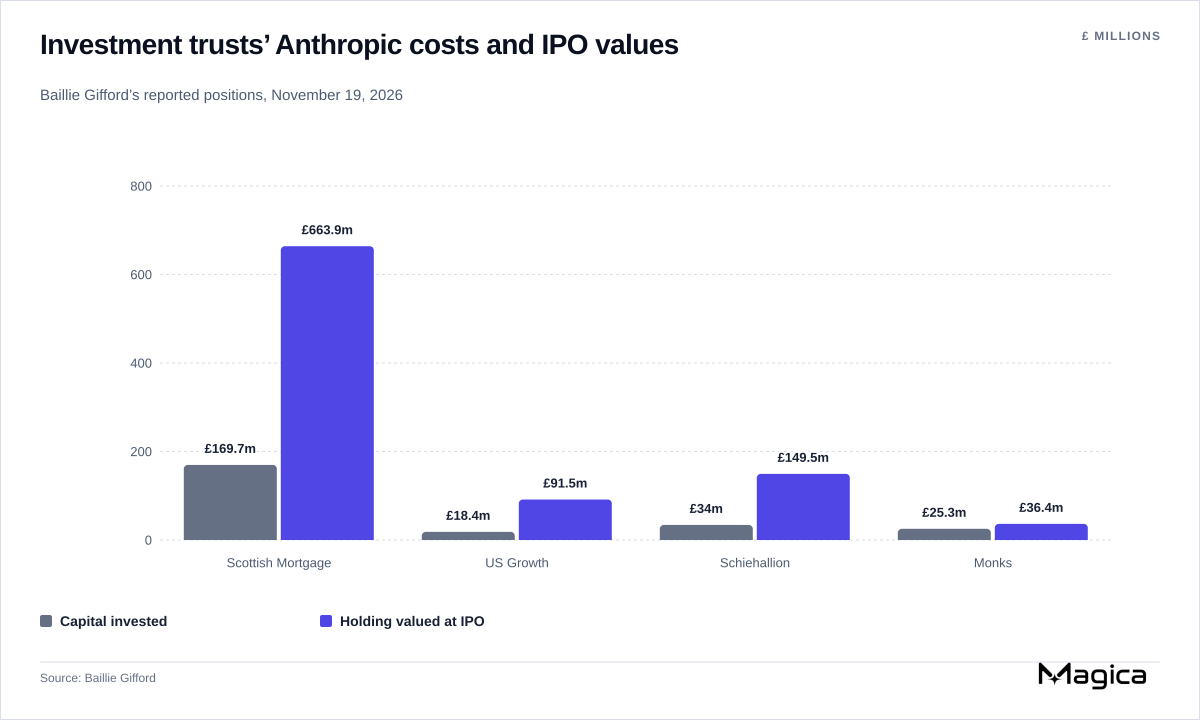
Company-reported capital invested and IPO holding values for four Baillie Gifford-managed trusts. The valuations represent paper holdings, not cash proceeds. Source: Baillie Gifford.
The beneficiaries include holders of investment trusts managed by Baillie Gifford, an independent investment partnership that invests in public and private companies. Its trusts built their Anthropic positions between August 2025 and May 2026, according to its November 19 announcement.
| Investment trust | Capital invested | Holding valued at IPO | Manager’s reported multiple of invested capital |
|---|---|---|---|
| Scottish Mortgage | £169.7 million | £663.9 million | 3.9 times |
| Baillie Gifford US Growth | £18.4 million | £91.5 million | 5 times |
| Schiehallion | £34 million | £149.5 million | 4.4 times |
| Monks | £25.3 million | £36.4 million | 1.4 times |
These are manager-reported holding valuations and multiples, not cash realizations or annualized returns. Exposure also differs: Anthropic represented 9.3% of US Growth’s total assets and 1.6% of Monks’ total assets as of October 31, before the listing. Those percentages describe each trust’s portfolio allocation, not ownership of Anthropic.
Anthropic’s business has expanded sharply. Its prospectus reports $33.2 billion in revenue for the nine months ended September 30, 2026, up 1,206% from the same period in 2025, and warns against expecting comparable growth rates to continue.
Its operating loss narrowed to $1.26 billion from $5.22 billion over those same periods. The $104 billion net loss in the 2026 period included $94.3 billion of fair-value charges on convertible notes, derivative liabilities and other financing instruments, primarily driven by increases in the company’s valuation. That headline loss is therefore a poor proxy for cash consumption: operating activities generated $6.57 billion in cash, compared with using $2.02 billion a year earlier.
Computing costs remain consequential. Anthropic said $5 billion of short-term computing capacity delivered in the third quarter cost significantly more than comparable capacity under multiyear commitments. It is also expanding beyond fixed-term cloud agreements into directly leasing chips and hosting them in dedicated facilities, an approach it calls Anthropic Direct and expects to offer long-term economic advantages. That expectation has yet to establish the outcome of the build-out.
As of and subsequent to September 30, the company disclosed approximately $900.9 billion of purchase and lease commitments, including leases not yet commenced. About $70.7 billion was due in the following 12 months; $451.6 billion was expected before the end of 2030, with substantially all the remainder expected during 2031–2045. These are commitments across different periods, not a single year’s expense. Anthropic says it intends to fund the investments with revenue and capital raised.
The IPO was expected to close November 20, subject to customary conditions, and underwriters have a 30-day option for another 147 million shares, according to the pricing announcement. Final issuance and allocations will help clarify investors’ positions. Subsequent financial results must show whether new computing capacity supports growth at sustainable costs; sales after applicable restrictions will show how much of the paper windfall investors can turn into cash.
Anthropic finished above its IPO price after a reported $81.35 billion offering, while US and Asian stocks fell. Its financing success leaves questions about computing costs and enterprise demand unresolved.
Smith Point Capital led the financing, with customer GE Vernova also investing. BrightAI aims to connect equipment sensing with field repairs, but established maintenance tools set a tougher benchmark than its estimate of trillions of dollars in infrastructure waste.
Everful has raised $48.5 million to expand its AI-assisted factory sourcing and fulfillment business. Its pitch rests on integrating work that smaller retailers struggle to manage, though rivals offer overlapping services and its reported scale remains company-provided.
Bajaj Finance and its investee Pennant Technologies have invested roughly $2 million each in Soket AI. The backing connects Indian model research with potential financial-sector users, but costs, performance and production deployments remain undisclosed.
OpenAI is testing its persistent ChatGPT agents with selected Plus subscribers and expanding Business Standard access in the United States. Usage allowances remain unclear for the new tiers, while Enterprise customers face a January billing start.
The Senate voted 62–33 for BAAJA, pairing faster energy approvals with data-center transmission-cost rules. The House must still act, while opponents dispute environmental safeguards and which computing facilities would have to pay.
Only two submissions supported Western Downs Digital Park in two differing accounts of its consultation. The proposed A$32 billion campus has a conditional first-stage Anthropic lease, while water, power and local benefits remain contested.
Epic says it is using AI to rewrite parts of Unreal Engine and plans to let developers connect their preferred models to UE6. The strategy combines claimed maintenance gains with a broader overhaul of programming, distribution and portable game assets, while rival Unity already offers outside-model connections.
At Ignite, Nvidia and Microsoft are expanding local coding AI, cloud desktop streaming and Azure infrastructure. The announcements build on an existing Windows AI strategy, with AMD alternatives, staggered availability and no comparable deployment-cost results in the announcements.
Microsoft and Nvidia are expanding Azure’s Vera Rubin virtual-machine preview, with systems already running in its data centers. Microsoft’s separate confidential-AI showcase covers four GPUs, while the announcements leave pricing, regions and general availability unspecified.
Meta is reconsidering its 2030 climate deadline after net emissions reached 11.8 million tonnes in 2025. Hardware and infrastructure purchases dominate its reported footprint, while new gas generation adds a longer-term challenge.
Three House committee chairs want the Remote Access Security Act in the annual defense bill as scrutiny of Nvidia intensifies. The available Senate text would authorize controls on specified foreign users’ remote access, with computing limits left to Commerce.
Google Quantum AI reports tests of quantum contextuality spanning up to 105 qubits on Willow processors. The experiments expose hardware errors and beat restricted classical strategies, while the largest task relies on an unproven classical benchmark.
A bipartisan House disclosure shows requests to sell 3.4 million AI chips to China and approvals for more than 879,000. The oversight question is whether Commerce verified the buyers, supply protections and access restrictions behind those authorizations.
OpenAI says its internal Performance Factory tracked more than 1,700 investigations in just over three months. About 400 cases reached proposed fixes, but far fewer shipped repairs used Codex’s code unchanged, and engineers retain approval.
Activists protested Anthropic’s stock-market debut outside Nasdaq, with at least one arrest and conflicting accounts of the total. Their campaign targets retirement-fund exposure to AI shares, alongside concerns about jobs, data centers and public accountability.
Anthropic says cash, growing revenue and multiyear payment schedules support its vast compute commitments. Its filing shows why flexibility matters: short-term capacity costs more, while major cloud contracts require payment regardless of usage.
OpenAI is rolling out live transcription for dictated ChatGPT prompts across free and paid plans. Users can see words as they speak and review the text before sending, but the company has not supplied performance measurements or a replacement recording maximum.
Boltz has raised a Bessemer-led $110 million Series A to expand molecular-design tools sold by usage. Its open-source research brought broad adoption; the commercial test is whether paid computation delivers repeatable gains in laboratory discovery.
Donald Trump said he and Xi Jinping supported minimal AI guardrails but had not discussed definitions. Their Shenzhen meeting leaves unresolved how bilateral safety cooperation would coexist with U.S. opposition to global regulation.