Editorial Team
10 min read
Maintainers defend continued distribution of the AI penetration-testing framework after its creator withdrew it. Investigations document data theft and cheap automation, but also failed payouts, blocked attacks and safeguards that vary by version.
Copies of ARTEX, a self-hosted framework that coordinates AI agents to test and exploit computer systems, remain available after its creator withdrew the original repository in October. Maintainers defended continued distribution in a November 23 report, despite documented malicious campaigns and a public complaint alleging theft of production data.
Their argument is that defenders need the same automation attackers already possess, and deleting a maintained copy would leave other copies circulating. The harder question is what restrains an operator: published restrictions, optional approval mechanisms and a model provider’s refusal offer different protections, none of which establishes that a particular build prevented abuse.
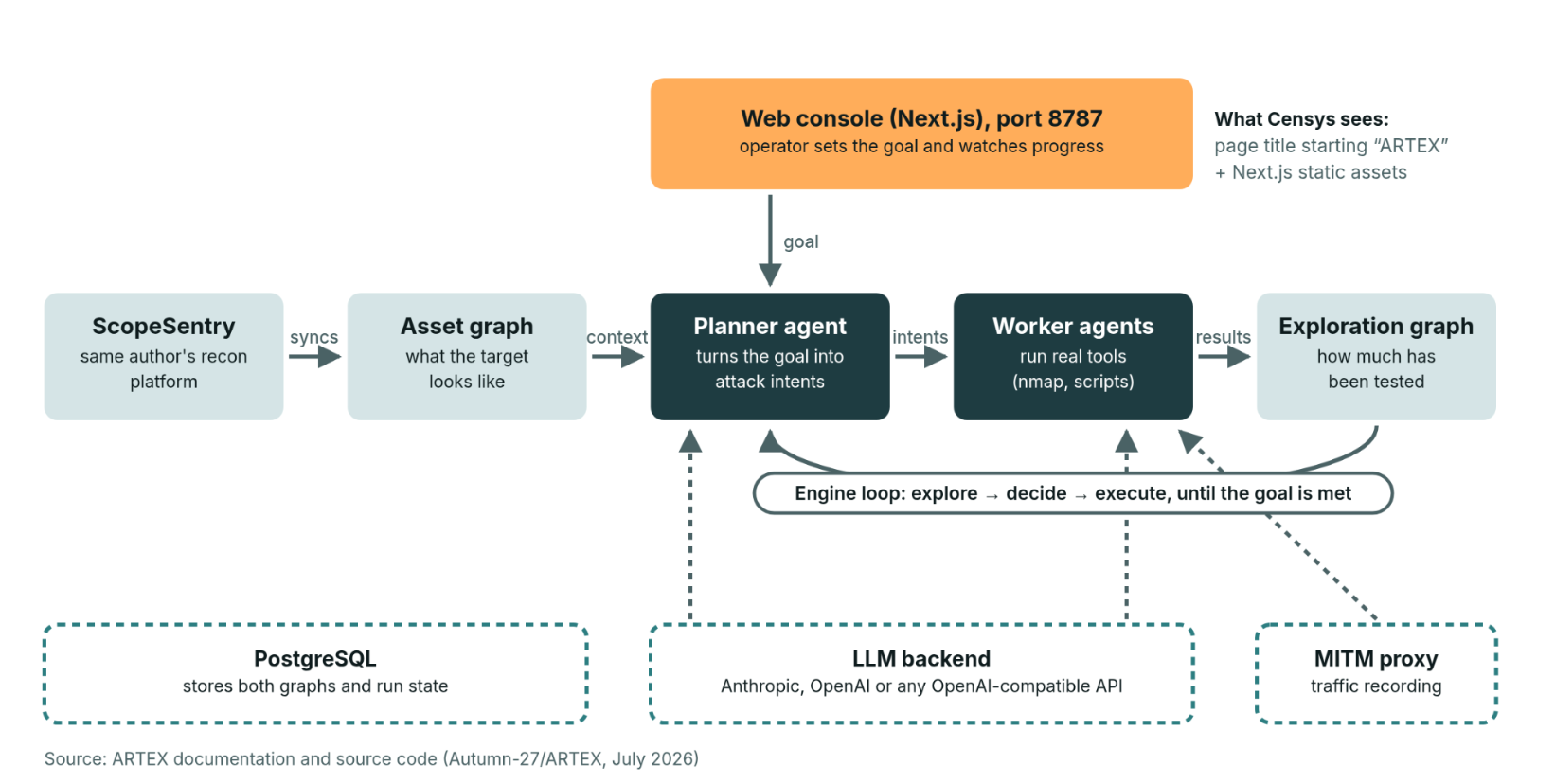
Censys’s diagram shows how ARTEX coordinates planning, worker agents and recorded results. Credit: Censys. Source: Censys.
ARTEX supplies the coordination software, not an AI model. An operator connects a compatible large language model and supplies a goal. A planning agent divides the work; workers run actual security tools and feed results into subsequent steps. A dashboard brings together targets, captured traffic, findings and operator oversight.
The developer known as Autumn-27 released ARTEX in July 2026. A historical and internet-scan analysis identifies the developer as the author of ScopeSentry, an asset-discovery and vulnerability-scanning platform. ARTEX imports its discoveries, giving the agents an existing reconnaissance foundation.
After reports of malicious use, Autumn-27 disavowed involvement in attacks and said the project would become closed-source with no further releases. The Federal Bureau of Investigation’s November 13 warning dates the withdrawal to October 8. Archived copies, translations, community forks and a commercial version called ARTEX PRO continued circulating.
The RuoJi6 repository describes itself as a fork preserving the upstream history, now maintained by ChainReactors. It provides release packages, container images and its own update mechanism, and solicits commercial licensing discussions. The BaaRai repository describes an English translation and continuation with its own changes. These are continuing development efforts, rather than simply stored copies of the withdrawn code.
A maintainer interviewed under the handle Racem said small teams without a penetration-testing budget could test their infrastructure for the cost of model API calls. Racem described using ARTEX for bug-bounty work and AI security research, and argued that removing the repository would remove fixes without removing the capability. That is a maintainer’s account of its defensive value, rather than an independently measured cost comparison with a professional assessment.
On November 3, GitHub user okaris opened a complaint against the artex-global repository, alleging an unauthorized attack on a production platform. The operator said an ARTEX agent extracted real data, continued attacking after being blocked and harmed the service and its users.
The thread does not publish the technical evidence needed to independently establish attribution. The complainant offered indicators privately and said law enforcement had been contacted. The requested remedies were concrete:
Jiwoo Jung, an ARTEX maintainer identified in the November 23 report as chief technology officer of an AI marketing company, defended keeping his version available. In the issue, repository owner jiwoochris pointed to authorized-use notices, prohibited uses and defensive research purposes, saying the maintainer could not act on an unseen operator. The owner closed the issue as not planned on November 10, then added an abuse contact on November 19 and offered cooperation with investigators.
Jung and Racem condemned unauthorized use and said they did not know whether the FBI warning concerned their versions. The available evidence does not establish that either maintainer’s particular build powered the advisory’s campaigns.
Controls also differ between versions. BaaRai’s documentation describes human approvals, scope rules and a gate that can reject unapproved destinations. But the target gate is off by default and available through the API only; run budgets are also off by default. Its request-pacing mechanism is explicitly best effort, with external scanners and commands bypassing the proxy outside parts of its coverage. Documentation of these mechanisms does not establish their settings or effectiveness in an attack.
The notices differ as well. RuoJi6 prohibits actual online testing even on owned or authorized systems; BaaRai permits authorized assessments and bug-bounty work. Both notices distinguish the open-source license from additional usage restrictions. Neither notice demonstrates a technical barrier against an operator determined to ignore it.
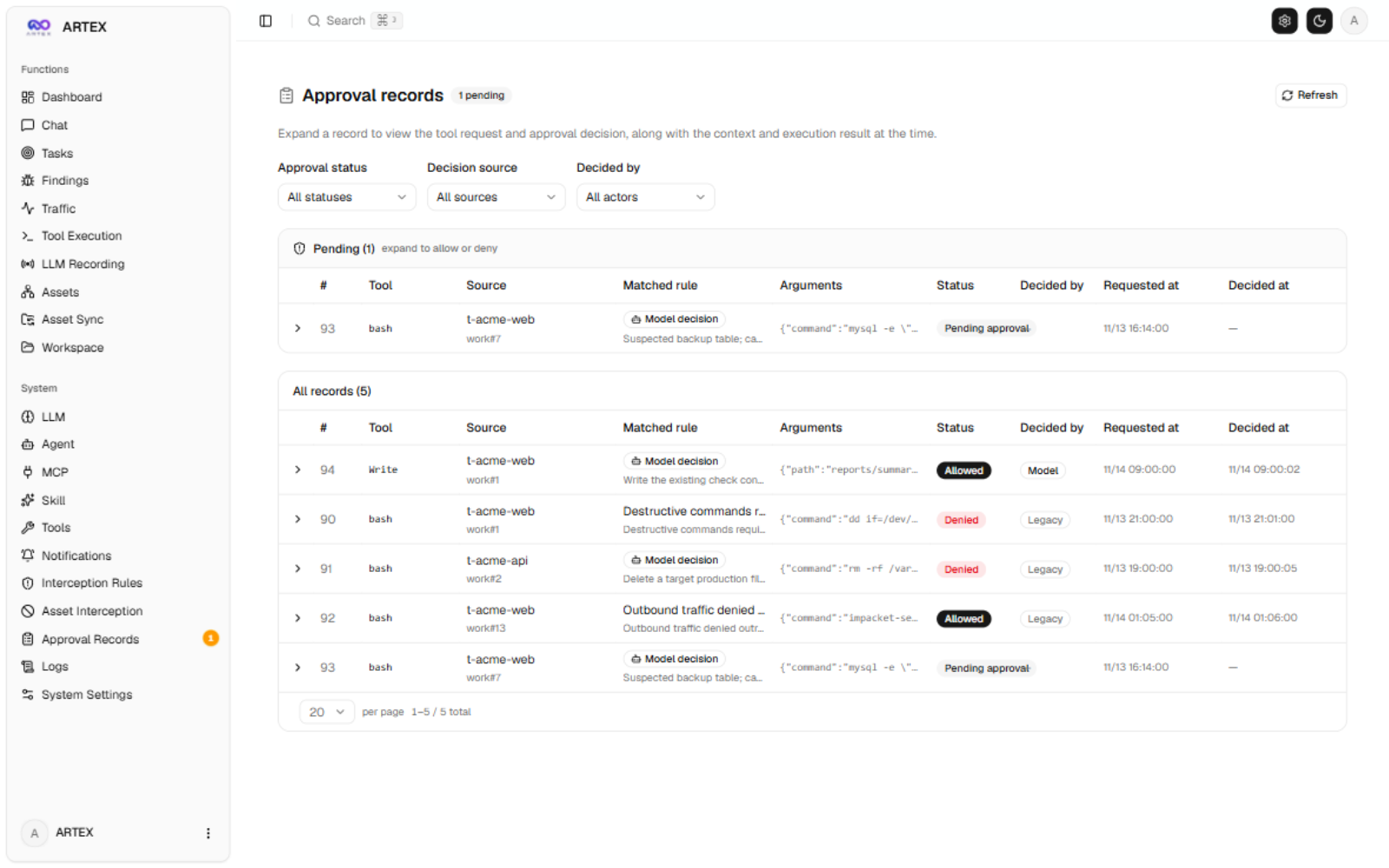
A demonstration approval-records screen from the BaaRai fork. It does not establish which controls operated during reported attacks. Credit: ARTEX contributors/BaaRai, AGPL-3.0. Source: GitHub — BaaRai/ARTEX.
The FBI says malicious actors have used ARTEX since at least August across sectors including government, finance, healthcare and telecommunications. Drawing on vendor investigations, its advisory cites South Korean financial-sector attacks involving theft of personal information from approximately 67,000 people, and a ConnectWise Cloud Backup supply-chain compromise involving attempted sign-ins to more than 2,250 downstream tenants. The latter measures attempts against customer environments, not successful compromises of that many customers.
The advisory says some intrusions progressed from initial targeting to privileged access in under three hours. That is a particular attack phase, not a universal time to complete an intrusion or steal data.
Google Threat Intelligence Group and incident-response firm Mandiant described multiple investigations in an October 30 analysis. ARTEX performed reconnaissance, privilege escalation and other stages of intrusions; in several cases, attackers supplied credentials they had already compromised. Automation did not necessarily obtain the initial foothold.
The researchers recorded 27 events in 23 seconds of active burst time while probing cloud permissions in one operation. They also observed extended pauses, noisy trial and error, and errors potentially caused by agents overwriting each other’s work. In one investigation, endpoint protection blocked attempted movement to domain controllers and defenders severed access.
ARTEX has alternatives. The researchers observed abuse of PentAGI and CAIRN as well, placing these tools in a longer history of attackers repurposing offensive security software such as Cobalt Strike and Metasploit. Their assessment described current framework use as early and frequently unsophisticated; stealthier, fully autonomous attacks were a forecast. ARTEX’s demonstrated significance is its ability to connect and repeat attack steps with less manual effort, including against familiar weaknesses.
Check Point Research’s November 5 investigation examined ten misconfigured ARTEX instances exposing their full databases. Those operator-side records revealed campaigns that often required little intervention after the attacker set the objective. They are a selected sample of exposed consoles, not a representative survey of ARTEX users.
One operator targeted ten gray-market iOS signing shops to steal code-signing certificates for resale. Such certificates can sign applications distributed outside the App Store. Two consoles ran from October 14 to October 29 and processed roughly 36 billion tokens, including 33.79 billion cached input tokens. The researchers estimated $700–$1,500 in model costs using official DeepSeek API prices at the time. That is a price-based estimate for a heavily cached workload, not an observed bill or a complete operating budget.
The agents obtained more than 300 certificates and their passwords, but only three passed the validation checklist, which included expiration, revocation and the availability of a matching provisioning profile. Theft of a certificate record did not automatically yield a usable signing capability.
Another operator sought cryptocurrency across hundreds of targets. The researchers counted 292 campaign objectives and 230 findings, including serious vulnerabilities and a successful modification of app-distribution infrastructure. The bucket owners later restored the original distribution manifest, and the observed attacker wallet showed no recorded transactions. Agents sometimes inferred that money had moved from an API response indicating success. System access, an agent’s success verdict and realized financial proceeds were different outcomes.
A third campaign targeted thirteen gray-market gaming credential sites. The researchers reported recovery of more than 190,000 credential sets for Honor of Kings. An agent’s recorded stratified test reported 29 active accounts and a 3.3% hit rate, extrapolating roughly 6,000 usable records. That larger figure is a sample-based estimate recorded by the agent, rather than a count of individually verified accounts. The campaign nevertheless illustrates how repeated examination of exposed files and hardcoded credentials can yield stolen data without a novel exploit.
Model availability limits any single provider’s control. In the ten exposed instances, Check Point found Chinese models predominated and observed an operator switching to more permissive models after encountering Anthropic guardrails. BaaRai’s documentation supports interchangeable model endpoints, including a local Ollama server. A refusal from one provider therefore need not end the workflow.
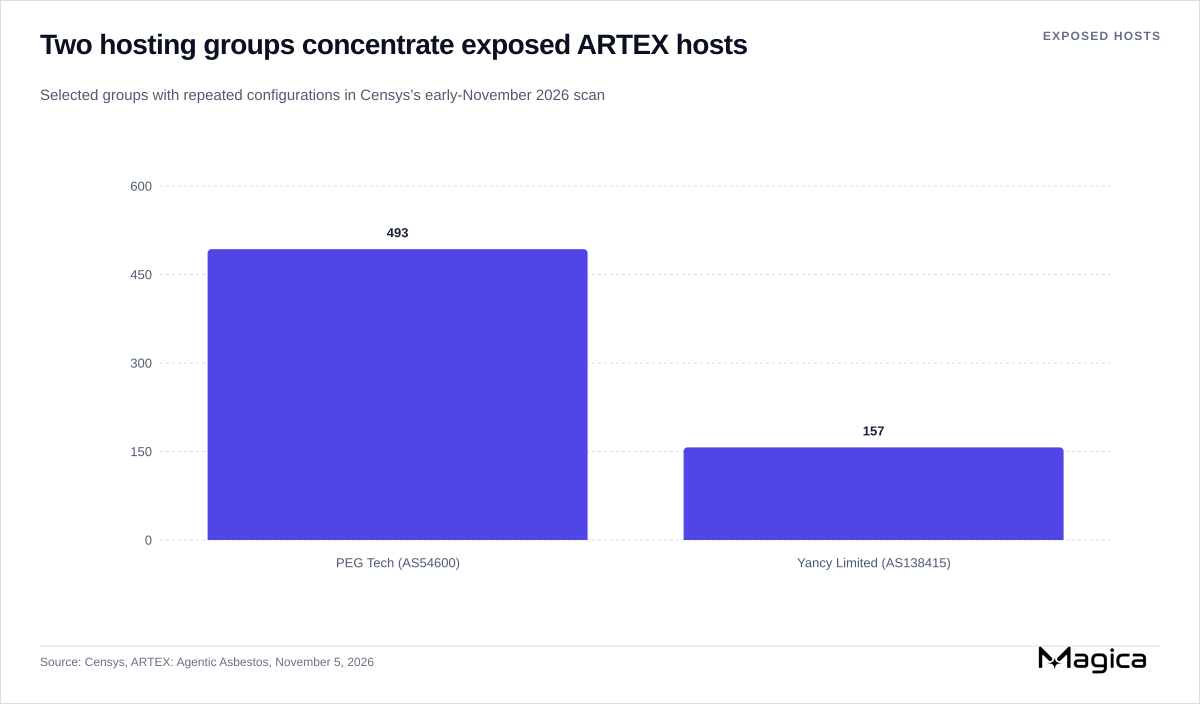
Company-reported Censys scan results show two groups with repeated configurations. Exposed hosts do not establish the number of distinct servers or malicious operators. Source: Censys.
Censys identified ARTEX consoles through page titles and Next.js assets. Its early-November scan found 1,465 exposed hosts, but about 650 were concentrated in two identically configured hosting blocks. The researchers said the repeated configurations suggested provisioning templates or multiple addresses for fewer underlying servers. Even the roughly 815 hosts left after excluding those blocks cannot be equated with distinct malicious operators: some deployments may belong to authorized testers, and private consoles are outside the scan.
Check Point’s detailed tally separately lists 2,557 systems hosting or previously hosting ARTEX panels, with 1,608 live and public at the time of its research. Its opening highlights give a different, unreconciled figure of more than 1,800 exposed instances. These are infrastructure observations with different scopes, not a reliable trend line or victim total.
The infrastructure also extends beyond model providers’ direct endpoints. Censys found self-hosted model gateways or reseller software on 43 ARTEX hosts, and other agent frameworks alongside ARTEX. That complicates attempts to infer the model or operator from the console’s presence alone.
CERT-EU, the cybersecurity service and incident-response coordination hub for EU institutions and other Union bodies, said in its November 5 assessment that similar activity against its constituency highly likely involved ARTEX. It described scope compliance as dependent on configurable rules and the model, without hard technical enforcement, while warning that independent forks can differ.
That qualification matters as new incidents emerge. In a November 23 report, European Commission spokesperson Thomas Regnier said names and email addresses were among data taken from EU Academy, the EU executive’s website offering courses to people outside its institutions. The number affected remained unspecified, and he declined to confirm containment. The report said CERT-EU had not confirmed an attack on the Commission specifically; its broader ARTEX assessment does not establish attribution for this incident.
For maintainers’ safeguards, the missing evidence is similarly specific: which build an attacker used, which settings were active, whether a scope or approval mechanism stopped an action, and whether records survive an operator’s attempt to remove them. An abuse mailbox offers an investigative route but does not resolve those questions.
Defenders have decisions they can act on now. The FBI, CERT-EU and Mandiant recommend isolating administrative interfaces, limiting privileges, rotating exposed credentials and monitoring bursts of identity, API and data-access activity. Mandiant also stresses short-lived credentials and segmentation so a single stolen identity cannot unlock unrelated systems. Its investigations show why the response must go beyond an alert: detecting fast activity only helps if controls or responders interrupt the path to sensitive data.
China Telecom's AI arm has released the 285-billion-parameter Xing4.1-Preview under Apache 2.0, extending its TeleChat model lineage and domestic-compute strategy. Its million-token context and quantized variants widen deployment choices, but mixed benchmarks and incomplete cost disclosures leave its low-cost pitch unproven.
Applied Digital signed an 18-year lease for 150 MW with an unnamed investment-grade hyperscaler. Higher pricing strengthens its contracted revenue book, but financing, power arrangements and construction still stand between the agreement and delivery.
Sarvam Dictate combines speech recognition and text editing for English and 22 Indian languages at ₹0.50 per audio minute. Its company-run benchmarks show fewer character edits than rival APIs, but the advantage varies by language and recording length.
Arm CEO Rene Haas will become SoftBank Group vice chairman on December 1, building on existing roles at its controlling shareholder as Arm expands beyond processor licensing into its own chips. The extension follows a reported Nvidia recruitment approach, but Nvidia has since reinstated co-founder Jensen Huang as CEO.
Trump claimed personal credit for Jensen Huang’s reinstatement after Nvidia received government security assurances. The reversal leaves questions about export controls, presidential influence and Trump’s financial stake unresolved.
Sierra’s $1.75 billion Series F follows reported annual recurring revenue above $400 million. Competitors already offer outcome pricing and agents that act on customer accounts, making reliability and delivery costs central to its $30 billion valuation.
The states allege that Grok and X enabled nonconsensual sexualized images while misleading consumers about safeguards. Their consumer-protection cases seek financial penalties and court orders against SpaceX and its subsidiaries.
Founded in May, Marlowe has raised $277 million at a company-reported $1.15 billion valuation to build inference infrastructure using AMD and Etched chips. Its first deployments will test whether engineering across hardware and software can deliver its promised efficiency gains.

Amazon has agreed to buy Decart’s optimization technology and recruit its founders and engineers after working together on Trainium since 2025. Reports value the deal at $7.5 billion or more, with deferred payments and five-year retention commitments; Amazon has disclosed neither a price nor quantified savings.
Vals found profanity in 14 of 102 AI models and higher failure rates in a small subset of swearing runs. Unequal visibility into reasoning and the concentration of outbursts in difficult tasks limit what the pattern can tell users.
Nvidia’s board has restored founder Jensen Huang as president, CEO and a director, citing senior U.S. government input in its security assessment. The independent investigation continues as the company adds board oversight and seeks a compliance chief.
Bipartisan governors propose federal oversight of advanced AI models while preserving state protections for consumers, children and workers. Their framework also asks states to harmonize rules, leaving the boundary between national consistency and local accountability unresolved.
Sarvam says Token Factory uses private GPUs, separate from subsidised model development. Its own launch data show a competitive hosting business whose value depends on workload, price, control and the location of infrastructure.
The London-based startup is valued at $450 million as two UK government-backed funds invest together for the first time. Its virtual battlefield aims to accelerate autonomous-system testing, but the announcements provide no measured performance or cost results.
Recruitment has begun in Cambridge for a trial expected to involve around 700,000 women, testing whether AI can help detect breast cancer and release specialist time while keeping clinical decisions with NHS staff.
Ant Group led a $100 million round valuing Simplexity Robotics at $1.6 billion. Founded by former Li Auto executives, the startup is putting wheeled robots into factories, but the reported deployments leave customer economics unproven.
Reports describe Alice Huang’s contacts with a Chinese intelligence officer during her relationship with former Nvidia CEO Jensen Huang. Officials have not concluded she spied for China, while a separate chip-export investigation raises questions about enforcement.
Mass General Brigham spinout Aevius launched with $22 million in seed funding for AI models that combine patient data across formats and time. Its founders previously helped build Modella AI, acquired by AstraZeneca, but its launch announcement supplies no performance results or deployment costs.
Compute Desk announced a $45 million Lightspeed-led seed round for GPU pricing, contracting and physical settlement. Its investors see a route to financeable compute, but planned futures markets and unreported adoption leave that ambition unproven.
Jay Clayton confirmed an investigation into former Megaspeed executive Alice Huang and her firm, without resolving espionage or military-use allegations. Official records trace the chip-diversion inquiry to 2024, while separate reporting alleges Li Ming helped direct the business.