Editorial Team
8 min read
China Telecom's AI arm has released the 285-billion-parameter Xing4.1-Preview under Apache 2.0, extending its TeleChat model lineage and domestic-compute strategy. Its million-token context and quantized variants widen deployment choices, but mixed benchmarks and incomplete cost disclosures leave its low-cost pitch unproven.
China Telecom's AI arm released Xing4.1-Preview on November 23, adding a large language model for coding and multi-step, tool-using work to its openly downloadable lineup. The developer, China Telecom Artificial Intelligence Technology Co., Ltd., presents Xing 4 as the latest generation of its TeleChat model family and says it was trained end-to-end on a domestic computing stack. The model card lists Apache 2.0 licensing and a maximum context of one million tokens.
China Telecom is a state-owned Chinese telecommunications operator with a substantial cloud business, a commercial platform for model access and investments in domestic chip suppliers. Open weights fit that wider business by giving enterprises another model to run on their own infrastructure or consume as a hosted service. Whether this model delivers the developer's promised low cost remains a separate, unresolved question.
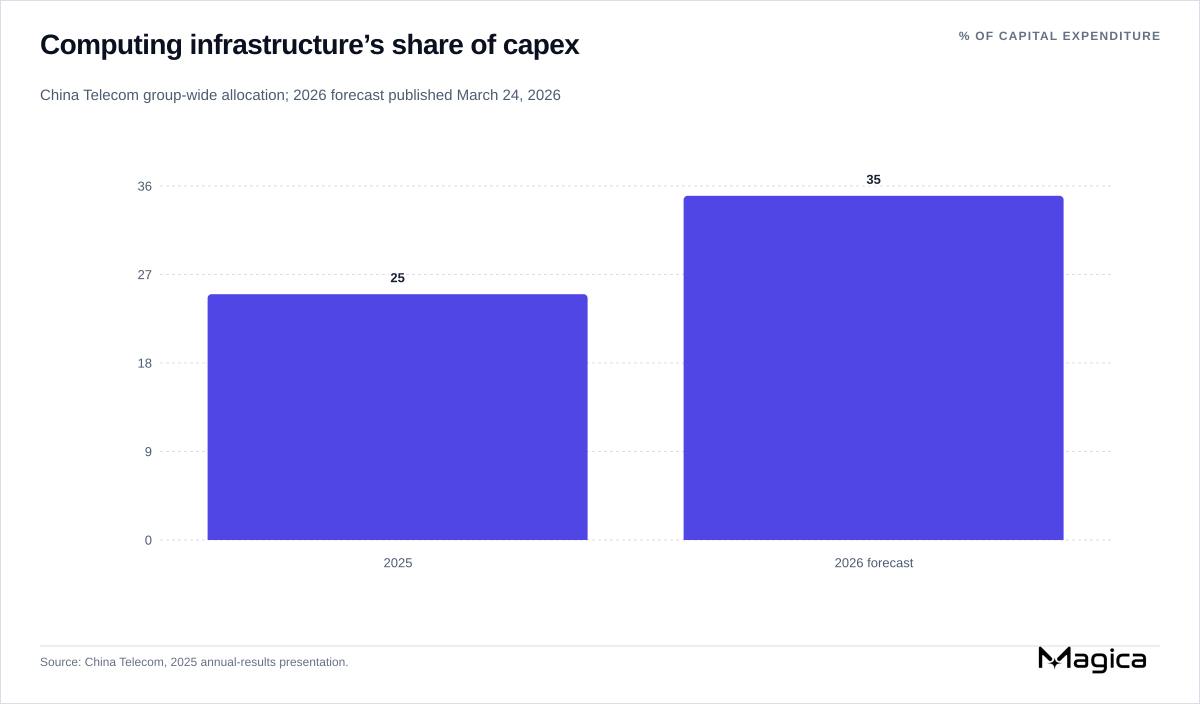
Company-reported computing-infrastructure share of capex: 25% in 2025 and a planned 35% in 2026. Group-wide figures, not a Xing4.1 budget. Source: China Telecom. Source: China Telecom 2025 annual results.
China Telecom reported RMB120.7 billion in China Telecom Cloud revenue in its 2025 annual-results presentation, against overall service-revenue growth of 0.7% from 2024. The presentation describes a cloud system offering both its own Xingchen models and third-party open and closed models. Its infrastructure business can therefore serve customers who choose competing models as well as its own.
Its March presentation also forecast that computing infrastructure would take 35% of planned 2026 capital expenditure, up from 25% in 2025, while total capital expenditure would fall from RMB80.4 billion to RMB73 billion. Those are company-wide investment figures and a spending plan, not a disclosed budget for Xing4.1. They show the scale and direction of the infrastructure business behind the release.
The developer's XingChen-AGI organization page describes an open-model effort spanning language, multimodal, vision and speech systems. Its earlier Xing4.0-29B-A4B language model has 29 billion total parameters, 4 billion active per token and a native 256K-token context, extensible to 512K. Xing4.1 expands capacity and context while adopting a different attention architecture.
Domestic-chip development predates this launch. A September 30, 2024 report recorded China Telecom's claim that it had developed two language models trained entirely on domestically produced chips. The new release continues that stated direction.
Xingchen AGI Lab, China Telecom's research team, gives a more specific account in its November 17 technical report. The authors describe pretraining a representative 285B Xing 4 model on 8,192 Ascend 910C accelerator cards using the MindSpore HyperParallel training system. They say the work was led by the lab in collaboration with Huawei and Harbin Institute of Technology (Shenzhen).
The report describes architecture choices tailored to Ascend's strengths in matrix computation and its constraints in other computation and memory bandwidth. This is evidence of an engineering program built around domestic infrastructure, although the results remain the team's own account.
There is also evidence behind the efficiency argument. In a simulation of a 32-card Ascend 910C deployment at a 256K-token context, adding DeepSeek Sparse Attention to a Multi-head Latent Attention baseline raised modeled prefill throughput—the rate of processing the input prompt—to 2.67 times the baseline. Adding cross-layer index reuse raised it to 4.68 times. The authors warn that simulation may be more optimistic than full deployment measurements.
These are comparisons among architectural variants of the team's 285B study, not price or performance comparisons with competing commercial models. Other training-system measurements use a smaller, 1,024-accelerator profiling cluster, limiting what those results establish about performance at production scale. The paper supplies evidence of internal efficiency gains without establishing what customers will pay per completed task.
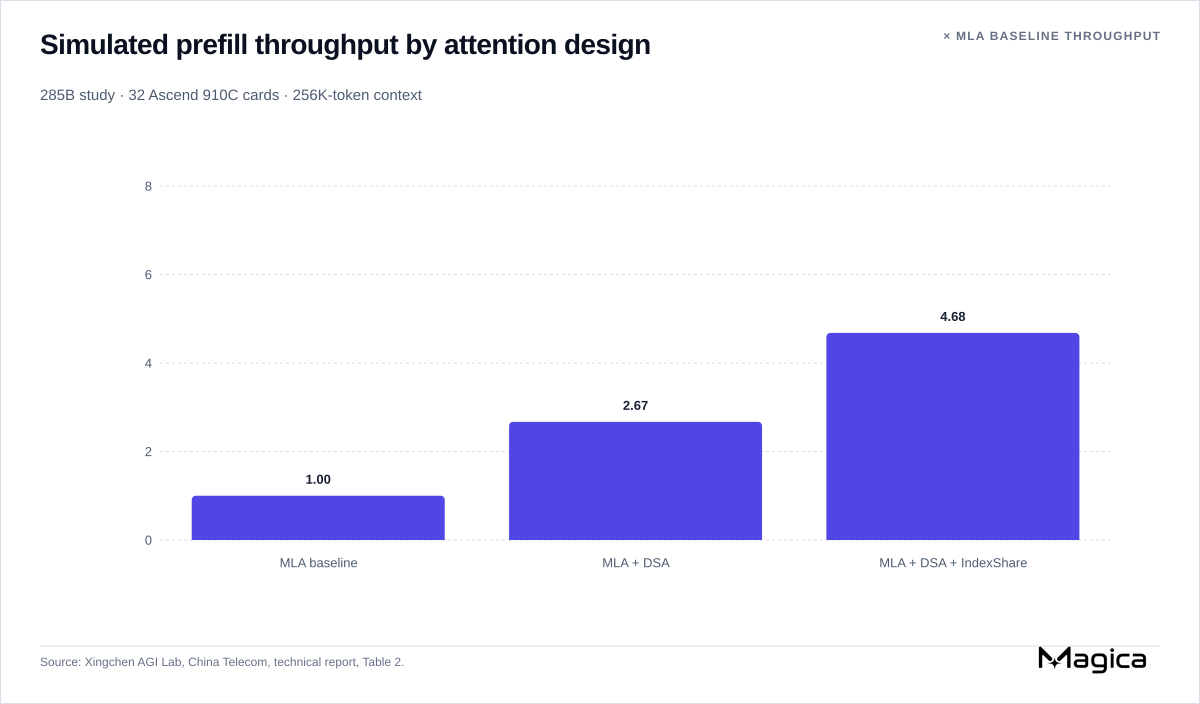
Company-reported simulated prefill throughput for the 285B study on 32 Ascend 910C cards at 256K context. Deployment results may be less optimistic. Source: Xingchen AGI Lab, China Telecom. Source: Xingchen AGI Lab technical report.
Xing4.1 uses a mixture-of-experts architecture, which selects portions of the network for each token. Its model card lists 256 routed experts, eight selected per token and one shared expert. About 17 billion parameters activate per token out of the stated 285 billion total.
That reduces active computation without shrinking the complete model to a 17B download. The main repository lists approximately 521.4 GiB of BF16 weights, with some auxiliary tensors in FP32. Its reference serving guidance calls for roughly eight 80 GB GPUs for the weights alone, with additional memory needed for longer contexts. The advertised context ceiling is therefore not a demonstrated economical operating point for every deployment.
The attention design combines Multi-head Latent Attention, which compresses stored key-value representations, with DeepSeek Sparse Attention, which selects a subset of historical context to attend to. The developer explicitly traces this design to DeepSeek-V3.2. The design builds on established architectural work; the team's technical report also identifies efficient million-token attention as an objective of the competing DeepSeek-V4 model.
The FP8 release uses eight-bit floating-point quantization with dynamic activation quantization and block-wise weight scaling. The NVFP4 release describes four-bit weights and activations for quantized components, while retaining attention, routing, shared experts and several other components in BF16.
Both quantized model cards nevertheless repeat the unquantized BF16 file table and its 521.4 GiB figure. Their format descriptions establish additional precision options, but those copied tables cannot establish each variant's storage savings. Both also say benchmark results are forthcoming, leaving their quality trade-offs undocumented in those pages.
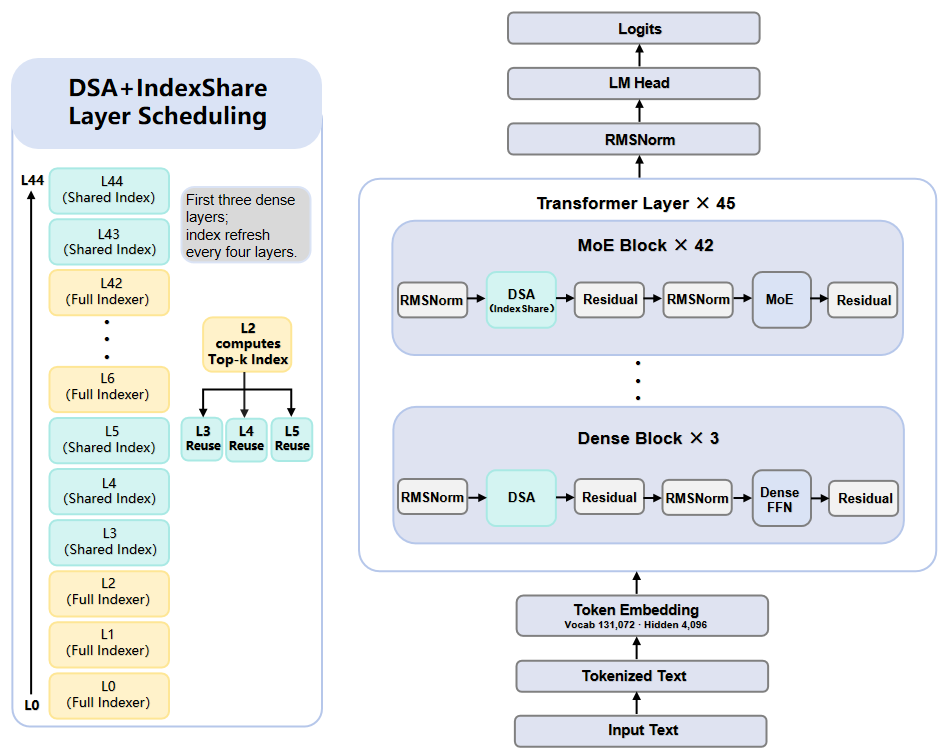
Company-reported architecture of the representative 285B Xing 4 model, with three dense layers and 42 mixture-of-experts layers. Source: Xingchen AGI Lab, China Telecom. Source: Xingchen AGI Lab technical report.
The main model card compares Xing4.1-Preview with three competing flash language models. Its reported scores vary by workload:
| Benchmark | Xing4.1-Preview | Hy4-flash | GLM-5.3-Flash | Deepseek-v4-flash-0731 |
|---|---|---|---|---|
| Terminal-Bench 4.0 | 20.6 | 19.2 | 35.4 | 7.0 |
| AutomationBench v1.0.6 | 45.3 | 52.2 | 48.4 | 37.7 |
| Apex-Agents v1.1 | 50.7 | 63.1 | 51.5 | 55.3 |
| HLE with tools | 45.7 | 55.2 | 52.2 | 51.5 |
| Claw-Eval, pass³ | 49.7 | — | — | 49.3 |
These are developer-published comparisons, with competitor scores taken from their public reports rather than a common rerun. Xing4.1's Terminal-Bench result skips GPU-sandbox tasks; its HLE result uses text-only data. Those differences limit like-for-like conclusions. Within the published table, Xing4.1 trails all three rivals on Apex-Agents and HLE, while narrowly exceeding the listed Deepseek result on Claw-Eval.
The separate MathBench mathematical evaluation displays 16.6 out of 100 in its release-day snapshot, but marks Lite and v1.3–v1.5 testing as unfinished. Hard and Challenge are excluded, with excluded problem cards counted as zero. That figure cannot be treated as a completed mathematical capability score.
MathBench says it runs the original BF16 weights on its own server with eight NVIDIA B300 GPUs and thinking mode enabled. It cautions that timings on that server are difficult to compare directly with other models. Domestic training and customer deployment hardware are distinct choices.
Chinese GPU supplier MetaX offers another stated deployment route. A release-day report describing its adaptation work says the company's Xiyun C-series GPUs support Xing4.1 using its MXMACA software stack. The report presents MetaX's claims of stable, high-throughput, low-latency operation without numerical measurements. It also describes prior release-day support for Xing4.0 and collaboration with the FlagOS community, whose unified multi-chip software stack supports a W8A8 version for MetaX hardware.
That supplier is financially connected to the model's parent: China Telecom's 2025 results said it had invested in MetaX. The connection matters when assessing ecosystem claims; the adaptation report is not an independent cost comparison.
Software readiness also varies. The main model card and organization page list SGLang serving, an official vLLM plugin and fine-tuning integrations, with TensorRT-LLM support under review. They restrict llama.cpp and KTransformers to Xing4.0, despite broader compatibility language in the quantized cards. Buyers need to verify the engine and precision variant they intend to use.
For those avoiding self-hosting, the developer says its Tianyi AI platform offers an OpenAI-compatible API with the full million-token context, up to 896K input and 128K output tokens, function calling and structured output. MathBench lists official API prices as unannounced in its snapshot. The model card also carries a developer disclaimer against unlawful uses and internet services lacking security review and filing; that wording should be considered separately from its Apache 2.0 license label.
The buying decision now requires variant-specific memory measurements, completed quality evaluations and serving prices, throughput and latency measured at stated context lengths and concurrency. China Telecom has added an openly downloadable model and reported domestic-infrastructure progress. Establishing a bargain requires those deployment results and a comparison with the alternatives on the customer's actual workload.
Maintainers defend continued distribution of the AI penetration-testing framework after its creator withdrew it. Investigations document data theft and cheap automation, but also failed payouts, blocked attacks and safeguards that vary by version.
Applied Digital signed an 18-year lease for 150 MW with an unnamed investment-grade hyperscaler. Higher pricing strengthens its contracted revenue book, but financing, power arrangements and construction still stand between the agreement and delivery.
Sarvam Dictate combines speech recognition and text editing for English and 22 Indian languages at ₹0.50 per audio minute. Its company-run benchmarks show fewer character edits than rival APIs, but the advantage varies by language and recording length.
Arm CEO Rene Haas will become SoftBank Group vice chairman on December 1, building on existing roles at its controlling shareholder as Arm expands beyond processor licensing into its own chips. The extension follows a reported Nvidia recruitment approach, but Nvidia has since reinstated co-founder Jensen Huang as CEO.
Trump claimed personal credit for Jensen Huang’s reinstatement after Nvidia received government security assurances. The reversal leaves questions about export controls, presidential influence and Trump’s financial stake unresolved.
Sierra’s $1.75 billion Series F follows reported annual recurring revenue above $400 million. Competitors already offer outcome pricing and agents that act on customer accounts, making reliability and delivery costs central to its $30 billion valuation.
The states allege that Grok and X enabled nonconsensual sexualized images while misleading consumers about safeguards. Their consumer-protection cases seek financial penalties and court orders against SpaceX and its subsidiaries.
Founded in May, Marlowe has raised $277 million at a company-reported $1.15 billion valuation to build inference infrastructure using AMD and Etched chips. Its first deployments will test whether engineering across hardware and software can deliver its promised efficiency gains.

Amazon has agreed to buy Decart’s optimization technology and recruit its founders and engineers after working together on Trainium since 2025. Reports value the deal at $7.5 billion or more, with deferred payments and five-year retention commitments; Amazon has disclosed neither a price nor quantified savings.
Vals found profanity in 14 of 102 AI models and higher failure rates in a small subset of swearing runs. Unequal visibility into reasoning and the concentration of outbursts in difficult tasks limit what the pattern can tell users.
Nvidia’s board has restored founder Jensen Huang as president, CEO and a director, citing senior U.S. government input in its security assessment. The independent investigation continues as the company adds board oversight and seeks a compliance chief.
Bipartisan governors propose federal oversight of advanced AI models while preserving state protections for consumers, children and workers. Their framework also asks states to harmonize rules, leaving the boundary between national consistency and local accountability unresolved.
Sarvam says Token Factory uses private GPUs, separate from subsidised model development. Its own launch data show a competitive hosting business whose value depends on workload, price, control and the location of infrastructure.
The London-based startup is valued at $450 million as two UK government-backed funds invest together for the first time. Its virtual battlefield aims to accelerate autonomous-system testing, but the announcements provide no measured performance or cost results.
Recruitment has begun in Cambridge for a trial expected to involve around 700,000 women, testing whether AI can help detect breast cancer and release specialist time while keeping clinical decisions with NHS staff.
Ant Group led a $100 million round valuing Simplexity Robotics at $1.6 billion. Founded by former Li Auto executives, the startup is putting wheeled robots into factories, but the reported deployments leave customer economics unproven.
Reports describe Alice Huang’s contacts with a Chinese intelligence officer during her relationship with former Nvidia CEO Jensen Huang. Officials have not concluded she spied for China, while a separate chip-export investigation raises questions about enforcement.
Mass General Brigham spinout Aevius launched with $22 million in seed funding for AI models that combine patient data across formats and time. Its founders previously helped build Modella AI, acquired by AstraZeneca, but its launch announcement supplies no performance results or deployment costs.
Compute Desk announced a $45 million Lightspeed-led seed round for GPU pricing, contracting and physical settlement. Its investors see a route to financeable compute, but planned futures markets and unreported adoption leave that ambition unproven.
Jay Clayton confirmed an investigation into former Megaspeed executive Alice Huang and her firm, without resolving espionage or military-use allegations. Official records trace the chip-diversion inquiry to 2024, while separate reporting alleges Li Ming helped direct the business.