Editorial Team
7 min read
Bipartisan governors propose federal oversight of advanced AI models while preserving state protections for consumers, children and workers. Their framework also asks states to harmonize rules, leaving the boundary between national consistency and local accountability unresolved.
The National Governors Association (NGA), the bipartisan governors’ organization, has proposed federal oversight of the most advanced AI models while defending states’ authority to protect residents. The principles, released November 22, seek to influence the incoming Congress before lawmakers decide how national rules should interact with state protections.
The proposal is a negotiating position, not an enacted regulatory framework. Its central bargain runs in both directions: Washington should preserve appropriate state authority, while states should reduce duplication and conflicting requirements. It leaves unresolved how to enforce that division and how demanding federal oversight should be.
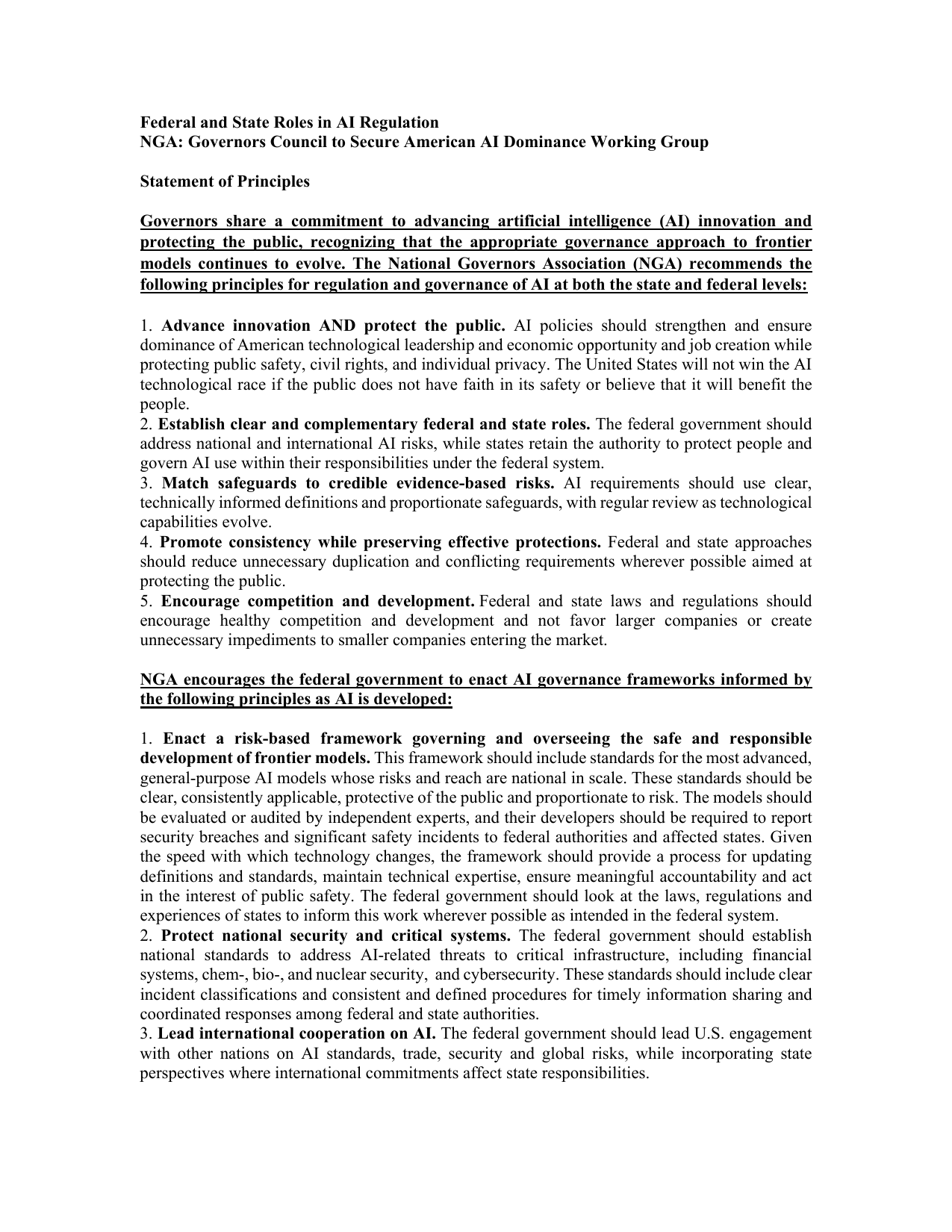
The NGA’s statement proposes complementary federal and state roles, independent frontier-model evaluations and incident reporting. These are recommendations, not enacted requirements. Source: National Governors Association. Source: National Governors Association statement of principles.
The NGA’s Governors Council to Secure American AI Dominance developed the proposal. Maryland Governor Wes Moore, the NGA chair, and Indiana Governor Mike Braun, its vice chair and a former U.S. senator, lead the council with North Carolina Governor Josh Stein and Utah Governor Spencer Cox, according to the announcement. Stein previously served as North Carolina’s attorney general and headed its consumer-protection division, a record documented by the state Justice Department. Cox points to Utah’s existing large-load energy legislation as an example of state action.
Their stake extends beyond regulating technology companies. States operate public services, oversee public employment and respond to harms involving consumers, children and workers. The governors also want AI investment and job creation. The principles therefore combine safeguards with an agenda for adoption in government, education, healthcare and cybersecurity.
Those responsibilities do not establish technical readiness. In their accompanying televised interview, none of the four raised a hand when asked whether government understood AI well enough to regulate it successfully. Cox explicitly acknowledged that gap. The statement calls for shared technical expertise and regularly updated definitions and standards.
The statement of principles proposes a risk-based federal framework for frontier models: the most advanced general-purpose AI systems whose risks and reach are national in scale. Independent experts would evaluate or audit them. Developers would have to report security breaches and significant safety incidents to federal authorities and affected states.
Federal standards would address threats to critical infrastructure, financial systems, cybersecurity and chemical, biological and nuclear security. Washington would lead international engagement, incorporating state perspectives where commitments affect state responsibilities. Safeguards should be proportionate to credible, evidence-based risks and change as capabilities evolve.
States would remain a primary route for accountability when deployed AI harms people. The proposal calls for preserving consumer and worker protections, antidiscrimination enforcement, access to legal remedies, and appropriate roles for tort law and civil liability. It also asks states to require regular monitoring of AI algorithms for unintended consequences.
For automated decisions affecting housing, employment, lending, insurance and essential services, the governors want human oversight, meaningful transparency and opportunities to challenge adverse outcomes. Other priorities include privacy, fraud and impersonation, exploitation of older adults, and risks to children from addictive design, chatbots and companion applications.
States would determine AI use in state and local public employment, including employee protections and applicable collective bargaining obligations, and support workers facing transitions. They would also protect public systems against AI-enabled cyber threats while preparing to use AI for cyber defense. The document encourages experimentation through regulatory sandboxes, alongside evaluation of public-service outcomes.
The governors urge caution over federal preemption—the displacement of state laws—and meaningful input from a representative cross-section of states. They will assess federal proposals against the NGA’s standing Principles of Federalism. This is a demand for consultation and preservation of appropriate powers, rather than a blanket rejection of federal rules.
Resistance has a recent precedent. On July 1, 2025, the Senate voted 99–1 to remove a ten-year moratorium on state AI regulation from the budget reconciliation bill, according to the Commerce Committee Democrats’ account. That account says opposition included 17 Republican governors and 40 state attorneys general. The vote demonstrates resistance to that moratorium; it does not determine the boundaries of future federal legislation.
The new principles acknowledge the problem of inconsistent state requirements. States should coordinate oversight standards, seek recognition and harmonization of one another’s frameworks, and draw on expertise from academia, industry, labor and peer governments. Without federal measures, the document says, interstate coordination becomes more important.
Competition is a separate constraint on both levels of government: rules should not favor large companies or unnecessarily impede smaller entrants. That concern also exposes a difference among the council’s leaders. In the interview, Stein called for a federal regulatory body to set parameters for frontier AI labs. Cox warned against regulation that shields large companies from competition. Agreement on independent evaluations leaves the regulator’s powers and compliance burden unsettled.
President Donald Trump has favored fewer AI limits. A report citing Bloomberg’s account of his remarks says he warned at the previous week’s Asia-Pacific Economic Cooperation summit that heavy rules would stifle the technology. The governors’ request for federal safeguards therefore also faces a different emphasis from the White House.
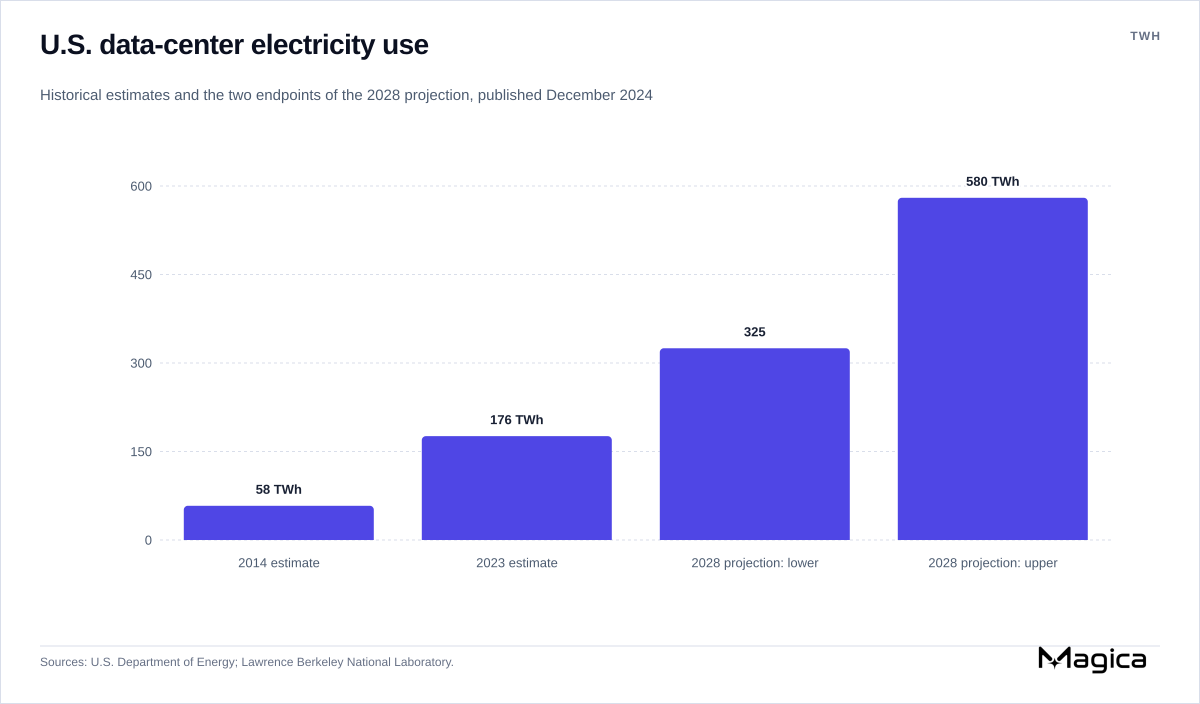
U.S. data-center electricity estimates and projections published in December 2024. The 2028 bars are alternative endpoints of one projection range, not additive quantities. Figures cover all data centers, not AI alone. Source: U.S. Department of Energy.
The governors’ common ground was clearer on data centers, the computing facilities supporting AI and other digital services. They said developers should largely pay for their own energy needs and communities should retain a say over development. That brings the debate over authority into decisions about power supply, water, siting and local employment.
The scale extends beyond AI alone. A December 2024 report produced by Lawrence Berkeley National Laboratory estimated that U.S. data centers used 176 terawatt-hours of electricity in 2023, about 4.4% of the national total. It projected 325–580 terawatt-hours in 2028, approximately 6.7%–12% of total U.S. electricity, as described in the Department of Energy’s release. Those are broad data-center estimates and projections, not measurements of current AI-only consumption or proof of an effect on a particular household’s bill.
The federal release also identifies alternatives to simply adding generation: onsite storage, greater flexibility in demand, transmission improvements and innovative rate structures. The governors’ demand that developers cover their costs still leaves utilities and public officials to decide how those costs and obligations should be measured.
Moore said about half of Maryland’s local jurisdictions had bans or pauses on data centers and pledged to respect local refusals. He also stressed local hiring. Braun argued that developers should add more power than they consume and should not seek tax abatements. Cox cited Utah’s large-load legislation as a framework for addressing power supply. These were the governors’ stated positions in the interview; the NGA statement does not itself create those requirements.
The NGA says its working group will continue examining common definitions, standards, shared technical capacity and mechanisms for multistate cooperation, including mutual recognition of state frameworks. Its immediate aim is to inform the incoming Congress.
The next decisions are substantive: which models trigger federal oversight, who evaluates them, which state protections survive, and how overlapping requirements are reconciled. For data centers, the corresponding test is whether calls for developers to pay their own way become enforceable obligations. The principles establish shared objectives; legislation, regulatory arrangements and state cooperation must supply the mechanisms.
Sarvam says Token Factory uses private GPUs, separate from subsidised model development. Its own launch data show a competitive hosting business whose value depends on workload, price, control and the location of infrastructure.
The London-based startup is valued at $450 million as two UK government-backed funds invest together for the first time. Its virtual battlefield aims to accelerate autonomous-system testing, but the announcements provide no measured performance or cost results.
Recruitment has begun in Cambridge for a trial expected to involve around 700,000 women, testing whether AI can help detect breast cancer and release specialist time while keeping clinical decisions with NHS staff.
Ant Group led a $100 million round valuing Simplexity Robotics at $1.6 billion. Founded by former Li Auto executives, the startup is putting wheeled robots into factories, but the reported deployments leave customer economics unproven.
Reports describe Alice Huang’s contacts with a Chinese intelligence officer during her relationship with former Nvidia CEO Jensen Huang. Officials have not concluded she spied for China, while a separate chip-export investigation raises questions about enforcement.
Mass General Brigham spinout Aevius launched with $22 million in seed funding for AI models that combine patient data across formats and time. Its founders previously helped build Modella AI, acquired by AstraZeneca, but its launch announcement supplies no performance results or deployment costs.
Compute Desk announced a $45 million Lightspeed-led seed round for GPU pricing, contracting and physical settlement. Its investors see a route to financeable compute, but planned futures markets and unreported adoption leave that ambition unproven.
Jay Clayton confirmed an investigation into former Megaspeed executive Alice Huang and her firm, without resolving espionage or military-use allegations. Official records trace the chip-diversion inquiry to 2024, while separate reporting alleges Li Ming helped direct the business.
Satya Nadella says Claude Code caught Microsoft off guard by moving AI coding toward the terminal. Microsoft’s response includes managing rival agents in VS Code, while its investment and cloud commitments with Anthropic complicate the competitive picture.
Apple’s reported Siri layoffs targeted older infrastructure, while a beta update points to some migration onto newer systems. The harder test is delivering app control promised in 2024 and subsequently delayed.
Zhipu says GLM-5.4 adds vision and stronger coding to its subscription service, with larger usage quotas. Undisclosed credit rates and benchmarks leave its value unresolved as the company expands a cloud business backed by substantial financing.
The London consumer law business has secured seed funding led by Insight Partners to expand beyond conveyancing. Its bet is on delivering legal work directly, but claimed growth has yet to establish a cost or service advantage over competing practices.
Meta chief AI officer and former Scale AI CEO Alexandr Wang warns that unconstrained AI self-improvement threatens human control. His call for a different industry path follows an AI-assisted mathematical breakthrough, but neither that collaboration nor new research-automation data establishes fully autonomous science.
US President Donald Trump urged Nvidia to bring back its co-founder and former CEO Jensen Huang, despite a reported board statement against reinstatement and unresolved allegations involving Chinese intelligence and chip shipments.
Claude’s estimated October web visits rose 23.8%, but the figures measure neither paying customers nor job losses. A resurfaced account of Dario Amodei discussing immersive games at OpenAI raises a separate question about how AI’s builders approach its social consequences.
OpenAI wants frontier labs to tie development limits to prediction loss and monitoring milestones. Its internal figures offer a starting point, but datasets differ across companies and the metric misses major reasoning gains.
A 2,000-cubic-metre tank and mobile pumping capacity address northern Hong Kong flooding, while AI tools help position crews and detect rising water. Official records distinguish established monitoring from three-site forecasting trials, with costs disclosed but comparative performance results absent.
Reported server price demands reach 45% above earlier agreements. HPE explicitly permits repricing before shipment, while XTX's disputed Dell order raises a sharper question: what happens when a buyer says it paid extra for a fixed price?
OpenRouter disclosed provider removals after investigations into inference data handling. Separate notices describe forwarded requests, a compromised deployment and stolen prompt samples, exposing different weaknesses behind privacy assurances.
Choi Kyo-jin resigned after last-minute anti-cheating changes disrupted preparations for South Korea’s college entrance exam. A breakdown of 111 electronic-device cases leaves the extent of AI-assisted cheating unresolved as authorities review penalties and future safeguards.