Editorial Team
5 min read
Compute Desk announced a $45 million Lightspeed-led seed round for GPU pricing, contracting and physical settlement. Its investors see a route to financeable compute, but planned futures markets and unreported adoption leave that ambition unproven.
Compute Desk, a startup building financial infrastructure for rented graphics processing unit (GPU) capacity, emerged from stealth on November 17, 2026, with a $45 million round led by venture investor Lightspeed Venture Partners. The financing backs an effort to turn privately negotiated compute deals into contracts that buyers, sellers and lenders can price and manage more consistently.
The company's transaction adviser, law firm Wilson Sonsini Goodrich & Rosati, confirmed the announcement. Other participants were Menlo Ventures, Hedosophia, Motive Partners, Crucible Capital, Inovia Capital, Soma Capital, Mythos Ventures, Blue Wire Capital, Firesteak Ventures and Drysdale Ventures. Lightspeed describes the financing as a seed round.
The stakes extend beyond finding a rental price. A lender needs to value the capacity underlying a loan; a buyer needs usable computing power when promised; and a provider needs revenue it can plan around. Compute Desk's investors argue that linking prices, contracts and verified delivery could help address all three. The funding establishes backing for that strategy, rather than evidence of widespread use.
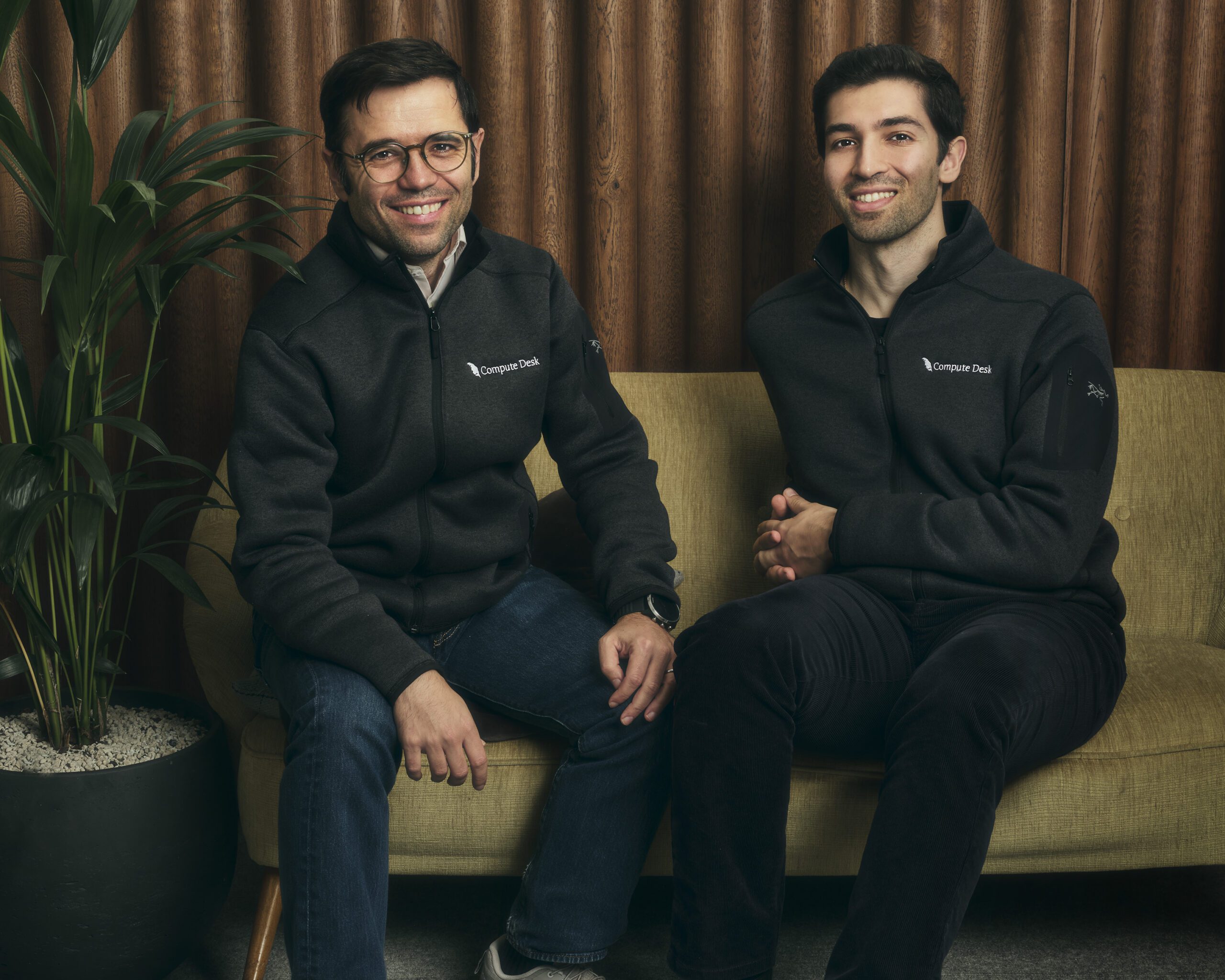
Compute Desk co-founders David López Mateos and Andy Bahou. Image: Lightspeed Venture Partners. Source: Lightspeed Venture Partners.
In its investment case, Lightspeed says multi-year purchase commitments, or offtakes, have allowed lenders to finance infrastructure against the creditworthiness of a buyer. But buyers must commit before knowing how much capacity they will need, while sellers face pressure to discount for those commitments.
Lightspeed argues that much financing described as GPU asset backing is effectively lending against expected customer payments. Its proposed alternative requires a reliable way to value and deliver the compute itself. That is difficult because unused GPU-hours cannot be stored, clusters perform differently and successive chip generations change prices.
Jay Clayton confirmed an investigation into former Megaspeed executive Alice Huang and her firm, without resolving espionage or military-use allegations. Official records trace the chip-diversion inquiry to 2024, while separate reporting alleges Li Ming helped direct the business.
Fellow investor Motive Partners describes three connected functions at Compute Desk:
Motive says the underlying grading framework compares clusters across GPU type, contract term, location, service level and price. Lightspeed says Compute Desk tests and monitors clusters before and after delivery.
These functions address different risks. A price hedge is useful only insofar as its reference price tracks the capacity a customer needs. Checking hardware performance addresses whether that customer's contracted service actually arrives. Combining them does not, by itself, establish protection against every delivery or counterparty failure.
Co-founder and chief executive Andrawes Bahou, identified as Andy Bahou in Lightspeed's account, previously built GPU data centers and clusters at Meta, designed chips at Arm and worked on exotic derivatives at Credit Suisse. Co-founder and chief technology officer David López Mateos holds a particle-physics doctorate from Caltech, spent a decade researching at Harvard and CERN, and later worked on commodities at Winton and pricing at FLYR, according to the investors.
That combination supplies the hardware and financial-market experience the investors say the business requires. Lightspeed says its selection followed a year of examining compute markets, including exchanges, trading firms, data centers and lenders. Both it and Motive have a financial stake in the outcome; their accounts explain the investment rationale, without independently establishing customer adoption.
Compute Desk is entering an existing contest over reference prices. GPU market-data provider Silicon Data announced updates to its A100 and H100 rental indices and a B200 on-demand rental index in December 2025. A GPU price index alone therefore does not establish Compute Desk's novelty.
Its investors instead emphasize the connection to contracts and physical settlement. Lightspeed says Compute Desk licenses prices across venues, including Nodal and Architect, treating exchanges as partners. Motive's investment thesis is that settling more transactions can produce better proprietary data, improving the benchmark and attracting further use. Whether that cycle develops depends on actual transaction activity.
Motive says Compute Desk's benchmarks are available on Bloomberg and Refinitiv and that its Compute Clear product is already settling physical capacity. Its disclosure also cautions that capability descriptions reflect its understanding of intended functionality and may not represent current or future capabilities. Those claims need to be read together.
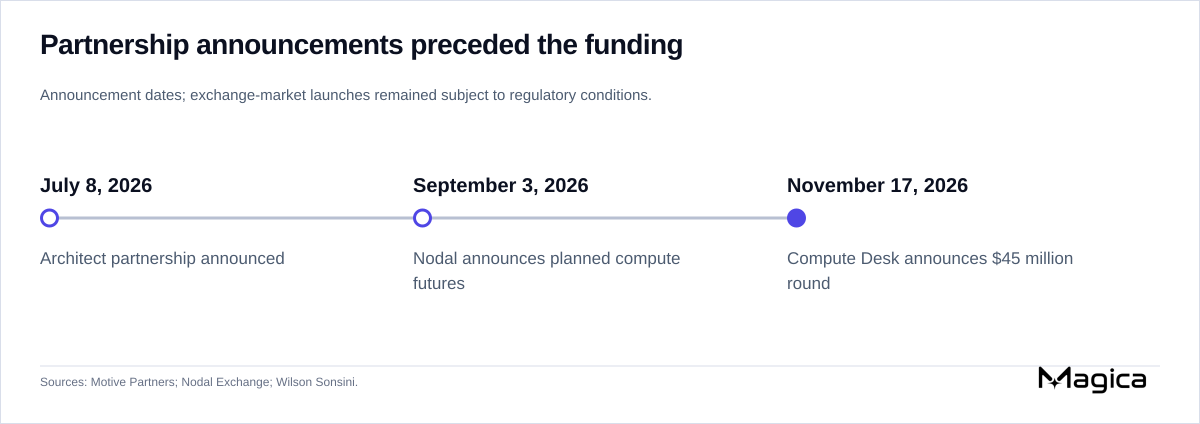
Company-reported partnership announcements preceded Compute Desk’s funding disclosure. These dates do not establish that either exchange market launched. Graphic: Magica. Source: Motive Partners.
Nodal Exchange, an established U.S. power derivatives venue, announced the planned compute futures partnership in September. The contracts would settle financially against Compute Desk's daily blended GPU price indices, with availability targeted for 2026 subject to regulatory compliance. Financial settlement of a futures contract is distinct from delivering a working GPU cluster.
Motive's November account still describes those futures as planned. It also describes a planned exchange-for-physical market with financial-technology company Architect, subject to regulatory approval. Benchmark distribution and investor statements about physical settlement do not establish that either exchange market has launched.
Lightspeed explicitly describes Compute Desk's mechanism as different from a traditional clearinghouse, which holds reserves and collateral to support delivery guarantees. Customers and lenders therefore need to establish what contractual remedies and financial resources support Compute Desk's physical settlement if a provider fails.
The financing announcements disclose no transaction volumes, revenues or customer counts, and no valuation with which to assess the round's terms. The next evidence that matters is repeat usage, completed delivery and clear allocation of losses when contracts fail. Those measures would show whether the new funding is building infrastructure lenders and compute customers can rely on.
Satya Nadella says Claude Code caught Microsoft off guard by moving AI coding toward the terminal. Microsoft’s response includes managing rival agents in VS Code, while its investment and cloud commitments with Anthropic complicate the competitive picture.
Apple’s reported Siri layoffs targeted older infrastructure, while a beta update points to some migration onto newer systems. The harder test is delivering app control promised in 2024 and subsequently delayed.
Zhipu says GLM-5.4 adds vision and stronger coding to its subscription service, with larger usage quotas. Undisclosed credit rates and benchmarks leave its value unresolved as the company expands a cloud business backed by substantial financing.
The London consumer law business has secured seed funding led by Insight Partners to expand beyond conveyancing. Its bet is on delivering legal work directly, but claimed growth has yet to establish a cost or service advantage over competing practices.
Meta chief AI officer and former Scale AI CEO Alexandr Wang warns that unconstrained AI self-improvement threatens human control. His call for a different industry path follows an AI-assisted mathematical breakthrough, but neither that collaboration nor new research-automation data establishes fully autonomous science.
US President Donald Trump urged Nvidia to bring back its co-founder and former CEO Jensen Huang, despite a reported board statement against reinstatement and unresolved allegations involving Chinese intelligence and chip shipments.
Claude’s estimated October web visits rose 23.8%, but the figures measure neither paying customers nor job losses. A resurfaced account of Dario Amodei discussing immersive games at OpenAI raises a separate question about how AI’s builders approach its social consequences.
OpenAI wants frontier labs to tie development limits to prediction loss and monitoring milestones. Its internal figures offer a starting point, but datasets differ across companies and the metric misses major reasoning gains.
A 2,000-cubic-metre tank and mobile pumping capacity address northern Hong Kong flooding, while AI tools help position crews and detect rising water. Official records distinguish established monitoring from three-site forecasting trials, with costs disclosed but comparative performance results absent.
Reported server price demands reach 45% above earlier agreements. HPE explicitly permits repricing before shipment, while XTX's disputed Dell order raises a sharper question: what happens when a buyer says it paid extra for a fixed price?
OpenRouter disclosed provider removals after investigations into inference data handling. Separate notices describe forwarded requests, a compromised deployment and stolen prompt samples, exposing different weaknesses behind privacy assurances.
Lawyers seeking a quarter of Apple's $250 million settlement fund expect participating buyers to recover at least $61 per eligible iPhone. The estimate depends on claims volume, deductions and final court approval.
Microsoft’s president says AI-assisted vulnerability discovery is forcing faster software repairs and raising disruption risks. But he says Microsoft’s own recent outage was unrelated to AI, leaving incident-by-incident evidence crucial to judging the warning.
Nasdaq-100 futures rose as much as nearly 3% in Sunday evening reports after a punishing selloff. The holiday-shortened week brings earnings and inflation tests for a market still questioning the AI investment boom.
Foreign intelligence officials describe a Chinese state security team helping companies obtain restricted AI chips and collecting semiconductor intelligence. The reported campaign predates the Megaspeed controversy, while new US rules target a separate route: remote access to computing power abroad.
Elon Musk says Tesla cars will retain AI4 while AI5 goes to Optimus. An upgraded AI4 remains in development, hardware costs are rising, and older-car owners still lack a retrofit date.
Visa Crypto Labs is testing an invitation-only wallet for US users to earn and spend OUSD through AI agents. Card verification links agents to owners, but marketplace admission, work acceptance and live identity checks remain separate hurdles.
Treasury Secretary Scott Bessent said responsibility for disputed China chip sales must be established before he backs Jensen Huang’s return to Nvidia, despite President Donald Trump’s support.
Employee equity at Anthropic’s IPO price is reportedly worth $232 billion, while book rightsholders await a first settlement installment estimated at $2,203.56 per work. Vesting, shared copyrights and founder voting rights complicate the comparison.