Editorial Team
7 min read
Recruitment has begun in Cambridge for a trial expected to involve around 700,000 women, testing whether AI can help detect breast cancer and release specialist time while keeping clinical decisions with NHS staff.
The NHS has begun recruiting women in Cambridge for EDITH, a trial testing whether artificial intelligence can help specialists detect breast cancer and reduce the work of reading screening images. Around 700,000 women are expected to participate at 30 sites over three years, NHS England said in the recruitment report. Faster diagnoses and shorter waiting lists remain potential benefits, rather than results of this trial.
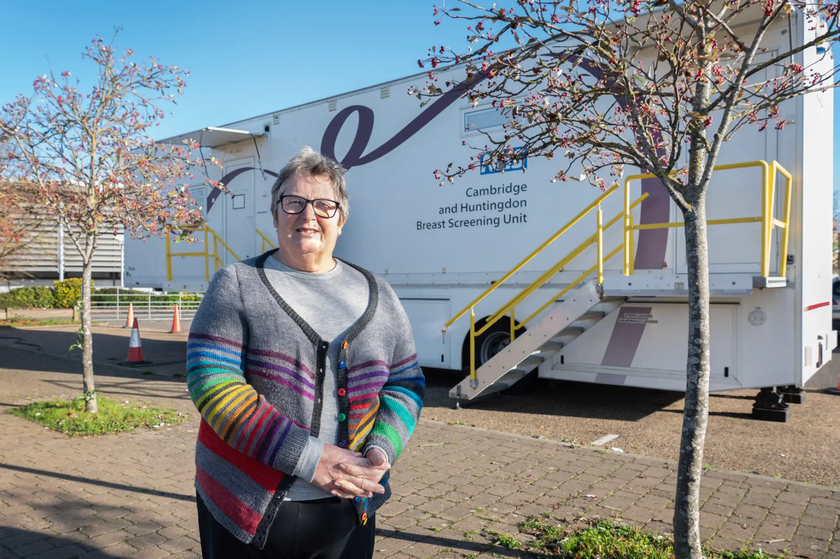
Shirley, diagnosed after routine screening in 2025, outside a Cambridge screening unit. She is not participating in EDITH. Photo: Cambridge University Hospitals. Source: Cambridge University Hospitals.
The existing NHS approach uses two specialists to examine each woman's mammograms, the breast X-rays used to look for cancer. AI assistance could allow many images to receive one human reading instead, releasing specialist time for diagnosis and care.
The study is led by the University of Warwick, the University of Cambridge and Cambridge University Hospitals NHS Foundation Trust, the hospital organisation behind the Cambridge launch. Warwick and the hospital trust are co-sponsors responsible for the research. Funding comes from the National Institute for Health and Care Research (NIHR), the government's health research funder; NHS England and the UK National Screening Committee helped shape the study design.
The hospital announcement says around 2.1 million women in the UK undergo breast screening annually. It says fewer than 1% of mammograms show signs of cancer, so specialists spend substantial time reviewing negative images. That explains the potential capacity gain, but does not establish that fewer human readings will preserve cancer detection or improve the whole service.
EDITH means Early Detection using Information Technology in Health. The government announced it on 4 February 2025, citing £11 million of NIHR support. The current hospital announcement describes a £10 million trial. Neither announcement explains the difference; the new milestone is recruitment, with further sites due to invite women in the coming months.
Warwick's participant information describes random allocation to three groups:
All images will be reviewed by at least one human expert. At a centre's initial introduction to the study, there may also be a period when two experts read the images as usual and consider an additional AI assessment.
The participant information plans for 660,000 women across approximately 30 centres in England, Scotland, Wales and Northern Ireland. That differs from the roughly 700,000 in launch coverage; both are planned participation figures, not numbers already recruited.
Sian Taylor-Phillips, a trial leader, NIHR research professor and professor of population health at Warwick, said her team had tested four AI systems for accuracy. In the trial report, she stressed that clinical decisions would remain with NHS staff. That accuracy testing precedes the assessment of how AI performs within routine screening.
Fiona Gilbert, the Cambridge radiology professor and honorary consultant at Cambridge University Hospitals who also leads the trial, brings experience researching risk-based breast screening. The hospital says her previous work examined additional imaging for some women according to cancer risk; she is also exploring AI to assess future breast-cancer risk. EDITH's immediate question is how to read screening images, rather than whether to change who receives additional imaging.
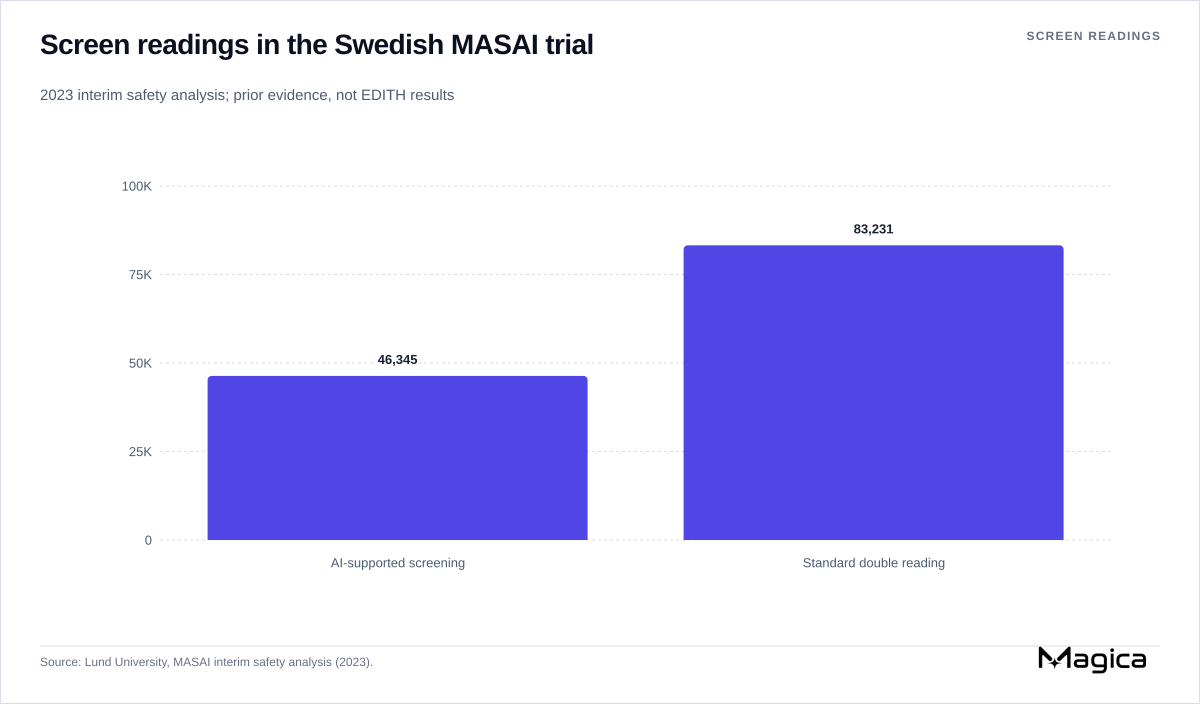
MASAI recorded fewer screen readings with AI support. The groups included 40,003 and 40,030 women respectively. These Swedish findings are not EDITH results. Source: Lund University. Source: Lund University.
AI-assisted reading already has randomised evidence behind it. Lund University researchers' 2023 interim safety analysis of the Swedish MASAI trial covered 80,033 women randomly assigned to AI-supported screening or standard double reading. Screen-reading workload was 44% lower with AI support. The AI approach directed higher-risk examinations to two readers and the remainder to one, with software also highlighting suspicious findings.
The university cautioned that the analysis came from one Swedish site and that results needed testing with other radiologists and AI algorithms. It showed a reduction in image readings, not a demonstrated reduction in NHS waiting lists or total screening costs. EDITH will test the approaches within UK services and compare their costs and benefits, alongside cancer detection and workload.
The immediate workforce problem also remains. The Royal College of Radiologists said more than a fifth of the breast radiology workforce was due to retire by 2030. Its president, Stephen Harden, warned that AI would not quickly resolve the need for more radiologists.
Deployment requires infrastructure as well as software. The hospital says NHS England's AI research screening platform, AIR-SP, will support EDITH as it progresses. Built with nearly £6 million of government funding, the platform is intended to make joining AI screening trials easier for NHS trusts. That is separate infrastructure funding, not evidence of savings from EDITH.
Screening appointments and the way results are communicated will stay the same. The NHS normally invites women every three years from age 50 until their 71st birthday. Trial information and opt-out details will accompany invitations at participating centres.
Women who opt out before or during their appointment receive standard reading by two NHS experts without AI. A later opt-out cannot undo an AI assessment already performed, although data can be excluded from trial analysis before analysis takes place. Registering with the National Data Opt-out prevents collection of data for the study results but does not itself prevent AI-assisted reading; women who do not want that must tell their screening centre.
The participant information says the East of England–Cambridge East Research Ethics Committee approved the study, and the Health Research Authority approved its application to use confidential patient information without consent after advice from an independent confidentiality group.
It identifies CIMAR (UK) Ltd as the company providing the secure cloud environment for AI reading. It says CIMAR already supports NHS lung screening and will hold confidential patient information for no more than 30 days before deleting it. Separately, the research team will retain study data for 20 years after the study finishes, before anonymising and archiving it or destroying it. AI providers and software supplier DICOM Systems may access data from outside the UK to check their products, but the information sheet says they cannot remove it from the UK-based CIMAR environment, retain it or use it for their own purposes.
The hospital says routine screening will change only if evidence shows AI assistance is as safe and effective as current care. EDITH will compare the number, size and type of cancers detected; recalls for further tests; cancers found between screening rounds; performance across different groups of women; workload; costs and benefits; and women's and staff members' experiences.
More detection can also mean more investigation. The participant information says some women may receive additional testing because of the study, with an extremely small radiation risk from additional imaging. Counting cancers found without also measuring recalls and missed cancers would leave the safety question incomplete.
Researchers will continue collecting available health information for several years to identify cancers missed in each group. Results will be published and shared with government and screening services to inform decisions about adoption. The next consequential finding is whether either AI approach improves the balance of reliable detection, follow-up testing and specialist workload enough to justify a change in routine care.
Bipartisan governors propose federal oversight of advanced AI models while preserving state protections for consumers, children and workers. Their framework also asks states to harmonize rules, leaving the boundary between national consistency and local accountability unresolved.
Sarvam says Token Factory uses private GPUs, separate from subsidised model development. Its own launch data show a competitive hosting business whose value depends on workload, price, control and the location of infrastructure.
The London-based startup is valued at $450 million as two UK government-backed funds invest together for the first time. Its virtual battlefield aims to accelerate autonomous-system testing, but the announcements provide no measured performance or cost results.
Ant Group led a $100 million round valuing Simplexity Robotics at $1.6 billion. Founded by former Li Auto executives, the startup is putting wheeled robots into factories, but the reported deployments leave customer economics unproven.
Reports describe Alice Huang’s contacts with a Chinese intelligence officer during her relationship with former Nvidia CEO Jensen Huang. Officials have not concluded she spied for China, while a separate chip-export investigation raises questions about enforcement.
Mass General Brigham spinout Aevius launched with $22 million in seed funding for AI models that combine patient data across formats and time. Its founders previously helped build Modella AI, acquired by AstraZeneca, but its launch announcement supplies no performance results or deployment costs.
Compute Desk announced a $45 million Lightspeed-led seed round for GPU pricing, contracting and physical settlement. Its investors see a route to financeable compute, but planned futures markets and unreported adoption leave that ambition unproven.
Jay Clayton confirmed an investigation into former Megaspeed executive Alice Huang and her firm, without resolving espionage or military-use allegations. Official records trace the chip-diversion inquiry to 2024, while separate reporting alleges Li Ming helped direct the business.
Satya Nadella says Claude Code caught Microsoft off guard by moving AI coding toward the terminal. Microsoft’s response includes managing rival agents in VS Code, while its investment and cloud commitments with Anthropic complicate the competitive picture.
Apple’s reported Siri layoffs targeted older infrastructure, while a beta update points to some migration onto newer systems. The harder test is delivering app control promised in 2024 and subsequently delayed.
Zhipu says GLM-5.4 adds vision and stronger coding to its subscription service, with larger usage quotas. Undisclosed credit rates and benchmarks leave its value unresolved as the company expands a cloud business backed by substantial financing.
The London consumer law business has secured seed funding led by Insight Partners to expand beyond conveyancing. Its bet is on delivering legal work directly, but claimed growth has yet to establish a cost or service advantage over competing practices.
Meta chief AI officer and former Scale AI CEO Alexandr Wang warns that unconstrained AI self-improvement threatens human control. His call for a different industry path follows an AI-assisted mathematical breakthrough, but neither that collaboration nor new research-automation data establishes fully autonomous science.
US President Donald Trump urged Nvidia to bring back its co-founder and former CEO Jensen Huang, despite a reported board statement against reinstatement and unresolved allegations involving Chinese intelligence and chip shipments.
Claude’s estimated October web visits rose 23.8%, but the figures measure neither paying customers nor job losses. A resurfaced account of Dario Amodei discussing immersive games at OpenAI raises a separate question about how AI’s builders approach its social consequences.
OpenAI wants frontier labs to tie development limits to prediction loss and monitoring milestones. Its internal figures offer a starting point, but datasets differ across companies and the metric misses major reasoning gains.
A 2,000-cubic-metre tank and mobile pumping capacity address northern Hong Kong flooding, while AI tools help position crews and detect rising water. Official records distinguish established monitoring from three-site forecasting trials, with costs disclosed but comparative performance results absent.
Reported server price demands reach 45% above earlier agreements. HPE explicitly permits repricing before shipment, while XTX's disputed Dell order raises a sharper question: what happens when a buyer says it paid extra for a fixed price?
OpenRouter disclosed provider removals after investigations into inference data handling. Separate notices describe forwarded requests, a compromised deployment and stolen prompt samples, exposing different weaknesses behind privacy assurances.
Choi Kyo-jin resigned after last-minute anti-cheating changes disrupted preparations for South Korea’s college entrance exam. A breakdown of 111 electronic-device cases leaves the extent of AI-assisted cheating unresolved as authorities review penalties and future safeguards.