Editorial Team
6 min read
Sierra’s $1.75 billion Series F follows reported annual recurring revenue above $400 million. Competitors already offer outcome pricing and agents that act on customer accounts, making reliability and delivery costs central to its $30 billion valuation.
Sierra, which builds AI agents for businesses to handle customer conversations and transactions, announced the round on November 23. The financing backs its ambition to become companies’ “digital front door,” after a $950 million round in May valued it at more than $15 billion.
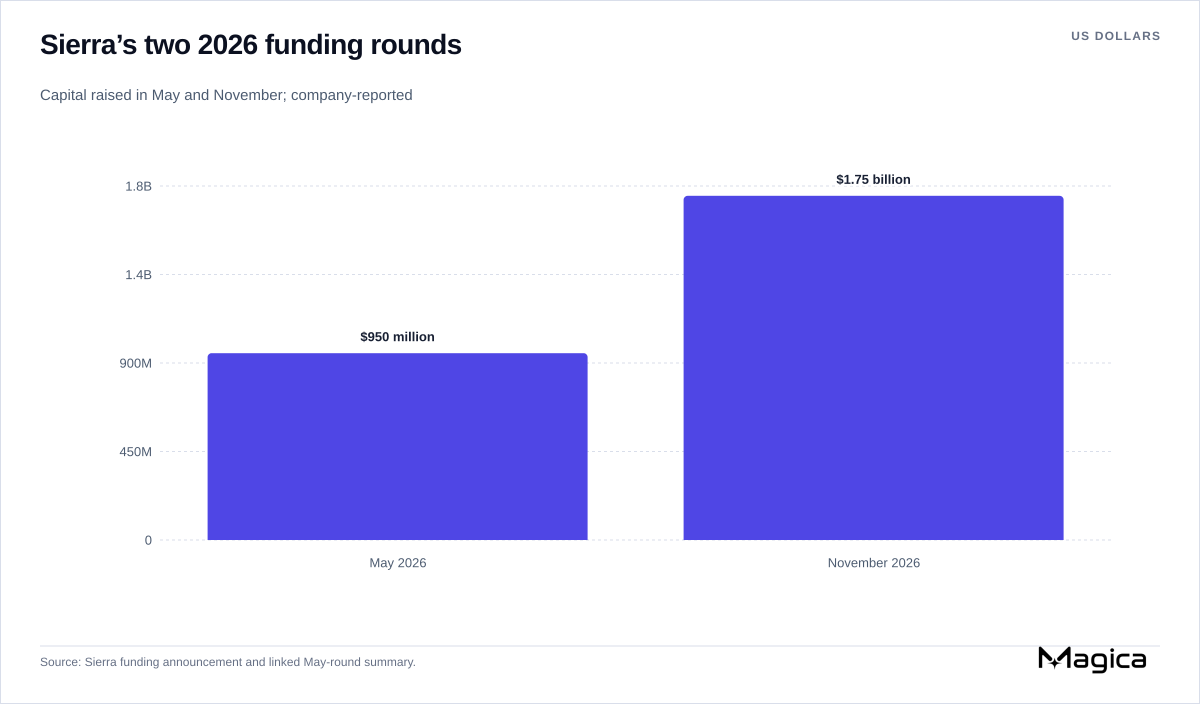
Company-reported capital raised in Sierra’s May and November 2026 rounds. Source: Sierra; chart: Magica. Source: Sierra.
Sierra said in its funding announcement that all its previous lead investors—Benchmark, Sequoia, Greenoaks, GV and Tiger Global—are investing again. The new round is nearly twice the size of May’s financing, whose amount and valuation are recorded in a funding overview. Existing backers are increasing their exposure as Sierra seeks larger enterprise relationships.
Founded in San Francisco in 2023, Sierra brings established enterprise-software and product leadership to that pursuit. Co-founder Bret Taylor previously served as co-CEO of Salesforce, a business-software provider competing in customer-service AI. Fellow co-founder Clay Bavor previously led Google Labs; both left those roles to build Sierra, as a 2024 interview explained.
Sierra says it exceeded $400 million in annual recurring revenue, or ARR, in just over two and a half years after launch. According to the funding overview’s account of Sierra’s October 30 disclosures, ARR rose from $100 million to $200 million in six months, then to $400 million in another five months. The company said it added more than $150 million in ARR in the third quarter of 2026 alone.
These company-provided figures measure recurring business at a point in time; they are not annual revenue already earned or evidence of profit. They support the growth case while leaving the cost of delivering that growth unresolved.
Sierra also says it works with almost 50% of Fortune 50 companies. In a report on the round, the company’s clients include BNY, HSBC, Wells Fargo, JPMorganChase, Singtel, Pearson, Next and Cox Automotive. That establishes reported reach into major enterprises, without showing what proportion of their customer interactions Sierra handles.
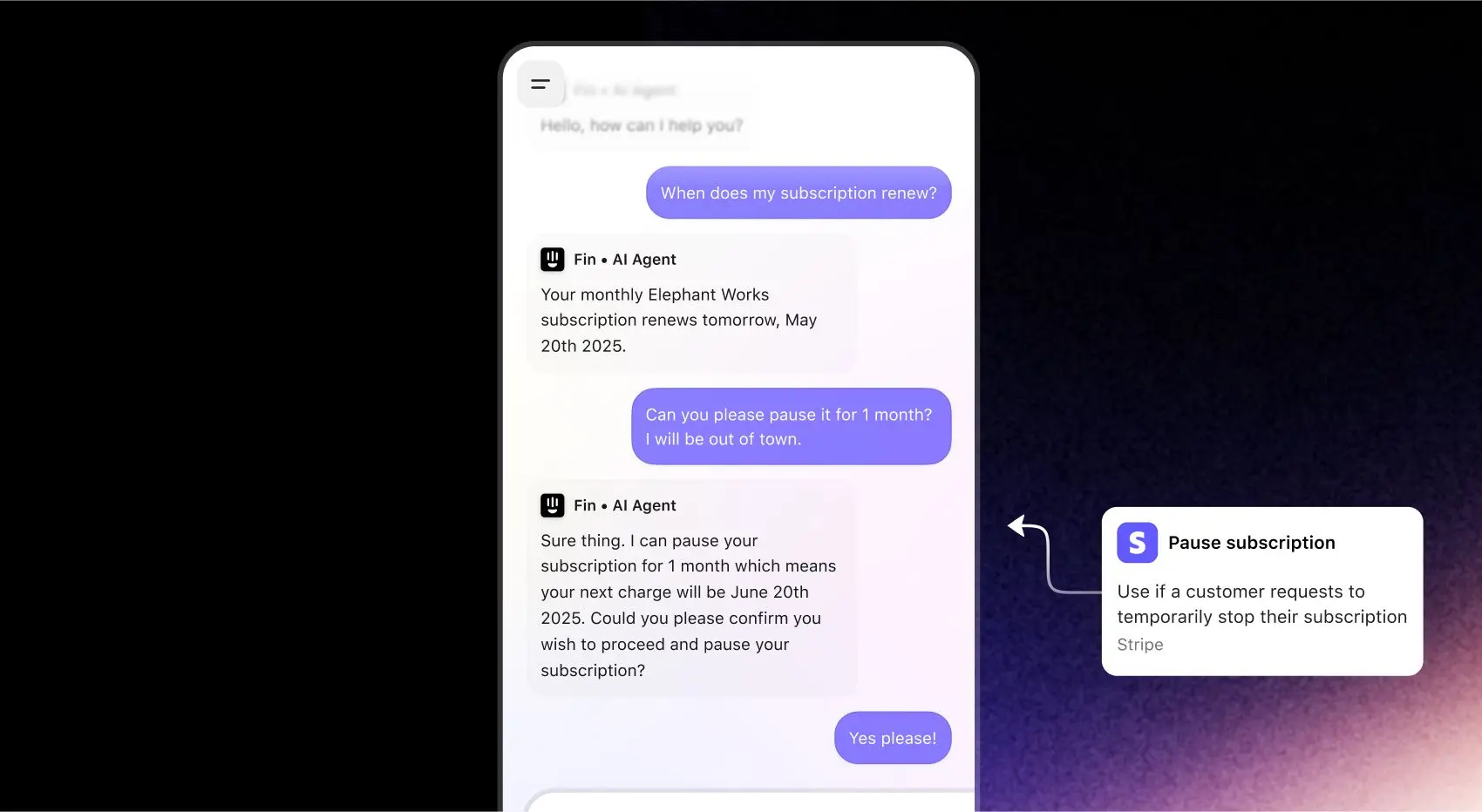
Intercom’s company-reported Fin capabilities include subscription changes through a Stripe connection. Product illustration: Intercom. Source: Intercom.
Sierra says it charges for completed outcomes, including a resolved problem, an originated loan, a paid insurance claim or a retained subscriber, rather than tokens or usage. It argues that this aligns its revenue with customers’ results.
The approach has precedents. Customer-service software provider Intercom’s October 2024 announcement of Fin 2, its customer-service AI agent, offered resolution-based pricing at $0.99 per resolution, with no charge when Fin could not answer. Intercom said Fin could retrieve customer information and update records, including shipping addresses and subscriptions. Transactional capabilities, as well as the pricing principle, therefore predate Sierra’s latest financing.
That is a historical benchmark, not a current price comparison: Sierra’s funding announcement supplies no unit-price schedule, and a support resolution differs from a loan origination or an insurance payout. Nor does the Fin announcement establish that all those services have equivalent complexity or value.
The industry overview also describes Salesforce and business-software provider HubSpot moving agents toward pricing based on resolutions or results. The funding report identifies other well-funded customer-experience competitors, including Decagon, Wonderful and Parloa. Sierra is financing expansion in a market where buyers have alternatives.
For vendors, billing only for success shifts attention to the resources consumed before an outcome becomes billable. Model computation, integration work and human supervision all matter. Neither reported ARR nor the pricing principle establishes Sierra’s margin per completed task.
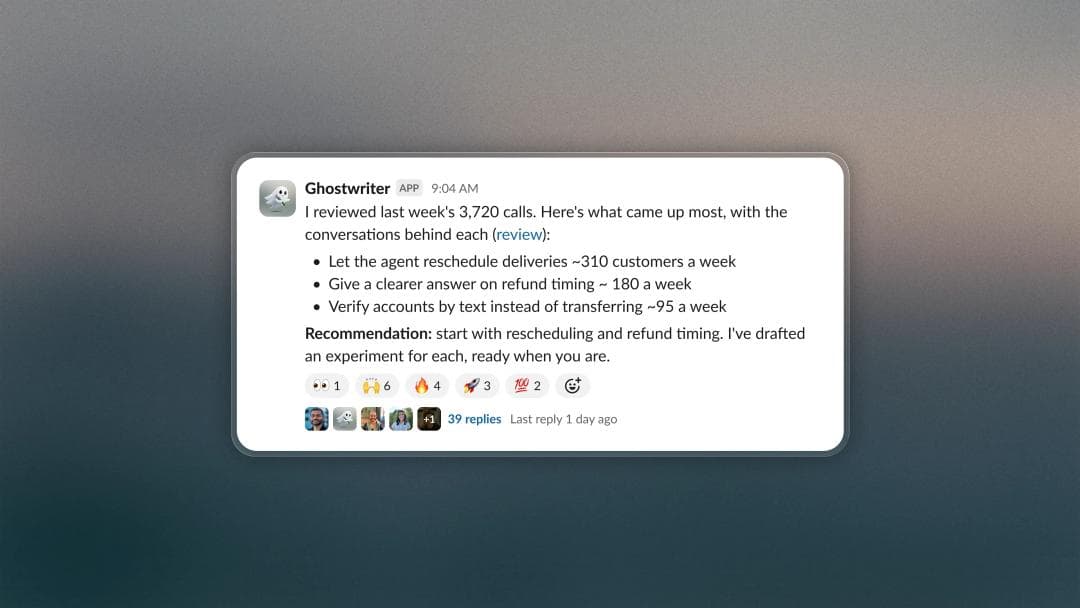
Sierra’s company-reported Ghostwriter capabilities include reviewing conversations and suggesting experiments. Product illustration: Sierra; example figures are illustrative. Source: Sierra.
Sierra says Ghostwriter, its agent-building tool, turns customer-defined goals and guardrails into agents it builds, tests and deploys. It also reviews conversations and suggests improvements. The company’s partnership model combines customers’ domain knowledge with Sierra’s deployment experience.
Its December 2025 architecture explanation describes agents assembled from more than 15 frontier, open-weight and proprietary models. Sierra says it selects models separately for tasks such as low-latency tool use, classification, long-context reasoning and conversational tone, and fine-tunes models where off-the-shelf options fail its requirements.
The same account describes supervisors enforcing policies and quality checks. Sierra says it monitors model-provider latency, errors and timeouts, and automatically routes work to equivalent models when a provider deteriorates. Those are company descriptions of safeguards, rather than independently measured uptime or error rates. They show why the underlying model is only one dependency in delivering a reliable transaction.
Sierra’s expansion also includes buying capabilities. The industry overview reports its July acquisition of long-horizon agent runtime Takeoff and its acquisition of Anon, a browser-automation vendor that lets agents navigate websites without APIs. It describes Horizon, Sierra’s platform spanning areas including lending and healthcare, and a Compliance Console for enforcing rules across jurisdictions. These additions extend the deployment work beyond answering questions.
The funding report says Sierra plans to expand its technology stack and sales team to win and maintain enterprise contracts. The industry overview describes European and Asian expansion and a push into sales and customer lifetime-value optimization. It also reports SoftBank becoming its exclusive Japan sales partner and a three-year Liberty Global framework covering roughly 80 million European connections. That framework’s reach is not a count of customers already served by Sierra agents.
The same overview reports the November 13 release of Personal Agent Protocol 1.0, a protocol for interactions between personal agents and businesses, with design partners including Meta, Shopify, Stripe and Walmart. Its release extends Sierra’s ambition beyond a company’s own chat window to exchanges between agents; it does not establish widespread use.
The next evidence buyers and investors need concerns deployments after launch: successful task completion, human intervention, renewals and delivery costs. The industry overview relays Sierra’s claim that an unnamed US retailer with more than $40 billion in revenue went from first meeting to a live agent in 27 days. That is a claim about launch speed, not sustained performance.
The effects on workers also remain consequential. In September, Bavor argued that a majority of Sierra’s customers were reassigning existing employees rather than replacing them, according to the funding report. That is the co-founder’s account of customer behavior, not an independent workforce assessment.
The financing gives Sierra more resources to pursue enterprise contracts. The test of its $30 billion valuation is whether its reported growth can translate into reliable, repeatable and profitable service as those deployments expand.
Maintainers defend continued distribution of the AI penetration-testing framework after its creator withdrew it. Investigations document data theft and cheap automation, but also failed payouts, blocked attacks and safeguards that vary by version.
China Telecom's AI arm has released the 285-billion-parameter Xing4.1-Preview under Apache 2.0, extending its TeleChat model lineage and domestic-compute strategy. Its million-token context and quantized variants widen deployment choices, but mixed benchmarks and incomplete cost disclosures leave its low-cost pitch unproven.
Applied Digital signed an 18-year lease for 150 MW with an unnamed investment-grade hyperscaler. Higher pricing strengthens its contracted revenue book, but financing, power arrangements and construction still stand between the agreement and delivery.
Sarvam Dictate combines speech recognition and text editing for English and 22 Indian languages at ₹0.50 per audio minute. Its company-run benchmarks show fewer character edits than rival APIs, but the advantage varies by language and recording length.
Arm CEO Rene Haas will become SoftBank Group vice chairman on December 1, building on existing roles at its controlling shareholder as Arm expands beyond processor licensing into its own chips. The extension follows a reported Nvidia recruitment approach, but Nvidia has since reinstated co-founder Jensen Huang as CEO.
Trump claimed personal credit for Jensen Huang’s reinstatement after Nvidia received government security assurances. The reversal leaves questions about export controls, presidential influence and Trump’s financial stake unresolved.
The states allege that Grok and X enabled nonconsensual sexualized images while misleading consumers about safeguards. Their consumer-protection cases seek financial penalties and court orders against SpaceX and its subsidiaries.
Founded in May, Marlowe has raised $277 million at a company-reported $1.15 billion valuation to build inference infrastructure using AMD and Etched chips. Its first deployments will test whether engineering across hardware and software can deliver its promised efficiency gains.

Amazon has agreed to buy Decart’s optimization technology and recruit its founders and engineers after working together on Trainium since 2025. Reports value the deal at $7.5 billion or more, with deferred payments and five-year retention commitments; Amazon has disclosed neither a price nor quantified savings.
Vals found profanity in 14 of 102 AI models and higher failure rates in a small subset of swearing runs. Unequal visibility into reasoning and the concentration of outbursts in difficult tasks limit what the pattern can tell users.
Nvidia’s board has restored founder Jensen Huang as president, CEO and a director, citing senior U.S. government input in its security assessment. The independent investigation continues as the company adds board oversight and seeks a compliance chief.
Bipartisan governors propose federal oversight of advanced AI models while preserving state protections for consumers, children and workers. Their framework also asks states to harmonize rules, leaving the boundary between national consistency and local accountability unresolved.
Sarvam says Token Factory uses private GPUs, separate from subsidised model development. Its own launch data show a competitive hosting business whose value depends on workload, price, control and the location of infrastructure.
The London-based startup is valued at $450 million as two UK government-backed funds invest together for the first time. Its virtual battlefield aims to accelerate autonomous-system testing, but the announcements provide no measured performance or cost results.
Recruitment has begun in Cambridge for a trial expected to involve around 700,000 women, testing whether AI can help detect breast cancer and release specialist time while keeping clinical decisions with NHS staff.
Ant Group led a $100 million round valuing Simplexity Robotics at $1.6 billion. Founded by former Li Auto executives, the startup is putting wheeled robots into factories, but the reported deployments leave customer economics unproven.
Reports describe Alice Huang’s contacts with a Chinese intelligence officer during her relationship with former Nvidia CEO Jensen Huang. Officials have not concluded she spied for China, while a separate chip-export investigation raises questions about enforcement.
Mass General Brigham spinout Aevius launched with $22 million in seed funding for AI models that combine patient data across formats and time. Its founders previously helped build Modella AI, acquired by AstraZeneca, but its launch announcement supplies no performance results or deployment costs.
Compute Desk announced a $45 million Lightspeed-led seed round for GPU pricing, contracting and physical settlement. Its investors see a route to financeable compute, but planned futures markets and unreported adoption leave that ambition unproven.
Jay Clayton confirmed an investigation into former Megaspeed executive Alice Huang and her firm, without resolving espionage or military-use allegations. Official records trace the chip-diversion inquiry to 2024, while separate reporting alleges Li Ming helped direct the business.