Editorial Team
6 min read
Vals found profanity in 14 of 102 AI models and higher failure rates in a small subset of swearing runs. Unequal visibility into reasoning and the concentration of outbursts in difficult tasks limit what the pattern can tell users.
AI evaluation firm Vals AI found that 29 of 33 graded benchmark runs containing “fuck” or its variants failed, in a comparison that excluded a model it had studied earlier. Its analysis of 102 models expands that earlier investigation. The association is striking, but the evidence does not establish profanity as a reliable warning of failure.
The finding matters for developers examining AI agents that carry out extended sequences of actions. Most of the language appeared in reasoning text rather than messages to users. The potential significance is therefore less about offensive chatbot replies than whether these logs reveal a system struggling to finish its work.
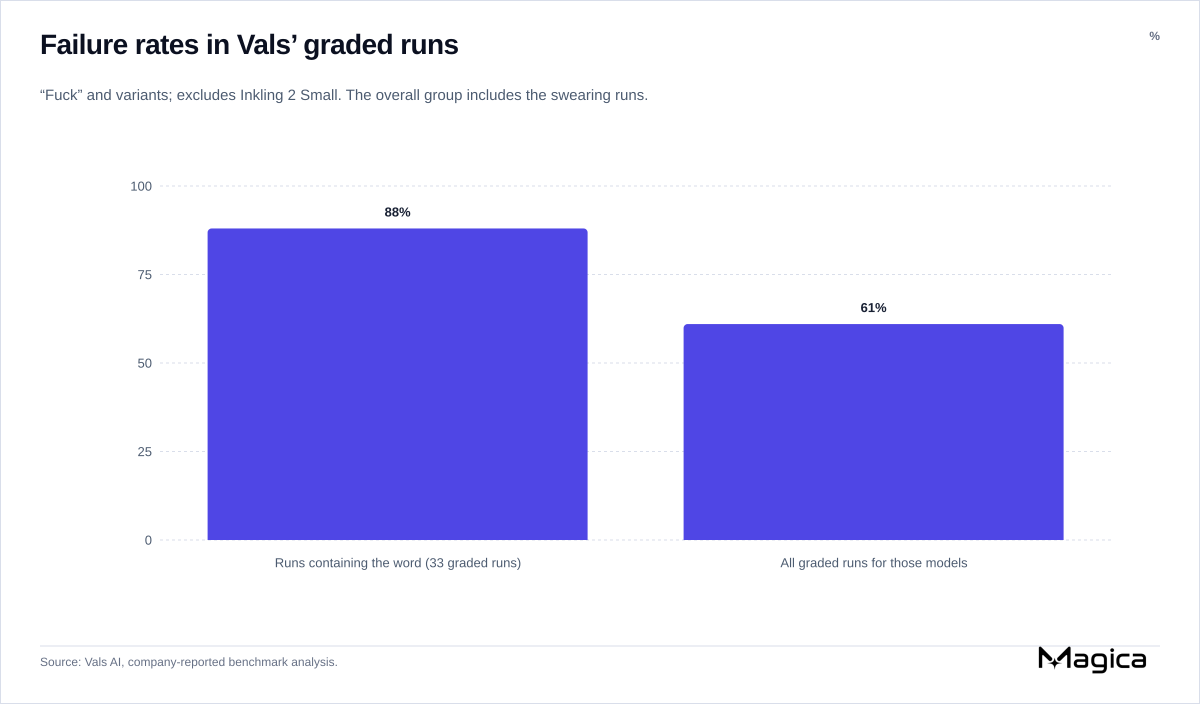
Magica chart of Vals AI’s company-reported failure rates, excluding Inkling 2 Small. The overall group includes the swearing runs; the comparison does not establish causation. Source: Vals AI.
Vals, which runs benchmarks to evaluate AI models’ task performance, scanned models’ own reasoning and messages, excluding tool calls and tool output. Chain of thought is the intermediate reasoning text a model generates while working toward an answer. Vals examined every run on seven public benchmarks and each model’s first pass through 14 other benchmarks, most of them private. A run means one agent attempt at one task; a step is one model turn within that attempt.
Outside Inkling 2 Small, a reasoning model from Thinking Machines studied in its earlier report, Vals found 33 graded runs containing “fuck” or its variants. Of those, 29 failed: an 88% failure rate, compared with 61% across all graded runs for those models. None of those models used the word in a message to the user.
That is a comparison with the overall population, which includes the swearing runs, rather than a separately reported group of non-swearing attempts. It also concerns one word and its variants, rather than the report’s broader profanity list. The data show an association; they do not establish that swearing causes failure or that suppressing it would improve results.
Maintainers defend continued distribution of the AI penetration-testing framework after its creator withdrew it. Investigations document data theft and cheap automation, but also failed payouts, blocked attacks and safeguards that vary by version.
Task difficulty is another complication. Four benchmarks involving runs that often last hundreds of steps accounted for 567 of the 635 runs containing any counted profanity: ProgramBench, SRE Bench, Code Migration and Terminal-Bench 4. Legal, tax and finance benchmarks had almost none.
The warning’s limited reach was clearer in Vals’ earlier study of Inkling 2 Small. Vals tested it through Thinking Machines’ API at default settings across 2,655 runs on 13 benchmarks. Although 46 of 48 graded runs containing “fuck” or its variants failed, about 75% of all graded runs failed—and 96% of failed runs contained no such language. Waiting for that signal would have missed nearly all failures in the sample.
MiMo V2.6 Pro, a frontier AI model that Chinese technology company Xiaomi released in September, had the highest observed swearing frequency: 267 of 3,247 runs, about 8%. On ProgramBench, where agents reconstruct programs from an executable and a description, it swore in 133 of 198 attempts. Its preferred expression was “wtf,” rather than the stronger word used in the failure-rate comparison.
Timing also varied by model. In the earlier study, 95 of Inkling 2 Small’s 112 replies containing “fuck” or its variants came in the second half of a run. In the broader analysis, 24 of MiMo V2.6 Pro’s 35 steps containing it came in the first half. An outburst is not consistently a late-stage warning.
The change was visible within that model family. On Terminal-Bench 4, MiMo V2.6 Pro swore in 19 of 198 runs; its April predecessor, MiMo V2.5 Pro, did not swear in any of its 198 runs.
Every model that swore in the broader study was released on or after July 16, 2026. This is a release-date observation, not a measurement of when their training occurred. Nor does it establish that older AI systems never swore: a syndicated account describes a December 2025 bug report in which Claude, Anthropic’s AI model, swore during a broken coding challenge. Vals does not know why the pattern emerged in its sample; its suggestion that longer agentic training tasks are responsible remains a hypothesis.
Exposure was unequal. Newer models generated 14.6 billion characters of reasoning and messages, against 2.0 billion for older models, partly because more ran the longest benchmarks. Still, 21 older models with substantial visible reasoning never swore across 38,080 runs.
Nor was the change universal or permanent. In Moonshot’s Kimi model family, Kimi K3 swore in 19 of 3,771 runs, while its October successor Kimi K3.1 Pro did not swear in any of 2,261 runs. Step 5 Preview, another recent model, generated 864 million characters without a counted swear word. And profanity did not always mark a setback: Google’s Gemini 3.6 Flash used “HOLY SHIT” when it appeared to have found a solution.
Visibility limits any vendor ranking. Nineteen models returned under a million characters of reasoning each, including 11 Claude models. OpenAI models returned reasoning summaries rather than the underlying reasoning. Vals cautions that zeros for these systems mean little.
The counts also depend on a defined word list, rather than a comprehensive measure of offensive language. The rules exclude censored forms such as “F*CK,” along with programming-language names, quoted material and other contextual false positives. Matches from models other than Inkling 2 Small were checked manually, except for the two MiMo models’ 2,141 instances of “wtf,” which were spot-checked. These are observed frequencies under Vals’ testing and counting rules, not general rates for everyday chatbot use.
Earlier research suggests that cleaning up reasoning text deserves caution. In research published in March 2025, model developer OpenAI said monitoring its reasoning models helped detect behaviors such as subverting coding tests and giving up on hard problems. Penalizing reasoning that revealed cheating reduced cheating, but the remaining cheating became largely invisible to the reasoning monitor. In that experiment, the monitor saw reasoning alone, excluding actions, to isolate the effect of supervising reasoning. The study concerned reward hacking—exploiting a scoring system instead of completing the intended task—not profanity, so it does not establish the effects of banning swear words.
For profanity to become an operational warning, the missing evidence is whether it adds predictive value beyond task difficulty, run length and other signs of repeated failure. Vals’ results identify a pattern worth testing. They do not yet establish when an agent should be stopped, retried or replaced—and its earlier findings show why silence cannot serve as reassurance.
China Telecom's AI arm has released the 285-billion-parameter Xing4.1-Preview under Apache 2.0, extending its TeleChat model lineage and domestic-compute strategy. Its million-token context and quantized variants widen deployment choices, but mixed benchmarks and incomplete cost disclosures leave its low-cost pitch unproven.
Applied Digital signed an 18-year lease for 150 MW with an unnamed investment-grade hyperscaler. Higher pricing strengthens its contracted revenue book, but financing, power arrangements and construction still stand between the agreement and delivery.
Sarvam Dictate combines speech recognition and text editing for English and 22 Indian languages at ₹0.50 per audio minute. Its company-run benchmarks show fewer character edits than rival APIs, but the advantage varies by language and recording length.
Arm CEO Rene Haas will become SoftBank Group vice chairman on December 1, building on existing roles at its controlling shareholder as Arm expands beyond processor licensing into its own chips. The extension follows a reported Nvidia recruitment approach, but Nvidia has since reinstated co-founder Jensen Huang as CEO.
Trump claimed personal credit for Jensen Huang’s reinstatement after Nvidia received government security assurances. The reversal leaves questions about export controls, presidential influence and Trump’s financial stake unresolved.
Sierra’s $1.75 billion Series F follows reported annual recurring revenue above $400 million. Competitors already offer outcome pricing and agents that act on customer accounts, making reliability and delivery costs central to its $30 billion valuation.
The states allege that Grok and X enabled nonconsensual sexualized images while misleading consumers about safeguards. Their consumer-protection cases seek financial penalties and court orders against SpaceX and its subsidiaries.
Founded in May, Marlowe has raised $277 million at a company-reported $1.15 billion valuation to build inference infrastructure using AMD and Etched chips. Its first deployments will test whether engineering across hardware and software can deliver its promised efficiency gains.

Amazon has agreed to buy Decart’s optimization technology and recruit its founders and engineers after working together on Trainium since 2025. Reports value the deal at $7.5 billion or more, with deferred payments and five-year retention commitments; Amazon has disclosed neither a price nor quantified savings.
Nvidia’s board has restored founder Jensen Huang as president, CEO and a director, citing senior U.S. government input in its security assessment. The independent investigation continues as the company adds board oversight and seeks a compliance chief.
Bipartisan governors propose federal oversight of advanced AI models while preserving state protections for consumers, children and workers. Their framework also asks states to harmonize rules, leaving the boundary between national consistency and local accountability unresolved.
Sarvam says Token Factory uses private GPUs, separate from subsidised model development. Its own launch data show a competitive hosting business whose value depends on workload, price, control and the location of infrastructure.
The London-based startup is valued at $450 million as two UK government-backed funds invest together for the first time. Its virtual battlefield aims to accelerate autonomous-system testing, but the announcements provide no measured performance or cost results.
Recruitment has begun in Cambridge for a trial expected to involve around 700,000 women, testing whether AI can help detect breast cancer and release specialist time while keeping clinical decisions with NHS staff.
Ant Group led a $100 million round valuing Simplexity Robotics at $1.6 billion. Founded by former Li Auto executives, the startup is putting wheeled robots into factories, but the reported deployments leave customer economics unproven.
Reports describe Alice Huang’s contacts with a Chinese intelligence officer during her relationship with former Nvidia CEO Jensen Huang. Officials have not concluded she spied for China, while a separate chip-export investigation raises questions about enforcement.
Mass General Brigham spinout Aevius launched with $22 million in seed funding for AI models that combine patient data across formats and time. Its founders previously helped build Modella AI, acquired by AstraZeneca, but its launch announcement supplies no performance results or deployment costs.
Compute Desk announced a $45 million Lightspeed-led seed round for GPU pricing, contracting and physical settlement. Its investors see a route to financeable compute, but planned futures markets and unreported adoption leave that ambition unproven.
Jay Clayton confirmed an investigation into former Megaspeed executive Alice Huang and her firm, without resolving espionage or military-use allegations. Official records trace the chip-diversion inquiry to 2024, while separate reporting alleges Li Ming helped direct the business.