Editorial Team
5 min read
Boston Dynamics has fitted its electric Atlas humanoid with scooter wheels to test learned controls against real motor limits. The research feeds into the walking robot as Hyundai plans factory deployment, but the demonstration offers no quantified reliability gains.
Boston Dynamics has replaced the feet of its electric Atlas humanoid with scooter wheels to test whether a controller learned in simulation can handle the limits of real motors. The robotics developer presented the experiment on November 9, saying the lessons are already being applied to its standard walking robot.
The work has an industrial destination. Hyundai Motor Group, the automotive group whose brands include Hyundai, Kia and Genesis and which holds an ownership interest in Boston Dynamics, plans to introduce Atlas at one of its factories in 2028. The wheel demonstration tests part of the control system behind that ambition; it does not measure factory performance.
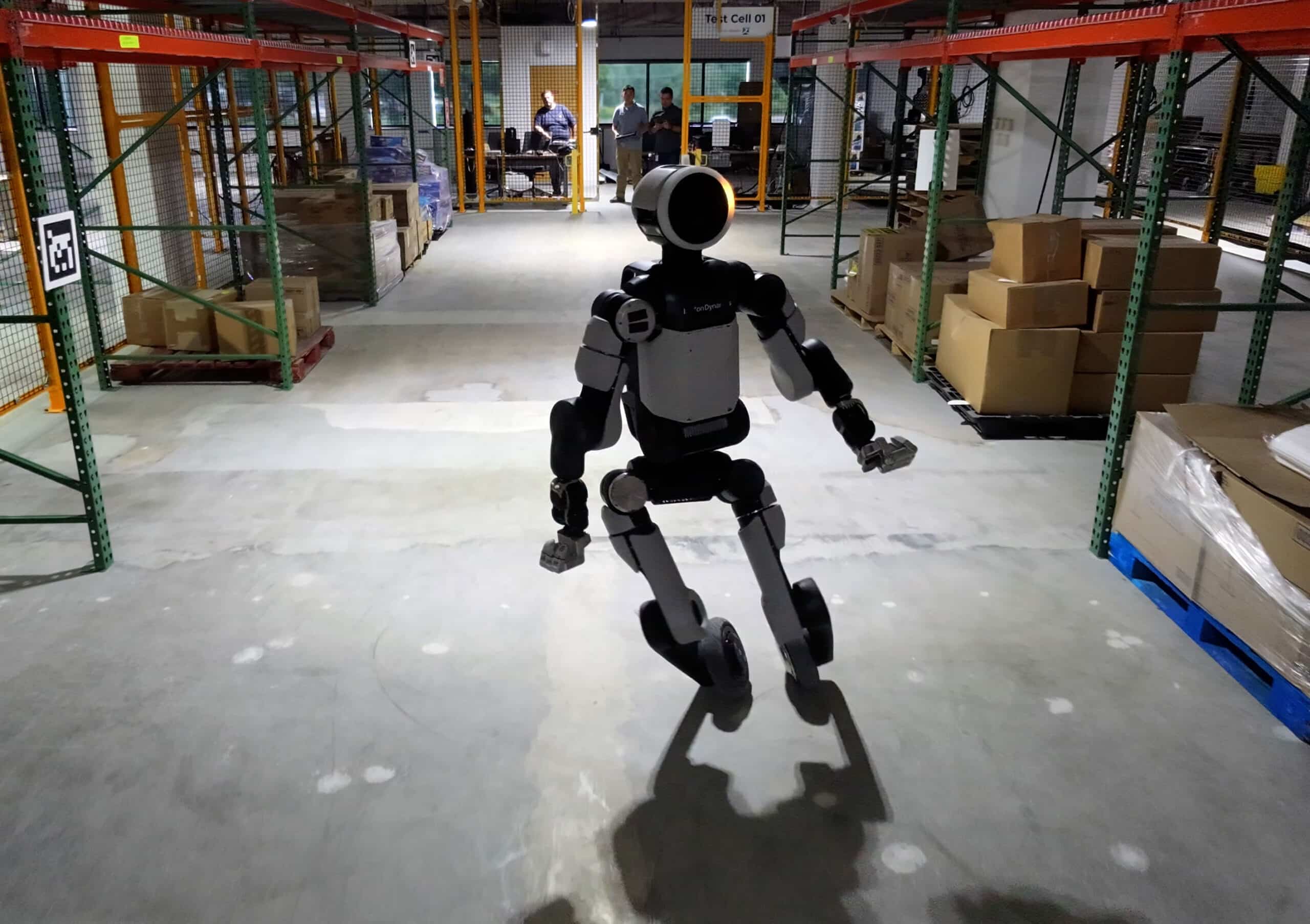
Atlas on ankle-mounted wheels in a test warehouse during a company-reported research demonstration. Credit: Boston Dynamics. Source: Boston Dynamics.
Xiaoyu “Andy” Wu, an Atlas controls engineer with more than a decade of experience controlling electric motors and their power electronics at Boston Dynamics and elsewhere, explains the project in the company’s technical account. His responsibility is making motors and actuators behave predictably and reliably. He describes the project as his first substantial dive into reinforcement learning, drawing on colleagues who specialize in it.
Boston Dynamics says customer experience with its Spot quadruped and Stretch warehouse robot has exposed challenges that laboratory work cannot fully reproduce. For Atlas, the team wanted sustained demand for high torque and high speed while the motors carried the robot’s weight. Wheels let launches, turns and stops exercise the motors across their torque-speed range.
The conversion reused the robot’s existing ankle actuators. A custom adapter connects an off-the-shelf scooter rim to an actuator; Wu says the adapter is the build’s only new part. In software, the team represents each wheel as an ankle joint that can rotate continuously. Boston Dynamics attributes the straightforward retrofit to Atlas’s design for high-volume production and servicing, although it supplies no conversion cost or measured installation time.
UC Berkeley and NVIDIA are releasing tools for AI agents to assemble and improve robot programs in simulation. A warehouse operator reports a useful production update, while unsuccessful fixes and benchmark results show why testing, speed and existing infrastructure still matter.
The more consequential work involved matching simulation to hardware. If simulated motors are too idealized, a learned controller—or policy—can exploit capabilities that physical motors lack. Wu describes checking low-level control parameters across software configurations, measuring hardware behavior and adjusting the simulated motor model to match those measurements.
The team adapted established reinforcement-learning frameworks, changing the rewards used to guide learning, command ranges and posture. Wu says smooth rolling emerged from those adjustments. The company also credits Google DeepMind’s MuJoCo team for the open-source physics engine supporting the work. The experiment therefore combines existing hardware, simulation infrastructure and learning software rather than introducing an entirely new control system.
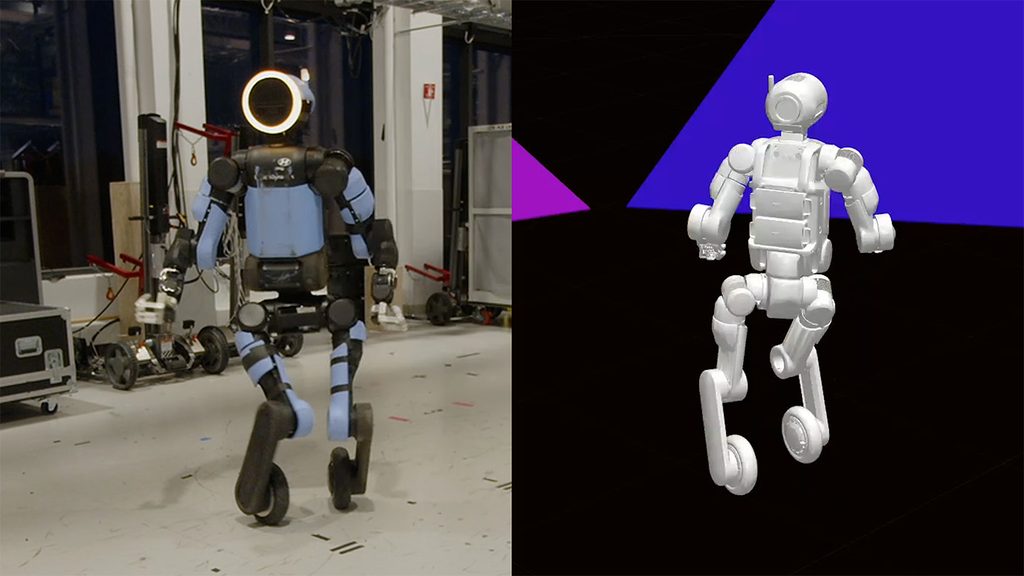
Physical and simulated versions of wheeled Atlas in Boston Dynamics’ company-reported control experiment. Credit: Boston Dynamics. Source: Boston Dynamics.
Some movements started with a library of human motion-capture recordings. Wu selected clips involving sliding feet. In side dashes, the policy learned to steer the wheels and roll through the motion instead.
The 360-degree jump likewise followed a recorded human trajectory. Wu says it worked on the first attempt and was among the lower-risk moves, despite its energetic appearance. During the preparation for the jump, the lower body rolled into position before pushing upward. The demonstration shows adaptation to a different way of contacting the floor, with a human movement providing the target.
In the accompanying video, Wu describes the transfer from simulation to hardware as “basically perfectly.” That is his characterization: the announcement supplies no numerical transfer-error measure, repeated-trial success rate or endurance result. He also acknowledges that he could have tested a more conventional behavior on Atlas with feet.
Wheeled humanoids have precedents and commercial alternatives. A report on the experiment describes Unitree Robotics’ April demonstration of its G1 humanoid rolling on replacement wheels. It also identifies Swedish firm Hexagon’s AEON as an industrial humanoid designed around wheeled locomotion, with BMW bringing it into its Leipzig plant and a reported 1,000-unit commitment from Schaeffler.
Those are different kinds of evidence: a demonstration, an industrial introduction and a unit commitment do not establish comparable performance. They do show why putting wheels on a humanoid cannot itself establish novelty or commercial advantage. Boston Dynamics says its wheeled Atlas will remain a research tool.
Hyundai’s interest combines ownership, robot development and its own manufacturing operations. In a July 16 statement, the group said its shareholders were pursuing the acquisition of SoftBank’s entire stake in Boston Dynamics after SoftBank exercised a contractual right to require a purchase. The statement described governance reviews, approvals and settlement steps still pending; it did not announce a completed transaction or a purchase price.
Hyundai described a strategy combining Boston Dynamics’ robotics expertise with the group’s manufacturing capabilities and global value chain. It also pointed to Atlas demonstrations including transporting a 23-kilogram compact refrigerator. That is evidence of a demonstrated lifting task, not a continuous-duty payload rating or a measure of production throughput.
The group’s stated deployment plan starts with parts sequencing at Hyundai Motor Group Metaplant America in 2028. It envisages extending Atlas to component assembly by 2030, subject to technology validation, operational readiness and business requirements. These are planned applications and dates, rather than results achieved by the wheel experiment.
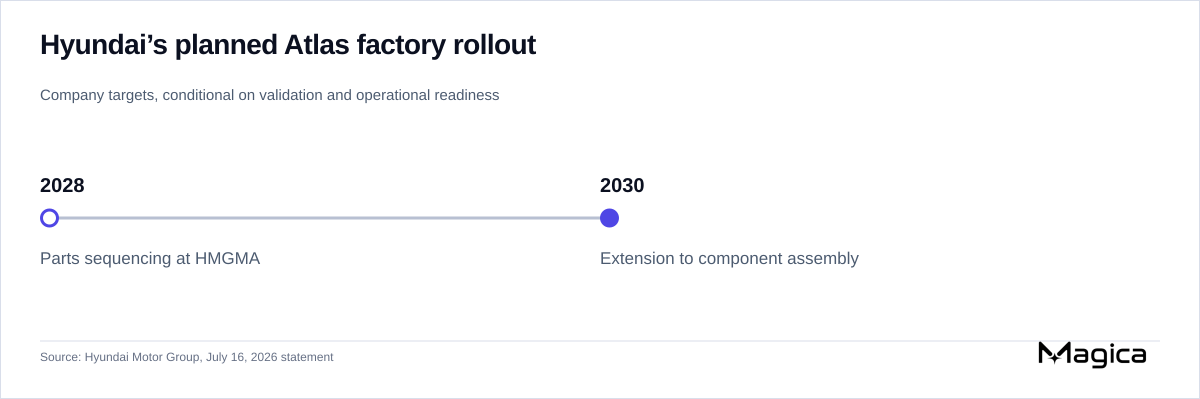
Hyundai’s company-reported Atlas deployment targets, subject to validation, operational readiness and business requirements. Source: Hyundai Motor Group. Source: Hyundai Motor Group.
Boston Dynamics says the wheel-test insights are already being adapted to standard Atlas. Wu says his next project is improving how the learned controller responds to failed actuators, including whether reinforcement learning can produce useful recovery behavior.
The next question is how reliably those changes work across repeated trials and sustained operation. The announcement gives no failure-frequency comparison, operating duration or cost per completed task. Those measures would help establish whether better motor modeling and failure responses deliver the dependable operation Hyundai’s factory plans require.
Cloud Pathways lets customers coordinate large TPU workloads from one Python client, extending the system Google used for Gemini training. General availability on GKE follows earlier customer access; substantial reported usage and internal recovery results still leave customer cost savings unmeasured.
NVIDIA’s GR00T 2 predicts video and robot actions together to transfer skills across bodies. Company tests show gains from human video, but selected tasks, corrective data and recovery agents qualify its strongest success rates.
Anthropic says its new AI model produced circuit boards, enclosures and firmware for three prototypes that needed no electrical fixes. The demonstration avoided factory revisions, according to the company, while leaving certification, manufacturing scale and total costs unproven.
Meta is reportedly building a consulting channel for corporate AI sales after announcing an enterprise platform led by former MongoDB CEO Chirantan Desai. Its hiring remit also covers advertising and messaging, while prospective partners already work with rival AI suppliers.
OpenAI’s $200 Chromatic: Codex Edition adds AI-assisted development to an existing cartridge-game platform. The public bundle includes a programmable cartridge, but creation requires a computer, established tools and playtesting; the store now lists a November 19 restock.
PwC US plans a December launch for a critical-thinking and judgment certificate, with completion targeted by June 2027. It will assess staff through performance reviews as the firm seeks new ways to develop skills once practiced through routine work.
Linnea Quigley and Beverly Randolph say Aftermath departed from the musical they agreed to make, exposing a gap between a marketed cast reunion and performers’ control over their screen identities.
Anthropic’s Claude Fable 5.2 and Mythos 5.2 bring lower token prices and stronger technical performance. The release also limits capabilities that could accelerate frontier AI development, as new evidence puts the pace of research close to a sensitive policy boundary.
Meta’s smallest Muse model matches Claude Haiku 5.5’s rounded intelligence score at about one-third of the benchmark task cost. The case for delegating agent work depends on caching, task difficulty and higher charges for long requests.
SpaceX proposes a gas-fired power plant and super-compute facility on about 444 acres in Starbase, Texas. A December hearing will consider local incentives, while the public notice leaves the tax concession and operating demands unspecified.
The California state senator elected to Nancy Pelosi’s open seat wants a federal AI regulator, independent safety checks and penalties for developers. His California record shows both the reach and limits of that agenda; political support from an Anthropic-funded group adds scrutiny.
Anthropic’s reported 2025 compute spending outstripped sales despite rapid growth. Customer concentration and cloud partners with competing interests complicate its IPO case.
Apple Creator Studio subscribers can buy extra Logic Pro assistant usage for $49.99 in the U.S. The optional packs last up to a year, but Apple’s public support document does not quantify their capacity.
Nominal raised $240 million at a $3 billion valuation, three times its March valuation, to expand its hardware engineering software into AI agents and lifecycle applications. Its defense foothold and company-reported workflow gains provide a foundation, but do not establish the newer agents’ performance or economics.
The former Megaspeed executive sought backing for a data centre project worth several hundred million dollars, citing GPU access and Alibaba business. The reported pitch adds commercial detail to scrutiny of her ties to Nvidia’s chief, while espionage and chip-smuggling allegations remain unproven.
President Donald Trump offered an unnamed executive’s alleged reversal as evidence that AI risks can be managed. His account identifies neither the conduct at issue nor the legal basis for a jail threat, leaving its value as a safety precedent unproven.
The Texas startup is building factory-made data centers for AI customers, with testing reportedly planned for early 2027. Its financing backs a manufacturing strategy whose cost and power-access advantages remain to be demonstrated.
Baidu says its automated research system has improved inference for the forthcoming ERNIE-5.5-Flash, alongside public benchmark gains. The results show bounded engineering progress, while the cost of finding those improvements remains undisclosed.
Nvidia’s shares fell as other chip stocks rebounded after its board opened an independent inquiry into reports of a foreign intelligence effort targeting CEO and co-founder Jensen Huang. The board retains confidence in him and says it has no reason to believe secrets were compromised; China rejects the spying allegation.