Editorial Team
7 min read
Meta’s smallest Muse model matches Claude Haiku 5.5’s rounded intelligence score at about one-third of the benchmark task cost. The case for delegating agent work depends on caching, task difficulty and higher charges for long requests.
Meta released Muse Ember on November 9 as its smallest Muse AI model, targeting the repeated work inside agents: calling tools, routing requests, extracting information and completing focused coding tasks. Independent evaluations support its low-cost positioning, but show why a cheaper worker cannot replace a more capable model for every task.
The launch expands the model portfolio developed by Meta Superintelligence Labs. Meta wants developers to use a larger model to plan a job and Ember to execute repeated steps—a division that could reduce costs when an agent makes many calls to finish one assignment.
Meta’s illustration accompanying the Muse Ember announcement. Credit: Meta. Source: Meta Research.
Ember is available as muse-ember-1.0 through Meta’s Model API, its developer service, and Muse Code, its coding product. Meta’s developer documentation recommends pairing it with Muse Wonder or Muse Spark: the larger model runs the main planning loop and delegates bounded subtasks to Ember. The models accept the same request body, making the model choice a per-request setting.
The release follows the mid-sized Spark in April, its open-source counterpart Glimmer in August and the frontier model Wonder in October, according to the launch report. Meta says in its announcement that Ember is the first model trained using Muse Wonder Full. It does not specify the technical process behind that relationship.
The cost comparison also challenges Meta’s existing lineup. Meta’s announcement puts Ember at 36 on the Artificial Analysis Intelligence Index and about $0.14 per index task, against 37 and $2.39 for Spark 1.3, both at maximum reasoning effort. That is a substantial cost gap for a one-point difference on the rounded composite score, though it does not establish interchangeable capabilities. Meta itself recommends Spark or Wonder for difficult single-shot coding, knowledge-heavy questions and visual coding.
This is a hosted, proprietary release. The independent model listing says Ember’s weights are unavailable and its parameter count is undisclosed. Developers therefore cannot run the weights on their own infrastructure or assess hardware requirements from a published model size.
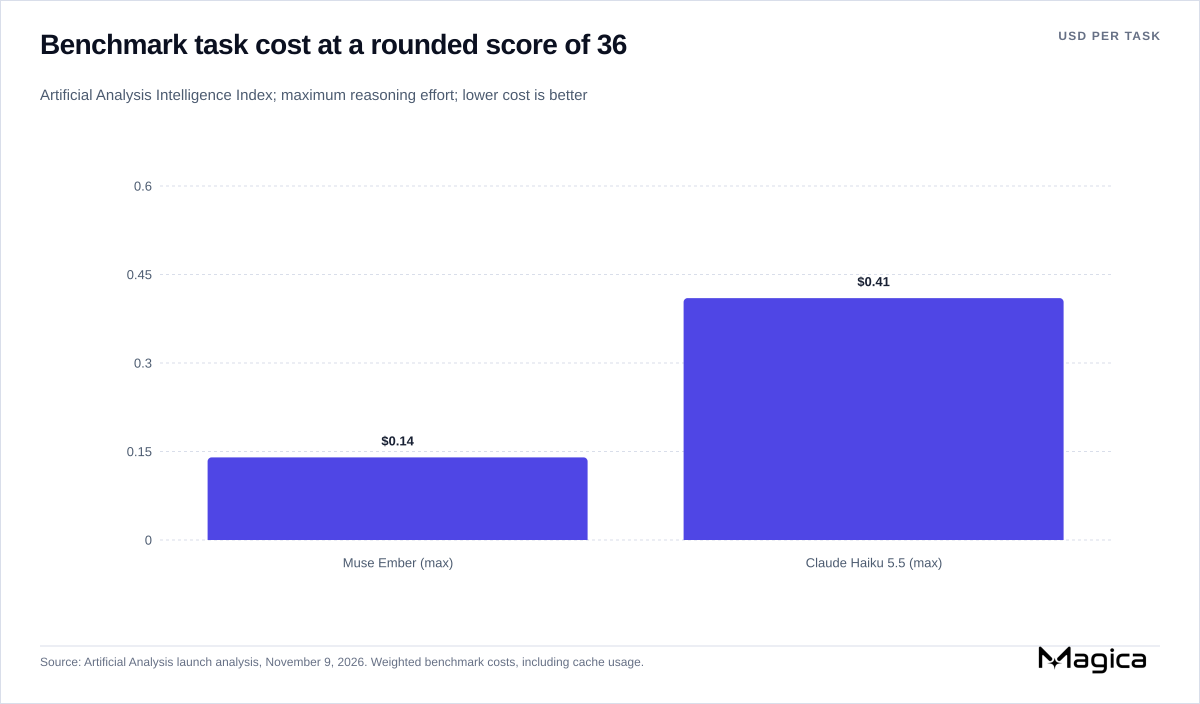
Artificial Analysis reports weighted benchmark task costs of $0.14 for Ember and $0.41 for Haiku at the same rounded intelligence score. Costs include cache usage. Chart: Magica. Source: Artificial Analysis launch analysis.
Artificial Analysis, an independent model evaluator, gives Ember at maximum reasoning effort an Intelligence Index score of 36 and a weighted average cost of about $0.14 per task. Its launch analysis puts Anthropic’s competing Claude Haiku 5.5 at the same rounded score for $0.41 per task. Ember at the lower xhigh reasoning setting scores 34 for about $0.12.
These are benchmark economics. The index combines nine evaluations spanning knowledge work, coding, science and general knowledge. Its cost measure weights each evaluation’s per-task token charges, including cache usage, reasoning and answer tokens. It is not a price quote for completing a production workflow. Meta’s more precise chart puts Ember at 35.8 and Haiku at 36.2, so the rounded tie also conceals a small score difference.
The evaluator says Ember has the same input and output token prices as Haiku 5.5 and OpenAI’s competing GPT-6 Luna. Its advantage comes instead from cached input that is 60% cheaper and roughly one-third of Haiku’s output-token consumption. Cached input accounts for most of the cost in the evaluator’s agentic tests. That narrows the launch report’s characterization of Ember as significantly cheaper per input token: the stronger evidence concerns total task cost under the evaluator’s workload and pricing assumptions.
Ember is not the cheapest option at every capability level. Meta’s chart shows a lower-effort Luna setting at $0.073 per task with a 21.4 score, and a Haiku setting at $0.092 with 24.6. Artificial Analysis’s claim is narrower: Ember is the cheapest model scoring at least 36. Its analysis puts DeepSeek V4.1 Flash 1017 at 33 and $0.60 per task, and GLM-5.3-Flash at 28 and $0.58. Wonder scores 44 but costs $6.95 per task.
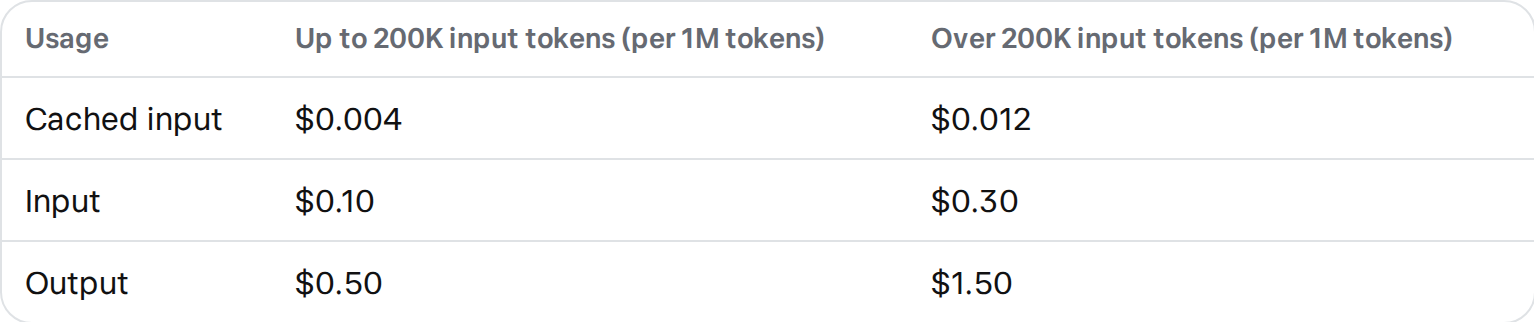
Meta’s company-reported Muse Ember rates per million tokens. Requests exceeding 200K input tokens incur the higher rates for the entire request. Source: Meta. Source: Meta Model API pricing.
Meta advertises a one-million-token context window and up to 512K output tokens. Its base prices are $0.10 per million input tokens, $0.004 per million cached input tokens and $0.50 per million output tokens.
The pricing documentation imposes higher long-context rates when a request exceeds 200,000 input tokens. Cached tokens count toward that threshold, as does the conversation included when continuing a stored exchange. Crossing it reprices the entire request, rather than only the excess tokens. Spark and Wonder do not carry that premium. On a Muse Code subscription, those long Ember requests also consume the plan’s usage faster.
Ember runs only in Standard mode on the API, where Meta says customer content is not used to train its models. Its low API price therefore does not require the data-sharing permission exchanged for discounts under Contributor mode. Muse Code subscriptions have separate settings and default to Contributor mode. Built-in web search adds $2.50 per 1,000 queries to token charges.
Throughput also has limits. Meta applies API quotas per team across its keys, and caps submissions for background responses at 600 per minute per team. A low token price alone does not establish how quickly a team can process a large batch.
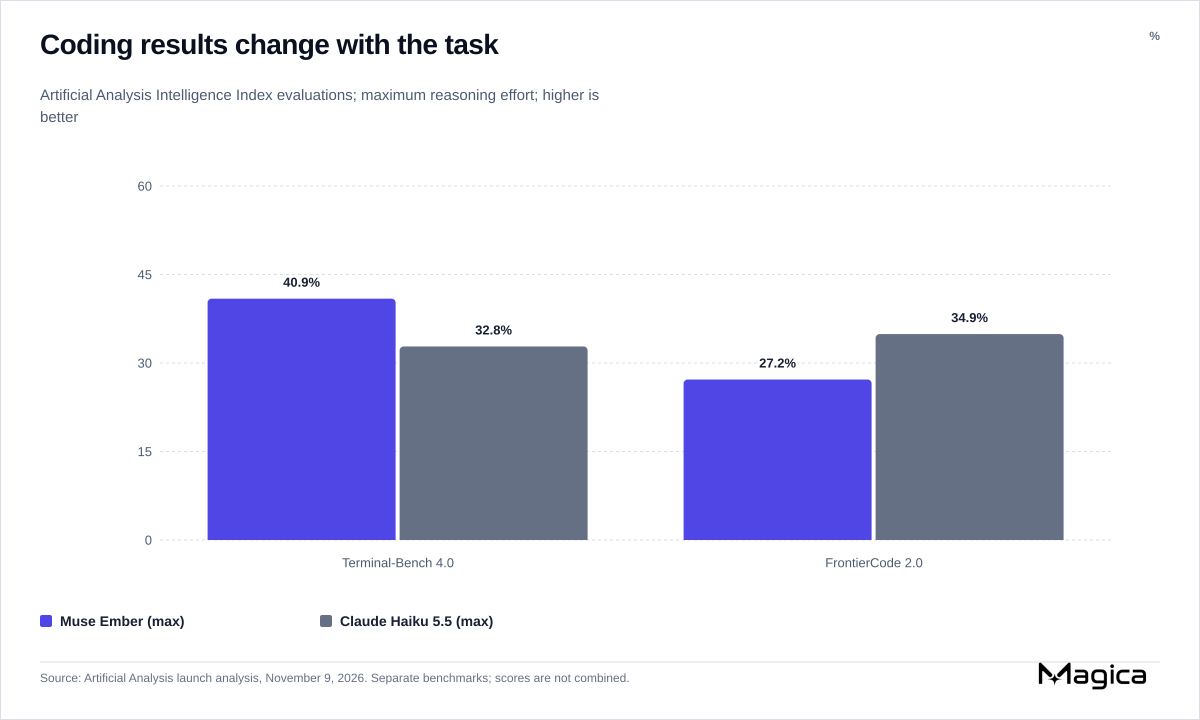
Artificial Analysis reports Ember ahead on Terminal-Bench 4.0 and behind on FrontierCode 2.0 at maximum reasoning effort. These are separate benchmarks. Chart: Magica. Source: Artificial Analysis launch analysis.
Artificial Analysis finds mixed coding performance. In its Intelligence Index tests, Ember beats Haiku on Terminal-Bench 4.0, 40.9% to 32.8%, but trails it on FrontierCode 2.0 software engineering tasks, 27.2% to 34.9%.
The software surrounding the model matters too. On the evaluator’s separate Coding Agent Index, Ember in Muse Code scores 46, ahead of Haiku in Claude Code at 37 and Luna in Codex at 31. Those results compare model-and-agent combinations, rather than isolating the underlying models.
Knowledge is a clearer weakness. On AA-Omniscience, Ember answers 21.1% of questions correctly, versus 34.7% for Haiku, and declines to answer 64% of questions. The evaluator connects Ember’s low hallucination rate to that high refusal rate. A system that avoids a wrong answer by declining the task may still require escalation to another model.
A separate evaluation by model-testing service Vals AI reports 60.48% on its Vals Index at maximum reasoning effort, with a displayed cost of $0.153 per test. Its launch update calls Ember the index’s cheapest model per test. Results differ by field: it scores 75.69% on the Legal Index, 60.91% on the Finance Index and 38.23% on Tax Agent Bench. These are separate benchmarks, not percentages of all real-world work Ember can complete.
Some published results remain difficult to reconcile. Meta reports 37.8% for Ember on AutomationBench-AA under strict pass@1, while Artificial Analysis reports 68.1%. Meta also gives Haiku a higher Terminal-Bench score than the evaluator’s launch analysis, labeling its comparison as using each model’s best published harness. The accounts do not explain all these differences; they should not be merged into a single ranking.
Developers considering Ember still need to verify the inputs and safeguards their workflow requires. Meta says it natively understands text, images, audio and video. Artificial Analysis lists text and image inputs, while Vals explicitly lists video as unsupported. Those listings leave a gap between the advertised capabilities and the independently described input support.
Meta says its pre-release safety evaluations placed Ember below its framework’s high-risk thresholds and examined resistance to malicious instructions hidden in documents and tool outputs. That company assessment does not establish how reliably an unattended production agent will resist such attacks.
The practical decision is which repeated subtasks can move to Ember while preserving completion quality. Measuring retries, refusals and escalation alongside cache usage, long-context charges and throughput will show whether its benchmark cost advantage translates into cheaper completed work.
UC Berkeley and NVIDIA are releasing tools for AI agents to assemble and improve robot programs in simulation. A warehouse operator reports a useful production update, while unsuccessful fixes and benchmark results show why testing, speed and existing infrastructure still matter.
Cloud Pathways lets customers coordinate large TPU workloads from one Python client, extending the system Google used for Gemini training. General availability on GKE follows earlier customer access; substantial reported usage and internal recovery results still leave customer cost savings unmeasured.
NVIDIA’s GR00T 2 predicts video and robot actions together to transfer skills across bodies. Company tests show gains from human video, but selected tasks, corrective data and recovery agents qualify its strongest success rates.
Anthropic says its new AI model produced circuit boards, enclosures and firmware for three prototypes that needed no electrical fixes. The demonstration avoided factory revisions, according to the company, while leaving certification, manufacturing scale and total costs unproven.
Meta is reportedly building a consulting channel for corporate AI sales after announcing an enterprise platform led by former MongoDB CEO Chirantan Desai. Its hiring remit also covers advertising and messaging, while prospective partners already work with rival AI suppliers.
OpenAI’s $200 Chromatic: Codex Edition adds AI-assisted development to an existing cartridge-game platform. The public bundle includes a programmable cartridge, but creation requires a computer, established tools and playtesting; the store now lists a November 19 restock.
PwC US plans a December launch for a critical-thinking and judgment certificate, with completion targeted by June 2027. It will assess staff through performance reviews as the firm seeks new ways to develop skills once practiced through routine work.
Linnea Quigley and Beverly Randolph say Aftermath departed from the musical they agreed to make, exposing a gap between a marketed cast reunion and performers’ control over their screen identities.
Anthropic’s Claude Fable 5.2 and Mythos 5.2 bring lower token prices and stronger technical performance. The release also limits capabilities that could accelerate frontier AI development, as new evidence puts the pace of research close to a sensitive policy boundary.
SpaceX proposes a gas-fired power plant and super-compute facility on about 444 acres in Starbase, Texas. A December hearing will consider local incentives, while the public notice leaves the tax concession and operating demands unspecified.
The California state senator elected to Nancy Pelosi’s open seat wants a federal AI regulator, independent safety checks and penalties for developers. His California record shows both the reach and limits of that agenda; political support from an Anthropic-funded group adds scrutiny.
Anthropic’s reported 2025 compute spending outstripped sales despite rapid growth. Customer concentration and cloud partners with competing interests complicate its IPO case.
Apple Creator Studio subscribers can buy extra Logic Pro assistant usage for $49.99 in the U.S. The optional packs last up to a year, but Apple’s public support document does not quantify their capacity.
Boston Dynamics has fitted its electric Atlas humanoid with scooter wheels to test learned controls against real motor limits. The research feeds into the walking robot as Hyundai plans factory deployment, but the demonstration offers no quantified reliability gains.
Nominal raised $240 million at a $3 billion valuation, three times its March valuation, to expand its hardware engineering software into AI agents and lifecycle applications. Its defense foothold and company-reported workflow gains provide a foundation, but do not establish the newer agents’ performance or economics.
The former Megaspeed executive sought backing for a data centre project worth several hundred million dollars, citing GPU access and Alibaba business. The reported pitch adds commercial detail to scrutiny of her ties to Nvidia’s chief, while espionage and chip-smuggling allegations remain unproven.
President Donald Trump offered an unnamed executive’s alleged reversal as evidence that AI risks can be managed. His account identifies neither the conduct at issue nor the legal basis for a jail threat, leaving its value as a safety precedent unproven.
The Texas startup is building factory-made data centers for AI customers, with testing reportedly planned for early 2027. Its financing backs a manufacturing strategy whose cost and power-access advantages remain to be demonstrated.
Baidu says its automated research system has improved inference for the forthcoming ERNIE-5.5-Flash, alongside public benchmark gains. The results show bounded engineering progress, while the cost of finding those improvements remains undisclosed.
Nvidia’s shares fell as other chip stocks rebounded after its board opened an independent inquiry into reports of a foreign intelligence effort targeting CEO and co-founder Jensen Huang. The board retains confidence in him and says it has no reason to believe secrets were compromised; China rejects the spying allegation.