Editorial Team
5 min read
President Donald Trump offered an unnamed executive’s alleged reversal as evidence that AI risks can be managed. His account identifies neither the conduct at issue nor the legal basis for a jail threat, leaving its value as a safety precedent unproven.
President Donald Trump, whose second-term administration has promoted AI deregulation and rapid data-center construction, says it threatened to jail the leader of a major AI company over unspecified conduct involving artificial intelligence. He presented the episode as evidence that the U.S. Department of Justice can manage AI risks, but declined to identify either the executive or the company.
The consequential question is whether this describes an enforceable safety standard or an intervention whose scope remains known only to the participants. His account comes as he expresses openness to legislation with Democrats while defending an AI expansion agenda built around competition with China.
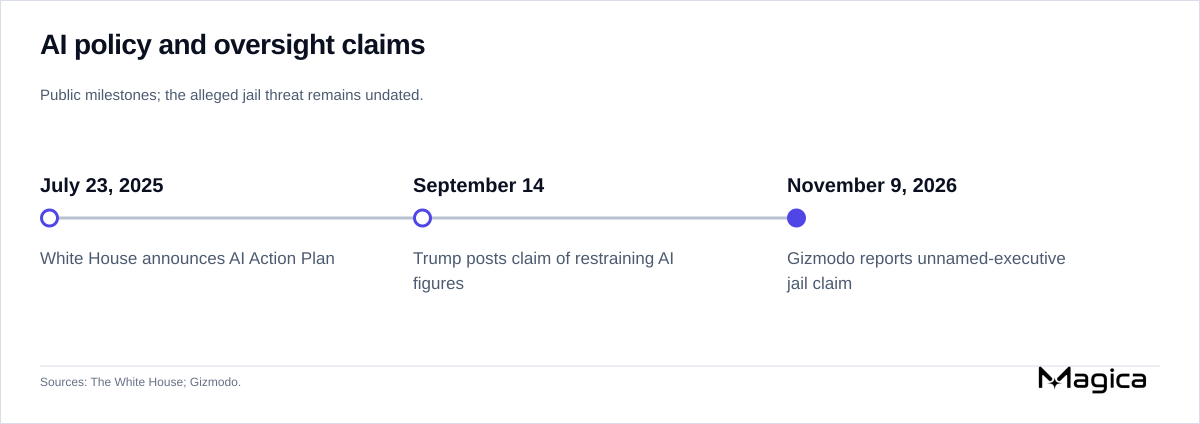
Public milestones in AI policy and oversight claims. The final entry dates reporting about the interview; the alleged jail threat remains undated. Graphic: Magica. Source: The White House.
Trump, speaking during his second presidential term in a 60 Minutes interview with Ross Douthat, invoked the Justice Department when challenged about why he discounted warnings from people developing AI. In the full transcript, he said someone had been reported to his administration for doing something bad with AI.
Trump described a forceful call and a warning to prepare for jail. Asked who the person or company was, he refused to say. When Douthat asked whether it was the leader of a major AI company, Trump confirmed it was one of the big ones.
He claimed the person subsequently changed everything. But he also said he did not think the conduct had been malicious. That qualification matters: his account offers neither a description of a deliberate abuse nor enough information to assess a different basis for criminal liability.
The transcript supplies no date for the incident, identifies no official who made the call and names no investigation, charge, applicable law or safety requirement. It also does not establish that the executive was arrested. An asserted change in behavior cannot, on those details alone, demonstrate that a particular AI hazard was identified and reduced.
UC Berkeley and NVIDIA are releasing tools for AI agents to assemble and improve robot programs in simulation. A warehouse operator reports a useful production update, while unsuccessful fixes and benchmark results show why testing, speed and existing infrastructure still matter.
The jail account follows earlier claims of personal control over AI. A report on the interview recounts Trump’s September 14 social-media claim that his administration had stopped AI figures from doing bad or potentially bad things. That post specifically singled out Dario Amodei, chief executive of AI developer Anthropic. The report says Amodei had published an essay warning that development was proceeding unsafely and urging the industry to slow down while governments helped establish safeguards.
The report places those calls in a wider dispute over researchers’ warnings that AI could cause catastrophic harm. It says Trump dismissed calls for a slowdown as a hoax but invited leaders of major AI companies to sign voluntary safety standards at the White House. Trump described the agreement as morally binding; the report says it was not a legal document.
It remains unclear whether the September post referred to the same incident described in the interview. Trump’s earlier criticism of Amodei does not establish that Amodei received the alleged jail threat.
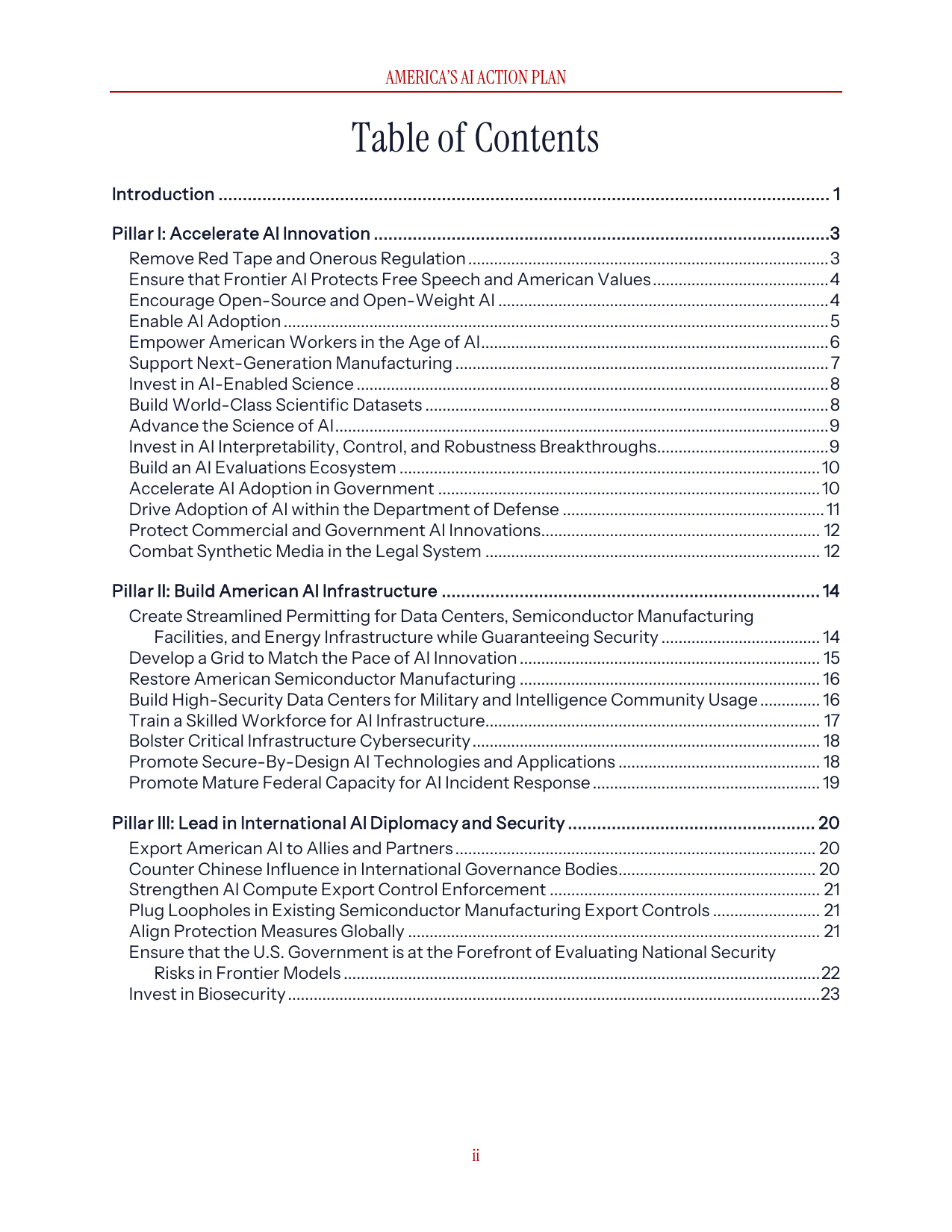
The July 2025 AI Action Plan lists policies on deregulation, infrastructure and security under three pillars. Source: The White House. Source: The White House.
Trump’s answer places the federal government in two roles: promoting AI expansion and claiming the power to restrain companies when problems arise.
That tension predates this interview. The White House’s July 23, 2025 announcement of America’s AI Action Plan laid out a federal program to accelerate innovation, build infrastructure and expand international partnerships. It called for removing regulations that hinder AI development and deployment, accelerating permits for data centers and semiconductor factories, and developing the workforce needed to build them. It also called for partnering with industry to export packages of American AI hardware, models, software, applications and standards. These were announced policy actions, not evidence that the promised infrastructure or commercial benefits had been delivered.
In the interview, Trump said the risks were less real than critics suggested and could be managed. He framed AI development as a race with China and argued that falling behind would put the United States at a severe disadvantage. He also claimed government experts were watching the companies, without explaining their methods or powers.
Infrastructure adds another unresolved question. When Douthat challenged him about public anxiety over AI and data centers, Trump claimed new centers were building their own electricity generation and supplying excess power to the grid. His prediction that this would lower electricity costs came without supporting figures in the exchange. The interview provides no basis for measuring that claimed benefit against the power demands of expansion.
There is also political pressure for limits. The report on the interview describes voters passing restrictions on data-center projects in local ballot measures and electing candidates, mostly Democrats, who favored tighter oversight. That opposition gives the debate a constituency beyond AI developers and federal officials.
Yet his answer did leave room for legislation. Asked whether he would work with Democrats on AI safety, Trump said he would. The account of that exchange highlights his accompanying condition: guardrails should not push the United States into a substantially weaker competitive position. He offered no specific legislative proposal in the exchange.
The next policy test is which obligations, if any, Trump would support making binding on AI developers. His willingness to discuss legislation leaves room for a more formal approach, but does not yet establish a safety standard. The distinction between voluntary commitments and legal obligations also leaves an important question unanswered: whether the alleged jail threat concerned an existing law, the safety agreement or something else entirely.
Resolving that question requires the executive’s identity, the conduct at issue, the authority invoked and an account of the resulting changes. Until those details emerge, Trump’s story is evidence of how he presents his oversight of AI companies. It is not enough to assess whether that oversight protects the people exposed to their systems.
Cloud Pathways lets customers coordinate large TPU workloads from one Python client, extending the system Google used for Gemini training. General availability on GKE follows earlier customer access; substantial reported usage and internal recovery results still leave customer cost savings unmeasured.
NVIDIA’s GR00T 2 predicts video and robot actions together to transfer skills across bodies. Company tests show gains from human video, but selected tasks, corrective data and recovery agents qualify its strongest success rates.
Anthropic says its new AI model produced circuit boards, enclosures and firmware for three prototypes that needed no electrical fixes. The demonstration avoided factory revisions, according to the company, while leaving certification, manufacturing scale and total costs unproven.
Meta is reportedly building a consulting channel for corporate AI sales after announcing an enterprise platform led by former MongoDB CEO Chirantan Desai. Its hiring remit also covers advertising and messaging, while prospective partners already work with rival AI suppliers.
OpenAI’s $200 Chromatic: Codex Edition adds AI-assisted development to an existing cartridge-game platform. The public bundle includes a programmable cartridge, but creation requires a computer, established tools and playtesting; the store now lists a November 19 restock.
PwC US plans a December launch for a critical-thinking and judgment certificate, with completion targeted by June 2027. It will assess staff through performance reviews as the firm seeks new ways to develop skills once practiced through routine work.
Linnea Quigley and Beverly Randolph say Aftermath departed from the musical they agreed to make, exposing a gap between a marketed cast reunion and performers’ control over their screen identities.
Anthropic’s Claude Fable 5.2 and Mythos 5.2 bring lower token prices and stronger technical performance. The release also limits capabilities that could accelerate frontier AI development, as new evidence puts the pace of research close to a sensitive policy boundary.
Meta’s smallest Muse model matches Claude Haiku 5.5’s rounded intelligence score at about one-third of the benchmark task cost. The case for delegating agent work depends on caching, task difficulty and higher charges for long requests.
SpaceX proposes a gas-fired power plant and super-compute facility on about 444 acres in Starbase, Texas. A December hearing will consider local incentives, while the public notice leaves the tax concession and operating demands unspecified.
The California state senator elected to Nancy Pelosi’s open seat wants a federal AI regulator, independent safety checks and penalties for developers. His California record shows both the reach and limits of that agenda; political support from an Anthropic-funded group adds scrutiny.
Anthropic’s reported 2025 compute spending outstripped sales despite rapid growth. Customer concentration and cloud partners with competing interests complicate its IPO case.
Apple Creator Studio subscribers can buy extra Logic Pro assistant usage for $49.99 in the U.S. The optional packs last up to a year, but Apple’s public support document does not quantify their capacity.
Boston Dynamics has fitted its electric Atlas humanoid with scooter wheels to test learned controls against real motor limits. The research feeds into the walking robot as Hyundai plans factory deployment, but the demonstration offers no quantified reliability gains.
Nominal raised $240 million at a $3 billion valuation, three times its March valuation, to expand its hardware engineering software into AI agents and lifecycle applications. Its defense foothold and company-reported workflow gains provide a foundation, but do not establish the newer agents’ performance or economics.
The former Megaspeed executive sought backing for a data centre project worth several hundred million dollars, citing GPU access and Alibaba business. The reported pitch adds commercial detail to scrutiny of her ties to Nvidia’s chief, while espionage and chip-smuggling allegations remain unproven.
The Texas startup is building factory-made data centers for AI customers, with testing reportedly planned for early 2027. Its financing backs a manufacturing strategy whose cost and power-access advantages remain to be demonstrated.
Baidu says its automated research system has improved inference for the forthcoming ERNIE-5.5-Flash, alongside public benchmark gains. The results show bounded engineering progress, while the cost of finding those improvements remains undisclosed.
Nvidia’s shares fell as other chip stocks rebounded after its board opened an independent inquiry into reports of a foreign intelligence effort targeting CEO and co-founder Jensen Huang. The board retains confidence in him and says it has no reason to believe secrets were compromised; China rejects the spying allegation.