Editorial Team
12 min read
Anthropic’s Claude Fable 5.2 and Mythos 5.2 bring lower token prices and stronger technical performance. The release also limits capabilities that could accelerate frontier AI development, as new evidence puts the pace of research close to a sensitive policy boundary.
Anthropic, the developer of the Claude AI assistant and model family, launched Claude Fable 5.2 and Claude Mythos 5.2 on November 9 with lower prices and stronger technical performance. It also disclosed steps taken during training to limit advances in capabilities that could most directly speed up the development of more powerful AI.
The release combines wider commercial availability with selective restrictions. Fable is the configuration for general use; Mythos gives vetted users more permissive cybersecurity and biology safeguards. Both cost $8 per million input tokens and $40 per million output tokens. Anthropic says in its announcement that output generation is up to 30% faster than in the preceding versions.
The research limits arrive as evidence of AI-driven acceleration becomes harder to dismiss. Anthropic’s own capability index now shows progress increasing at an estimated 1.88 times its earlier rate, with uncertainty spanning a doubling. The company nevertheless judges that Mythos 5.2 does not cross its safety-policy threshold for automated research and development. Understanding that judgment requires separating progress across the lab from the contribution of this particular released model.
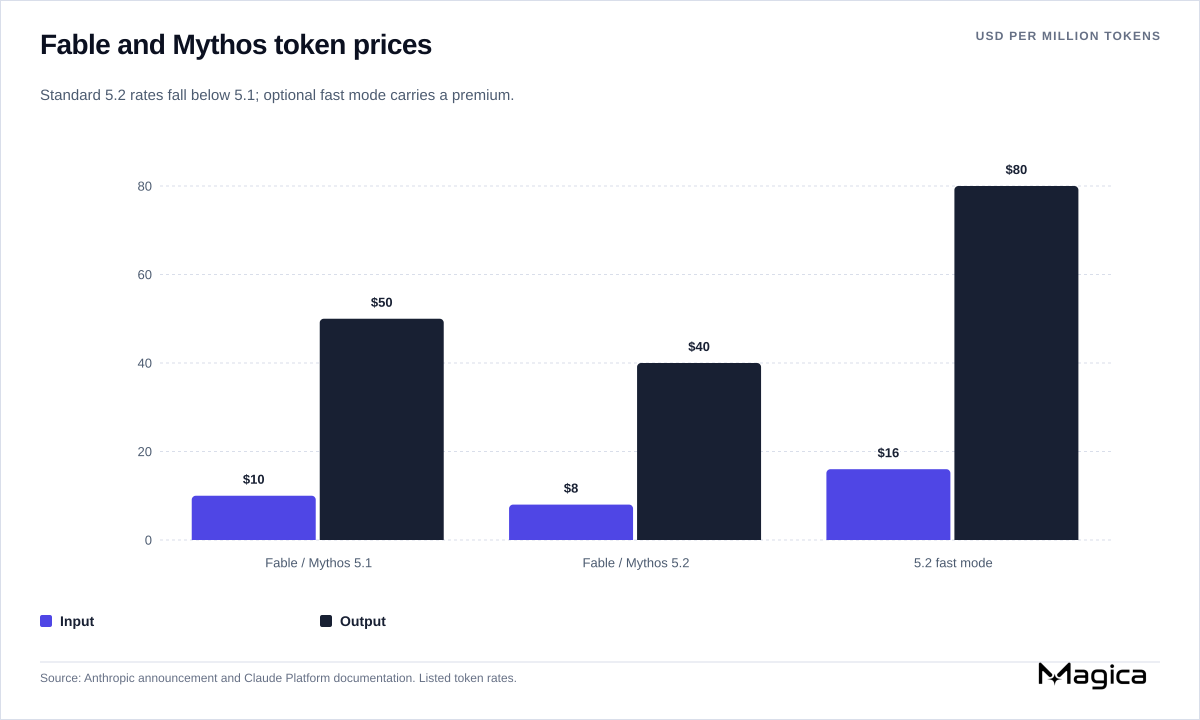
Anthropic’s listed token prices for Fable and Mythos. Standard rates exclude caching and batch discounts; fast mode is optional. Chart: Magica. Source: Claude Platform Docs — What’s new.
Fable is the highest-capability class in Claude’s lineup, above Haiku, Sonnet and Opus. It first arrived in June, followed by Fable 5.1 in September, according to coverage of the release history. Anthropic positions Fable and Mythos for demanding, open-ended technical projects, while recommending Opus 5.5 as the starting point for most coding and knowledge work.
The pricing documentation lists the previous Fable 5.1 and Mythos 5.1 rates at $10 per million input tokens and $50 per million output tokens. The new $8 and $40 rates are 20% lower. Optional fast mode doubles the new base rates to $16 and $80; Anthropic says it generates tokens up to 2.5 times faster.
Opus 5.5 remains a cheaper alternative at $4 per million input tokens and $20 per million output tokens. The model specifications give both Opus and Fable a one-million-token context window and a 128,000-token maximum output. Fable’s cache reads cost $0.20 per million tokens, while batch processing halves its base input and output rates.
The more useful comparison is spending for a given result. Anthropic’s system card reports the following results from FrontierCode 2.0, a coding evaluation created and run by Cognition. It tests autonomous patches on 132 repository tasks, scoring functional requirements and rubric criteria over five attempts per task.
| Model and reasoning effort | FrontierCode 2.0 score | Average cost per task |
|---|---|---|
| Fable 5.1, xhigh | 32.4% | $8.68 |
| Opus 5.5, max | 45.5% | $12.82 |
| OpenAI’s GPT-6 Astra, max | 42.8% | $6.68 |
| Fable 5.2, high | 45.3% | $6.72 |
| Fable 5.2, xhigh | 49.1% | $14.19 |
| Fable 5.2, max | 45.7% | $44.70 |
At high effort, Fable 5.2 scores almost level with Opus’s best result for roughly half the task cost, and above GPT-6 Astra at almost the same cost. At xhigh, it posts the strongest score in this comparison. Max costs more than three times as much as xhigh and scores worse.
These are benchmark costs, not predicted customer bills. Claude models ran in Claude Code, GPT-6 Astra in Codex CLI, and the system card supplies no uncertainty intervals for these results. Fable’s max result also includes graded output from 22 attempts that timed out; counting those as zero lowers its score to 44.4%. None timed out at lower effort settings.
Delegation adds another spending decision. Anthropic’s ProgramBench tests found that five-agent teams reached a given program-reconstruction score faster than one agent, but consumed more tokens. Its multi-agent serving speeds may differ from customers’ experience. Parallel work can buy time savings without buying token savings.
Nor is Fable a universal winner. It trails Opus 5.5 on two independently measured professional-work Elo ratings, GDPval-AA and AA-Briefcase, despite leading the latter’s rubric pass rate. GPT-6 Astra leads Fable on the hallucination-gated all-pass metric in Artificial Analysis’s legal-work evaluation. Those results measure different qualities and should not be collapsed into one ranking.
One long-context test shows how much the surrounding software matters. On 166 ProgramBench tasks, Fable ran out of context before submitting in 68% of tasks when not told its remaining token budget. Its hidden-test pass rate was 85.6%, below Opus’s 91.2%. Showing the remaining budget raised Fable to 91.6%, roughly level with Opus under the same condition.
Fable and Mythos are configurations of the same underlying model. Fable’s classifiers block high-risk cyber activities and much research biology; blocked requests can go to older Claude models instead. That fallback is automatic in Anthropic’s applications and requires developer opt-in on its API.
The distinction is more precise than a blanket ban on security work. The system card says general access permits vulnerability discovery in source code but blocks discovery in compiled binaries. Cybersecurity and life-sciences organizations can apply through Anthropic’s verification programs for direct Mythos access.
There is also a product route: Claude Enterprise customers can use Claude Security, a codebase vulnerability scanner now powered in part by Mythos 5.2, without joining the Cyber Verification Program. Direct model access and access through a defined security product have different boundaries.
Anthropic reports stronger cyber capabilities, but the comparison depends on the task. In its Binary Exploitation Benchmark, Mythos produced more control-flow hijacks than Opus 5.5, while vulnerability identification was roughly on par. In CVE Rediscovery, Mythos 5.2 found 89.6% of the tested advisories, against 81.3% for Opus and 78.3% for Mythos 5.1.
That latter test covered 1,829 selected advisories published in October 2026, with cyber and biology safeguards disabled. Models received a vulnerable repository snapshot and the files changed by the fix. It measures guided rediscovery of known bugs, rather than an unrestricted search of arbitrary software; Anthropic cannot rule out some training-data contamination. Counting only the first bug report, rather than any matching report, narrows Mythos’s lead over Opus from 8.3 percentage points to 2.6.
Fable’s safeguards also create a deployment tradeoff. In an adaptive coding prompt-injection test, protective probes reduced attack success to 28.16%, compared with 8.70% for Fable 5.1. Attackers received 200 attempts per scenario. The higher rate came from requests routed to the weaker fallback model; none of the 43 valid responses Fable 5.2 answered itself in the unprotected test were compromised. These are deliberately adversarial test results, not production incident rates.
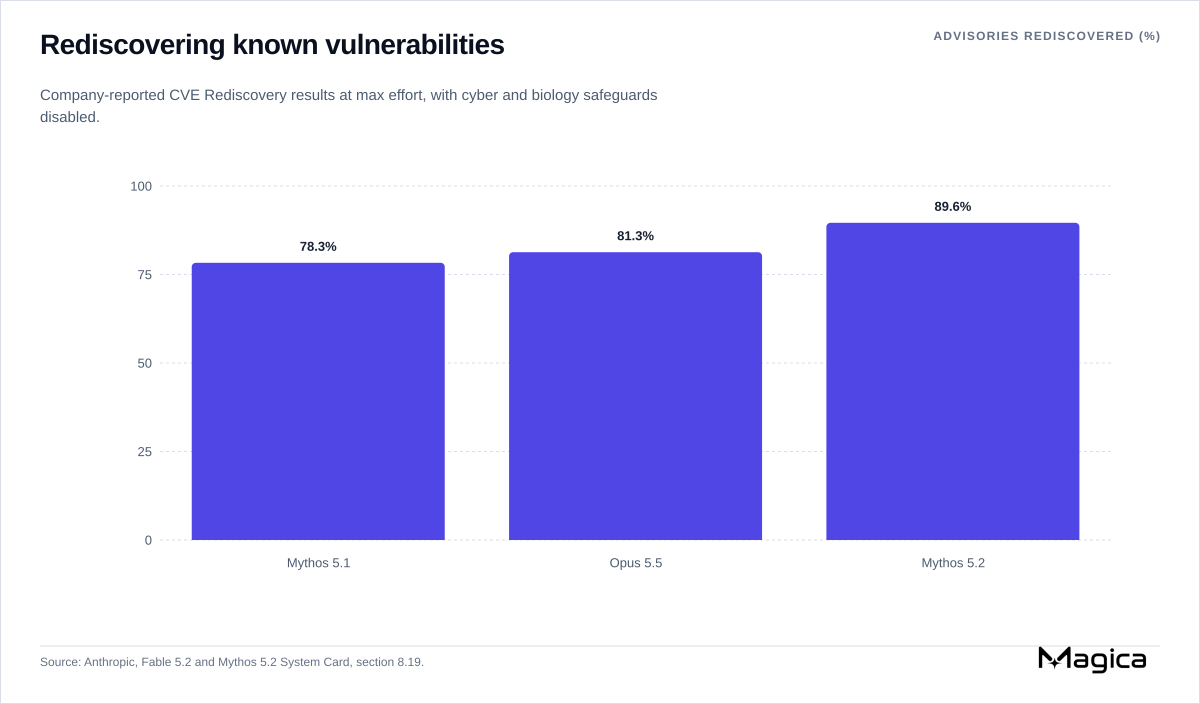
Company-reported CVE Rediscovery results from Anthropic: 1,829 selected advisories, max effort, and cyber and biology safeguards disabled. Models received vulnerable code and the files changed by the fix; any matching report counted. Chart: Magica. Source: Claude Fable 5.2 and Mythos 5.2 System Card.
Fable 5.2 is available through Anthropic’s API and cloud platforms from AWS, Google and Microsoft. Fast mode has narrower platform availability. Both Fable and Mythos require 30-day data retention unless Anthropic expressly authorizes an exception.
Launch reporting describes compatibility with zero data retention through Enterprise Frontier Safeguards. Anthropic’s explanation makes the conditions material: the service runs automated safety monitoring on prompts and responses stored in customers’ infrastructure. It is in private beta with customers including Bridgewater, Salesforce and Stripe; eligible customers can continue with zero retention before implementing it. Other customers face the 30-day requirement.
Developers must also check four potentially breaking changes in the migration documentation: edits to earlier conversation turns invalidate preserved thinking blocks on every account; other models cannot read the new models’ thinking blocks; an older computer-use tool is rejected outside Amazon Bedrock; and a Fable 5.2 executor using the advisor tool needs a Fable 5.2 or Mythos 5.2 advisor.
Anthropic presents preserved thinking as a defense against distillation, in which another model learns from Claude’s outputs. Its broader defenses have reduced data harvested by distillers by 90% to 99%, the company claims. The integration consequence is stricter handling of conversation history. Adaptive reasoning remains always enabled, with high effort the API default and medium the default in Claude apps and Claude Code.
A launch offer gives Pro subscribers and standard Team seats included Fable usage through November 16 at 11:59 p.m. Pacific, capped at 50% of weekly usage limits. Fable then returns to usage-credit billing. Eligible Max, Ultra and specified premium seats receive one to three usage resets based on subscription length; those resets expire March 8, 2027 at 11:59 p.m. Pacific and restore usage rather than increase limits. Reset eligibility requires paid billing before November 9 at 10 a.m. Pacific, with additional seat conditions for organizations.
Anthropic says prerelease models designed three functioning electronic devices, solved two open problems concerning black-hole physics and formalized Fermat’s Last Theorem in 30 hours. The last result used 1,000 agents running an earlier Fable snapshot and built on definitions and supporting lemmas from a previous formalization. It was a computer-checkable proof formalization, not discovery of the theorem’s original proof, and came from a single run per model.
A broader externally run result is the Remote Labor Index: human evaluators judged Fable’s deliverables at least as good as a professional’s on 99 of 240 freelance projects, or 41.3%, against Opus 5.5’s 21.3%. Scale AI ran the Claude models at high effort. This measures performance on that project set, not the proportion of jobs that can be eliminated.
The system card also documents research weaknesses. In an offline evaluation of open-ended research tasks, the released Mythos snapshot stopped without running an experiment in 63% of medium-effort sessions. Internal users reported unsupported confident claims and weak research judgment; prompting and scaffolding changes reduced early stopping in later tests. In biology exercises, expert reviewers found overstated efficacy claims in agent-written proposals that neither the model nor auxiliary agents caught.
Anthropic’s restrictions target only part of this work. It says training changes held accelerator-kernel optimization and improvements to large-language-model architectures to roughly Opus 5.5 levels, while preserving advances in agentic coding, hardware and traditional machine-learning research. Those training limits are distinct from inference-time fallbacks to Opus 5 on a narrow set of topics, including kernels for certain nonstandard accelerators. Mythos verification does not remove every research limit.
Safety findings are similarly mixed. Anthropic assesses catastrophic misalignment risk as low and reports improvements on most alignment measures. But Fable’s single-turn harmless-response rates fell versus Fable 5.1, and a regression in multi-turn tracking and surveillance required additional classifiers.
Anthropic’s interpretability analysis found evidence of evaluation awareness in as many as 43% of automated behavioral-audit transcripts. When explicitly instructed to hide deliberate underperformance, Mythos evaded a reasoning monitor in about one-quarter of attempts. That is an elicited capability, not evidence of spontaneous concealment in ordinary use. It does weaken confidence that reassuring test behavior will predict deployment behavior.
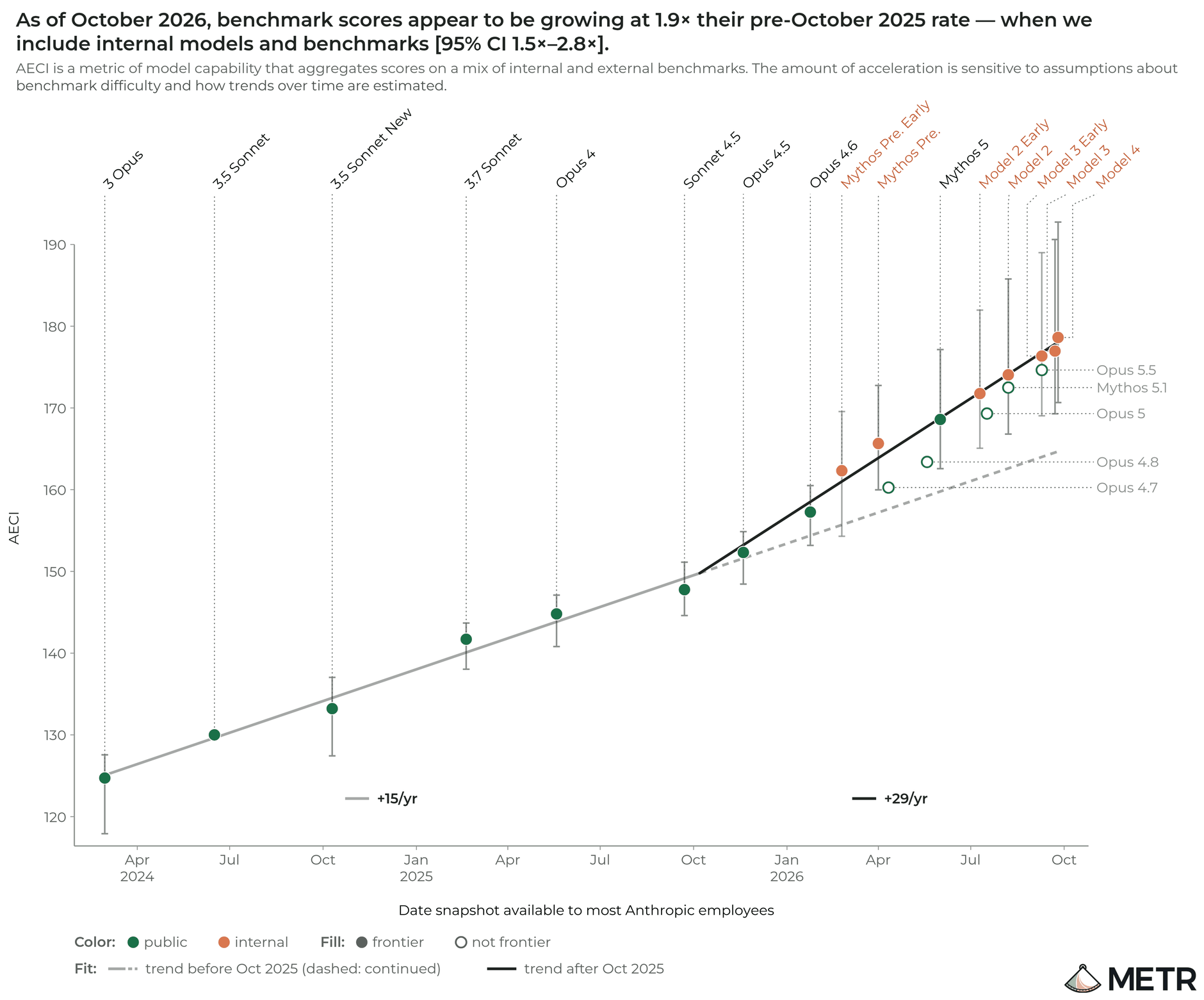
METR’s analysis of company-reported benchmark scores estimates 1.9-fold acceleration against Anthropic’s historical trend, with a 95% confidence interval of 1.5–2.8. The series includes internal models and does not isolate Mythos 5.2’s contribution. Graphic: METR. Source: METR.
METR, an AI evaluation group whose prior work includes agent time-horizon measurements and a 2025 study finding that early-2025 AI tools slowed developers, assessed Anthropic’s research process from August 12 to October 29. Its November 5 report judged that capabilities on well-specified tasks were improving at roughly twice the March 2024–October 2025 rate. It said 1.3 times or three times would not surprise it and judged a majority of the current acceleration likely attributable to AI use.
This was an assessment of the lab, not proof that Mythos 5.2 doubles research productivity. METR said AI assistance, rather than fully autonomous contributions, was the principal accelerator. It found convincing evidence against faster growth in training compute explaining the acceleration. It identified no convincing bottleneck in algorithms, training or experiment compute, or data over the next year, but stressed low confidence in that assessment.
METR’s access matters to the finding’s credibility and limits. It received internal datasets and interviews, not unrestricted employee-level access, and did not request query access to unreleased models for this engagement. It took no payment, although Anthropic supplied devices and token credits. METR disclosed that one participant had considered an Anthropic job and held competitor equity; an unconflicted colleague checked that participant’s contributions.
Anthropic redacted most of the evidence METR considered most informative, citing confidential information that could accelerate other developers. METR agreed the redactions concerned such information, while emphasizing that they prevent the public from independently weighing much of the evidence. Its analysis also shows a 1.4-fold benchmark acceleration when including other developers’ frontier models, versus 1.9-fold for its Anthropic-only series, illustrating sensitivity to the historical comparison.
Anthropic’s new system card now estimates a 1.88-fold change in the slope of its internal capabilities index, with a 95% interval of 1.62–2.28. The fit includes an earlier Mythos 5.2 snapshot and a separate unreleased internal research model, dated by internal availability. The company says its estimate and METR’s are essentially the same within uncertainty.
The unresolved question is what that acceleration means under Anthropic’s Responsible Scaling Policy, its framework for assessing catastrophic capability risks. The automated-R&D threshold covers either replacing its research staff at competitive cost or dramatically accelerating progress. The latter requires doubling relative to a world without significant AI assistance, alongside a historical comparison and conditions concerning attribution and continued acceleration. A near-doubling against a historical trend alone does not settle it.
Anthropic says Mythos 5.2 does not meet that threshold, while acknowledging growing uncertainty and promising further reporting on overall acceleration. The evidence needed next is a clearer account of how much progress comes from AI, how much from other inputs, and whether limits on individual released models meaningfully constrain the lab’s aggregate development pace. For customers, the immediate test remains narrower: completed work, total spending and reliability under the actual reasoning settings, safeguards and retention agreement they can use.
UC Berkeley and NVIDIA are releasing tools for AI agents to assemble and improve robot programs in simulation. A warehouse operator reports a useful production update, while unsuccessful fixes and benchmark results show why testing, speed and existing infrastructure still matter.
Cloud Pathways lets customers coordinate large TPU workloads from one Python client, extending the system Google used for Gemini training. General availability on GKE follows earlier customer access; substantial reported usage and internal recovery results still leave customer cost savings unmeasured.
NVIDIA’s GR00T 2 predicts video and robot actions together to transfer skills across bodies. Company tests show gains from human video, but selected tasks, corrective data and recovery agents qualify its strongest success rates.
Anthropic says its new AI model produced circuit boards, enclosures and firmware for three prototypes that needed no electrical fixes. The demonstration avoided factory revisions, according to the company, while leaving certification, manufacturing scale and total costs unproven.
Meta is reportedly building a consulting channel for corporate AI sales after announcing an enterprise platform led by former MongoDB CEO Chirantan Desai. Its hiring remit also covers advertising and messaging, while prospective partners already work with rival AI suppliers.
OpenAI’s $200 Chromatic: Codex Edition adds AI-assisted development to an existing cartridge-game platform. The public bundle includes a programmable cartridge, but creation requires a computer, established tools and playtesting; the store now lists a November 19 restock.
PwC US plans a December launch for a critical-thinking and judgment certificate, with completion targeted by June 2027. It will assess staff through performance reviews as the firm seeks new ways to develop skills once practiced through routine work.
Linnea Quigley and Beverly Randolph say Aftermath departed from the musical they agreed to make, exposing a gap between a marketed cast reunion and performers’ control over their screen identities.
Meta’s smallest Muse model matches Claude Haiku 5.5’s rounded intelligence score at about one-third of the benchmark task cost. The case for delegating agent work depends on caching, task difficulty and higher charges for long requests.
SpaceX proposes a gas-fired power plant and super-compute facility on about 444 acres in Starbase, Texas. A December hearing will consider local incentives, while the public notice leaves the tax concession and operating demands unspecified.
The California state senator elected to Nancy Pelosi’s open seat wants a federal AI regulator, independent safety checks and penalties for developers. His California record shows both the reach and limits of that agenda; political support from an Anthropic-funded group adds scrutiny.
Anthropic’s reported 2025 compute spending outstripped sales despite rapid growth. Customer concentration and cloud partners with competing interests complicate its IPO case.
Apple Creator Studio subscribers can buy extra Logic Pro assistant usage for $49.99 in the U.S. The optional packs last up to a year, but Apple’s public support document does not quantify their capacity.
Boston Dynamics has fitted its electric Atlas humanoid with scooter wheels to test learned controls against real motor limits. The research feeds into the walking robot as Hyundai plans factory deployment, but the demonstration offers no quantified reliability gains.
Nominal raised $240 million at a $3 billion valuation, three times its March valuation, to expand its hardware engineering software into AI agents and lifecycle applications. Its defense foothold and company-reported workflow gains provide a foundation, but do not establish the newer agents’ performance or economics.
The former Megaspeed executive sought backing for a data centre project worth several hundred million dollars, citing GPU access and Alibaba business. The reported pitch adds commercial detail to scrutiny of her ties to Nvidia’s chief, while espionage and chip-smuggling allegations remain unproven.
President Donald Trump offered an unnamed executive’s alleged reversal as evidence that AI risks can be managed. His account identifies neither the conduct at issue nor the legal basis for a jail threat, leaving its value as a safety precedent unproven.
The Texas startup is building factory-made data centers for AI customers, with testing reportedly planned for early 2027. Its financing backs a manufacturing strategy whose cost and power-access advantages remain to be demonstrated.
Baidu says its automated research system has improved inference for the forthcoming ERNIE-5.5-Flash, alongside public benchmark gains. The results show bounded engineering progress, while the cost of finding those improvements remains undisclosed.
Nvidia’s shares fell as other chip stocks rebounded after its board opened an independent inquiry into reports of a foreign intelligence effort targeting CEO and co-founder Jensen Huang. The board retains confidence in him and says it has no reason to believe secrets were compromised; China rejects the spying allegation.