Editorial Team
8 min read
NVIDIA’s GR00T 2 predicts video and robot actions together to transfer skills across bodies. Company tests show gains from human video, but selected tasks, corrective data and recovery agents qualify its strongest success rates.
NVIDIA, the accelerated-computing company behind the Isaac robot-learning tools, has introduced GR00T 2, a foundation model that predicts future video and robot actions together. Its central promise is to reduce the need to demonstrate each task on the particular robot that will perform it.
Announced at the Conference on Robot Learning in Austin, Texas, the model transfers some skills from human demonstrations or handheld devices to robots that have not practiced those tasks. But NVIDIA’s results also show why that is only one step toward industrial automation: success varies by task, and its most reliable assembly workflows add corrective demonstrations and a separate agent that detects and repairs failures.
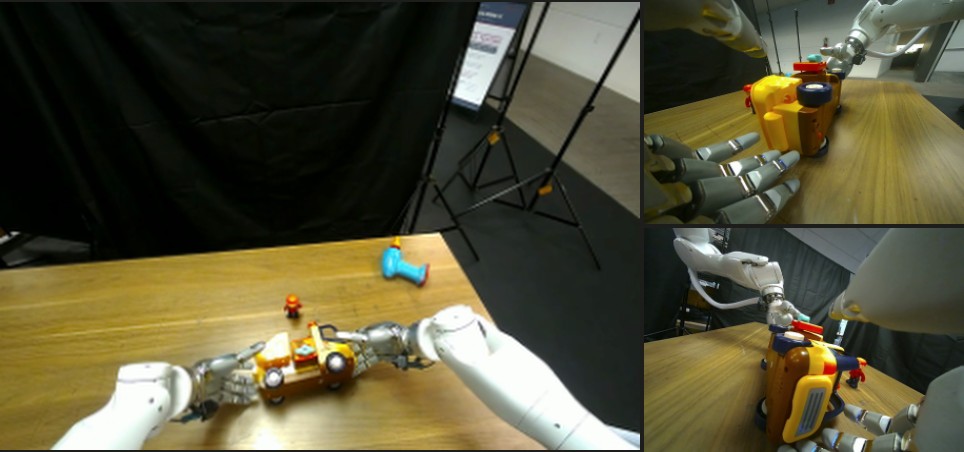
Head- and wrist-camera observations from a GR00T 2 truck-assembly rollout. Source: NVIDIA Research. Source: NVIDIA Research.
NVIDIA calls GR00T 2 a world-action model. It jointly predicts what cameras will see and what the robot should do; small components specific to each robot translate the shared model’s output into motor commands. The design supports gripper arms, five-fingered hands and humanoids, according to its research description.
It builds on Cosmos, NVIDIA’s platform of generative world models and video-processing tools for developing robots and autonomous vehicles. When NVIDIA introduced Cosmos in January 2025, it described models that generate physics-based synthetic data for training and evaluation. GR00T 2 couples prediction of the physical scene with prediction of actions.
Nor is combining high-level reasoning with robot movement new to this program. NVIDIA introduced GR00T N1 in March 2025 as a customizable humanoid foundation model with a vision-language reasoning system and a separate action system. A post-trained version powered a domestic-tidying demonstration on humanoid developer 1X’s robot. GR00T 2’s case for progress rests on joint video-and-action prediction, transfer across bodies and measured adaptation gains, rather than the first use of reasoning to direct movement.
The data mixture is larger than the public release alone suggests. NVIDIA lists a pretraining mixture of 402,730 hours of first-person human video, 10,184 hours of handheld-gripper demonstrations across 2,897 tasks, and 23,500 hours of robot teleoperation. It is releasing 100,000 hours of the human footage as Human-1M-100K; that subset is not the full human-video pretraining corpus.
In an experiment varying the amount of human video, NVIDIA reports that real-robot task progress across 72 downstream dexterous-robot tasks rose from 50% without it to 70% with the full human-video mixture. That is a 20-percentage-point gain in progress through tasks, not a 70% rate of completing entire jobs.
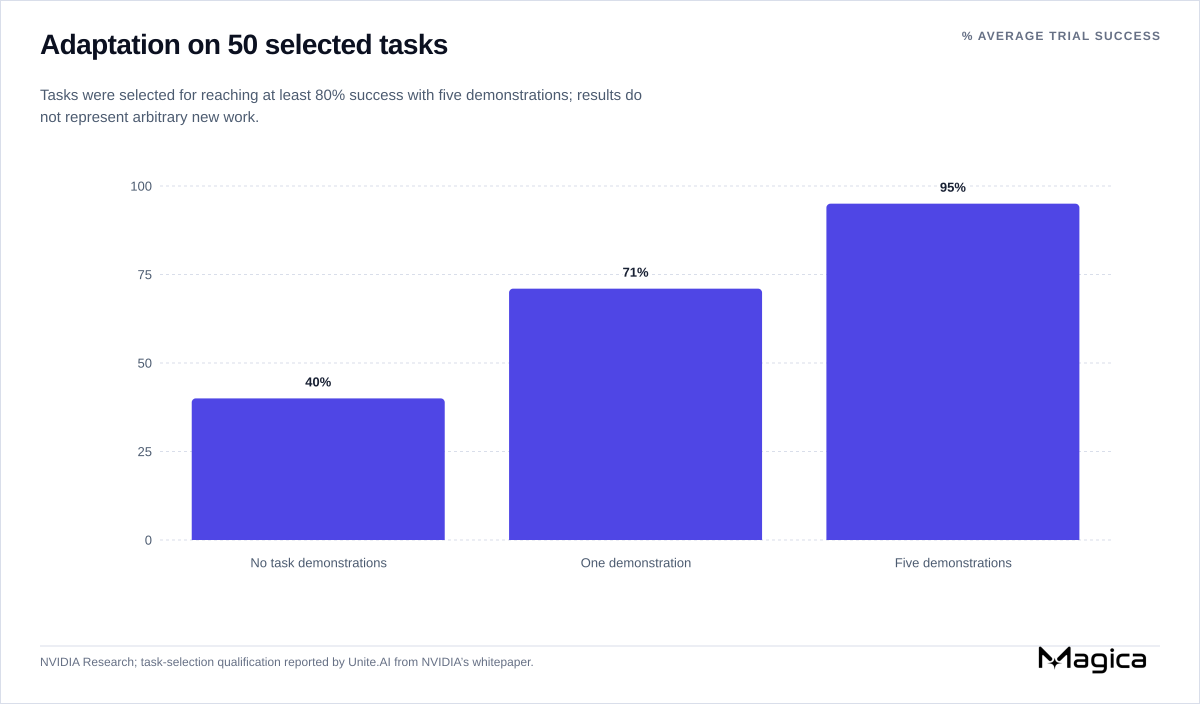
Company-reported adaptation results from NVIDIA on 50 selected tasks. Tasks qualified by reaching at least 80% success with five demonstrations. Source: NVIDIA Research.
NVIDIA’s human-to-robot experiment used demonstrations by people wearing cameras, plus task-agnostic data to teach the target robot about its own body. With no task-specific teleoperation, a two-handed robot succeeded at filter-paper setup in 65% of 20 trials. Across the other three tasks, success ranged from 10% for microscope-slide dabbing to 50% for conveyor-package tossing. Human demonstrations transferred useful behavior, but precision remained uneven.
In a separate test, demonstrations collected with a handheld gripper transferred to a YAM robot arm, yielding 60% end-to-end success on toy dump-truck assembly. YAM supplied task-agnostic teleoperation data, but no demonstrations of that task. These experiments test transfer without target-robot task demonstrations, not learning without robot data.
For a 50-task evaluation on a bimanual robot with two Sharpa hands, NVIDIA reports 40% average trial success without target-robot task demonstrations. The model succeeded at least once on 40 of those tasks—a different measure from the average success rate. One demonstration per task raised average success to 71%; five raised it to 95%. Each adaptation used a 30-minute fine-tune of small adapter weights on one RTX 5090 GPU, with the five demonstrations supplying under three minutes of robot data per task.
The selection rule limits that headline figure. A report examining NVIDIA’s paper notes that the tasks were chosen from those the model could already learn well. A technical account of the same whitepaper specifies that selected tasks reached at least 80% success with five episodes. NVIDIA’s 95% average therefore describes adaptation within that selected set, rather than an expected success rate on arbitrary new work.
There is competitive precedent for transferring knowledge between robots. Physical Intelligence, the developer of the π0 family of vision-language-action models that turn visual and language inputs into robot actions, introduced π0.5 in April 2025. Its recipe combines data from different robot bodies and environments with multimodal web data. The company demonstrated cleaning tasks in previously unseen homes, while explicitly distinguishing that goal from learning new skills or achieving high dexterity.
NVIDIA’s own comparisons report 60% success for GR00T 2 against zero for π0.5 on handheld-gripper-to-YAM dump-truck transfer. That supports a specific transfer advantage in NVIDIA’s test, not a universal ranking across the different capabilities the two developers emphasize.
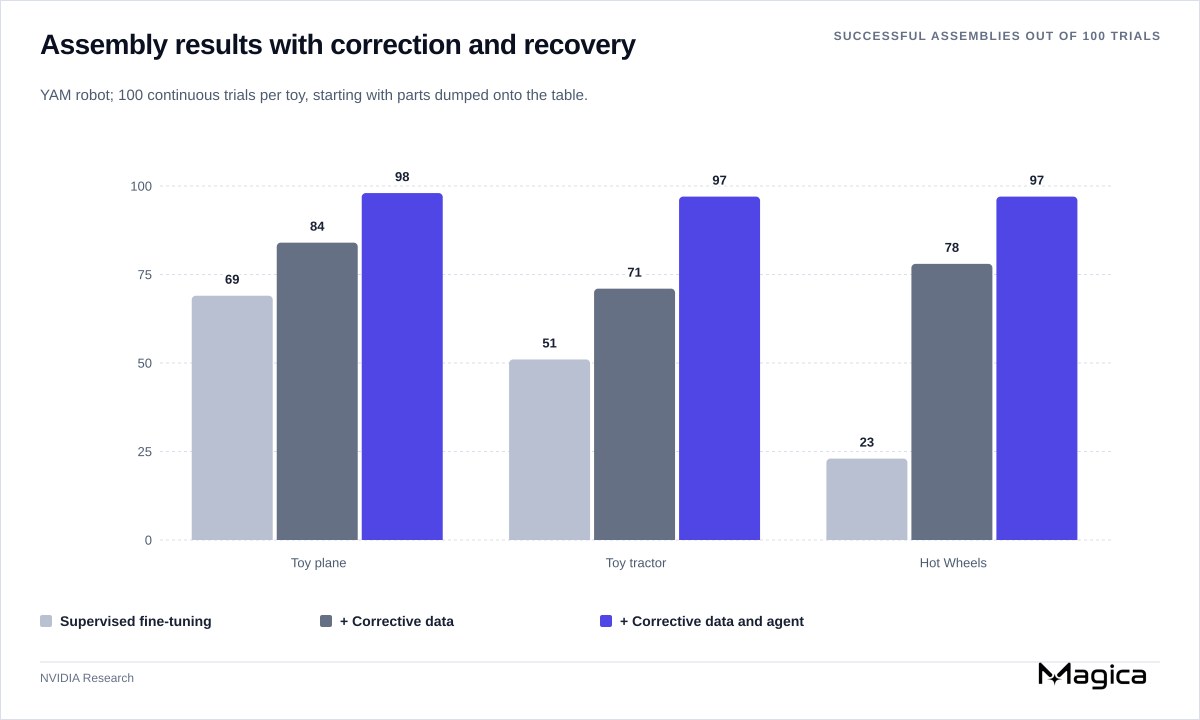
Company-reported NVIDIA assembly results with supervised fine-tuning, added corrective data, and corrective data plus an agent. The final condition measures the coordinated system. Source: NVIDIA Research.
NVIDIA’s continuous assembly tests show how much the surrounding system changes outcomes. Each trial began with toy parts dumped onto a table in a cluttered layout absent from post-training data.
| Successful assemblies out of 100 trials per toy | Supervised fine-tuning | With corrective data | With corrective data and agent |
|---|---|---|---|
| Toy plane | 69 | 84 | 98 |
| Toy tractor | 51 | 71 | 97 |
| Hot Wheels car | 23 | 78 | 97 |
In these company tests, the reasoning agent monitored progress and called recovery routines when parts dropped or work stalled. GR00T 2 performed most manipulation. The final column measures that coordinated system, rather than the pretrained model alone.
Precision also benefited from a distinct post-training phase. NVIDIA reports that reinforcement learning on the real robot raised success on three contact-rich insertion tasks from 40–76% after supervised post-training to 88–96%. Those gains required additional learning on physical hardware.
Agent guidance has limits and overhead. Marking grasp and release targets on camera views helped YAM complete 17 of 20 trash-sorting episodes, against none with step instructions alone. Yet the same approach completed only two of 20 trash-sorting episodes on the dexterous robot and no full board-disassembly episodes there. The technical account of NVIDIA’s whitepaper also reports that the robot waited for the agent during a median 38% of an episode in visually steered trash sorting.
NVIDIA is also promoting alternatives for coordinating skills. Its CoRL announcement describes UC Berkeley’s Graph-as-Policy framework, which uses agents to assemble robot programs, rehearse them in simulation and revise them after failures. Reliable orchestration is a broader development effort, not a capability supplied solely by GR00T 2.
GR00T 2 Turbo, a smaller variant with 2 billion parameters, addresses onboard computing. NVIDIA reports a median prediction latency of 124 milliseconds on the Unitree G1 humanoid’s Jetson Thor computer. Turbo plans chunks of motion; a separate whole-body controller executes them. Everything except the reasoning model runs onboard.
Speed does not preserve performance uniformly. Turbo trails the larger model on five of six disclosed dexterous-hand post-training tasks, tying on the sixth, while beating it on two of six YAM tasks. On the humanoid, Turbo completed all 48 popcorn-serving trials but only 14 of 30 spill-cleanup trials. Onboard operation and reliable execution across tasks remain separate tests.
NVIDIA’s commercial stake spans the workflow: its GPUs support adaptation and inference, while its Isaac software supports simulation and evaluation. Isaac Lab 3.0 is an open-source robot-learning framework; integration with the Newton physics engine adds support for deformable objects such as cables and cloth. NVIDIA says in its simulation announcement that this combination achieved up to 2.5 times the training throughput of Isaac Lab 2.3 with PhysX on a vision-based dexterous-manipulation benchmark. That comparison does not establish a reduction in total deployment cost.
Simulation also supplies a way to screen changes before using physical robots. NVIDIA reports a 0.92 Pearson correlation between simulated and real-world matched-task success rates for 14 GR00T 2 policies on a 25-task YAM benchmark. It used simulated evaluations to screen data-processing changes and inference settings. The result supports simulation as a development aid within that benchmark; it does not establish reliability across arbitrary industrial conditions.
NVIDIA says in its announcement that Nexuni is testing GR00T 2 for laundry handling, Foxconn is applying it to server-manufacturing automation, and Siemens is evaluating industrial uses. The disclosed applications do not establish a production rollout. Although the announcement calls GR00T 2 open, its research page schedules code availability for December.
The immediate questions are what developers can reproduce when code arrives and how much adaptation, recovery and supervision industrial users need. The disclosed trial success rates and single-GPU fine-tuning time do not establish cost per successful job, sustained throughput or human intervention across a factory shift. Those measurements would determine whether transferring skills from people lowers the full cost of deploying robots, beyond reducing the demonstrations needed to start teaching them.
UC Berkeley and NVIDIA are releasing tools for AI agents to assemble and improve robot programs in simulation. A warehouse operator reports a useful production update, while unsuccessful fixes and benchmark results show why testing, speed and existing infrastructure still matter.
Cloud Pathways lets customers coordinate large TPU workloads from one Python client, extending the system Google used for Gemini training. General availability on GKE follows earlier customer access; substantial reported usage and internal recovery results still leave customer cost savings unmeasured.
Anthropic says its new AI model produced circuit boards, enclosures and firmware for three prototypes that needed no electrical fixes. The demonstration avoided factory revisions, according to the company, while leaving certification, manufacturing scale and total costs unproven.
Meta is reportedly building a consulting channel for corporate AI sales after announcing an enterprise platform led by former MongoDB CEO Chirantan Desai. Its hiring remit also covers advertising and messaging, while prospective partners already work with rival AI suppliers.
OpenAI’s $200 Chromatic: Codex Edition adds AI-assisted development to an existing cartridge-game platform. The public bundle includes a programmable cartridge, but creation requires a computer, established tools and playtesting; the store now lists a November 19 restock.
PwC US plans a December launch for a critical-thinking and judgment certificate, with completion targeted by June 2027. It will assess staff through performance reviews as the firm seeks new ways to develop skills once practiced through routine work.
Linnea Quigley and Beverly Randolph say Aftermath departed from the musical they agreed to make, exposing a gap between a marketed cast reunion and performers’ control over their screen identities.
Anthropic’s Claude Fable 5.2 and Mythos 5.2 bring lower token prices and stronger technical performance. The release also limits capabilities that could accelerate frontier AI development, as new evidence puts the pace of research close to a sensitive policy boundary.
Meta’s smallest Muse model matches Claude Haiku 5.5’s rounded intelligence score at about one-third of the benchmark task cost. The case for delegating agent work depends on caching, task difficulty and higher charges for long requests.
SpaceX proposes a gas-fired power plant and super-compute facility on about 444 acres in Starbase, Texas. A December hearing will consider local incentives, while the public notice leaves the tax concession and operating demands unspecified.
The California state senator elected to Nancy Pelosi’s open seat wants a federal AI regulator, independent safety checks and penalties for developers. His California record shows both the reach and limits of that agenda; political support from an Anthropic-funded group adds scrutiny.
Anthropic’s reported 2025 compute spending outstripped sales despite rapid growth. Customer concentration and cloud partners with competing interests complicate its IPO case.
Apple Creator Studio subscribers can buy extra Logic Pro assistant usage for $49.99 in the U.S. The optional packs last up to a year, but Apple’s public support document does not quantify their capacity.
Boston Dynamics has fitted its electric Atlas humanoid with scooter wheels to test learned controls against real motor limits. The research feeds into the walking robot as Hyundai plans factory deployment, but the demonstration offers no quantified reliability gains.
Nominal raised $240 million at a $3 billion valuation, three times its March valuation, to expand its hardware engineering software into AI agents and lifecycle applications. Its defense foothold and company-reported workflow gains provide a foundation, but do not establish the newer agents’ performance or economics.
The former Megaspeed executive sought backing for a data centre project worth several hundred million dollars, citing GPU access and Alibaba business. The reported pitch adds commercial detail to scrutiny of her ties to Nvidia’s chief, while espionage and chip-smuggling allegations remain unproven.
President Donald Trump offered an unnamed executive’s alleged reversal as evidence that AI risks can be managed. His account identifies neither the conduct at issue nor the legal basis for a jail threat, leaving its value as a safety precedent unproven.
The Texas startup is building factory-made data centers for AI customers, with testing reportedly planned for early 2027. Its financing backs a manufacturing strategy whose cost and power-access advantages remain to be demonstrated.
Baidu says its automated research system has improved inference for the forthcoming ERNIE-5.5-Flash, alongside public benchmark gains. The results show bounded engineering progress, while the cost of finding those improvements remains undisclosed.
Nvidia’s shares fell as other chip stocks rebounded after its board opened an independent inquiry into reports of a foreign intelligence effort targeting CEO and co-founder Jensen Huang. The board retains confidence in him and says it has no reason to believe secrets were compromised; China rejects the spying allegation.