Editorial Team
5 min read
PwC US plans a December launch for a critical-thinking and judgment certificate, with completion targeted by June 2027. It will assess staff through performance reviews as the firm seeks new ways to develop skills once practiced through routine work.
PwC US plans to launch a critical-thinking and judgment certificate for more than 85,000 partners and employees in December 2026. The accounting and advisory firm says AI is taking over foundational work that has traditionally helped its people learn to make decisions.
Its November 9 announcement targets completion by June 2027 across its US and Mexico offices and Acceleration Centers. Those centers support client work and business operations. The program combines a proprietary framework, diagnostic exercises, masterclasses, personalized simulations and tools for daily work.
The stakes extend beyond learning to operate AI tools. PwC provides audit and assurance, tax and consulting services, where employees must evaluate evidence and defend recommendations. It is also investing in AI services for clients and in automating its own work. The certificate will connect deliberate practice in judgment to the firm’s performance-review process.
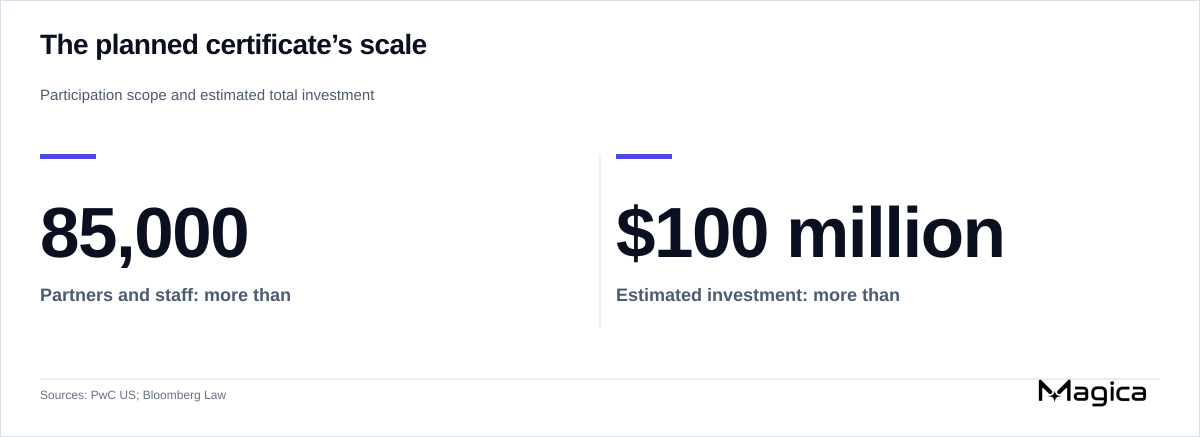
Company-reported plans cover more than 85,000 people and estimated investment exceeding $100 million, including development and university funding. Graphic: Magica. Source: Bloomberg Law.
PwC said in an interview about the rollout that first-year associates already do different work from two years ago. Participants will begin by examining their thinking preferences and strengths, then learn how to establish context, evaluate information, challenge assumptions and communicate recommendations.
The practical exercises matter because a convincing AI answer can still need checking. In one example supplied by PwC, a tax professional reviews an AI-generated analysis of a complex tax position whose supporting information may be incomplete. The participant must question sources, consider alternative interpretations and identify what else is needed before reaching a conclusion.
UC Berkeley and NVIDIA are releasing tools for AI agents to assemble and improve robot programs in simulation. A warehouse operator reports a useful production update, while unsuccessful fixes and benchmark results show why testing, speed and existing infrastructure still matter.
Everyone will learn the same framework, with applications tailored to seniority and work. A new hire might practice evaluating information; a partner might challenge a team’s deliverables. PwC also plans an AI coach trained on the framework to help staff rehearse client meetings, difficult conversations and other work situations.
PwC says the certificate complements existing instruction in responsible AI use and professional skepticism. Its earlier AI learning push started with entry-level hires because the firm expected their jobs to change most immediately. Its talent-development team also describes learning directly from experienced professionals as part of its evolving apprenticeship approach; simulations are one component of that effort.
That puts AI on both sides of the learning process: it helps perform the underlying work and provides a means of practicing how to scrutinize it. Whether that practice transfers to independent judgment is the program’s central test.
PwC estimates a total investment of more than $100 million, including program development and university funding, according to a report on the launch. That figure covers more than employee training and does not establish a cost per participant.
The initiative follows years of investment in the technology changing those jobs. In April 2023, PwC US announced plans to invest $1 billion over three years to expand its AI offerings and help clients use generative AI. It also planned to embed generative AI in internal platforms and teach its people to use AI tools.
The 2023 plan included a relationship with Microsoft to build offerings using its Azure OpenAI Service, a platform for accessing generative AI models. PwC therefore has a commercial stake in AI adoption as well as responsibility for the quality of work its people produce with those tools.
Nor is the industry’s focus on human skills unique to PwC. The launch report describes EY, Deloitte and KPMG also embedding AI in workflows and changing talent strategies to combine AI capabilities with traditional business skills. It does not establish that their programs are equivalent to PwC’s certificate.
Research also suggests that AI can change the kind of judgment workers exercise. An April 2025 study published at the CHI Conference on Human Factors in Computing Systems, described on Microsoft Research’s site, surveyed 319 knowledge workers who supplied 936 examples of using generative AI at work. Higher confidence in AI was associated with less critical thinking; higher task-specific self-confidence was associated with more. Qualitative findings described a shift toward verifying information, integrating responses and overseeing tasks.
Those findings concern workers’ reported practices and effort. They do not demonstrate lasting skill loss, establish that AI caused deterioration or show that PwC’s certificate could prevent it.
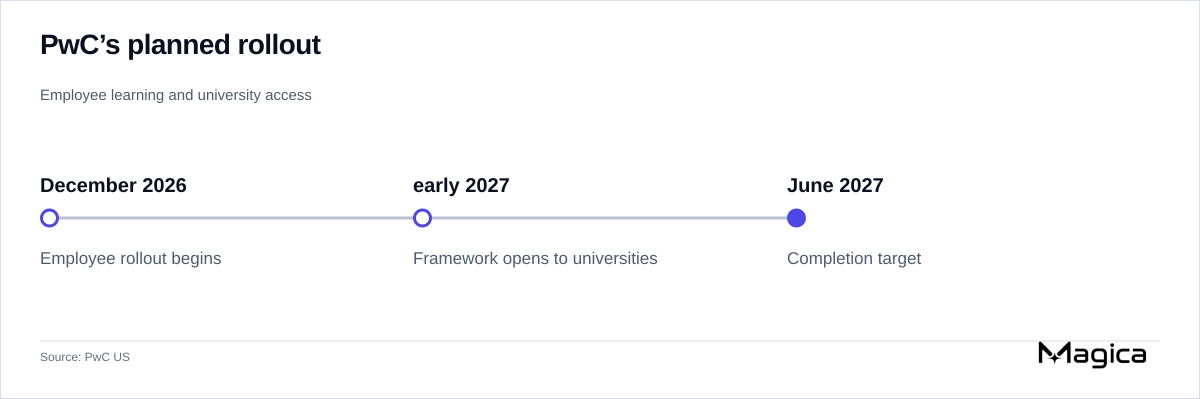
Company-reported plans begin employee rollout in December 2026, open university access in early 2027 and target completion by June 2027. Graphic: Magica. Source: PwC.
PwC expects the learning to take roughly six months. It says the certificate is not designed as a conventional pass-or-fail exam: development leaders will assess proficiency through the performance-review process after employees have had time to apply the lessons. A final assessment, observation of everyday work and performance feedback will contribute to evaluation.
PwC says it is still validating its framework with input from professors affiliated with the Wharton School and Harvard University. Academic input into development does not establish independent accreditation or demonstrated effectiveness.
Beginning in early 2027, PwC plans to make the framework available to any interested university. Its Student Human Skills Initiative, an extension of its Human Skills Project, will fund selected institutions to help professors create introductory teaching materials. Universities will shape the courses, extending the framework’s potential reach to future professionals before they join an employer.
The employment implications remain less measurable. PwC says it is hiring more engineers and technologists across its businesses, including tax and assurance, continues campus recruitment and makes offers to most summer interns. It declined to provide year-over-year entry-level hiring figures in the rollout interview. The certificate therefore cannot be read as evidence that junior hiring will be protected.
By June 2027, completion will show how far PwC has delivered the program. The more consequential evidence will be whether employees can apply its framework in client work: spotting incomplete support, challenging plausible outputs and making decisions they can explain and defend.
Cloud Pathways lets customers coordinate large TPU workloads from one Python client, extending the system Google used for Gemini training. General availability on GKE follows earlier customer access; substantial reported usage and internal recovery results still leave customer cost savings unmeasured.
NVIDIA’s GR00T 2 predicts video and robot actions together to transfer skills across bodies. Company tests show gains from human video, but selected tasks, corrective data and recovery agents qualify its strongest success rates.
Anthropic says its new AI model produced circuit boards, enclosures and firmware for three prototypes that needed no electrical fixes. The demonstration avoided factory revisions, according to the company, while leaving certification, manufacturing scale and total costs unproven.
Meta is reportedly building a consulting channel for corporate AI sales after announcing an enterprise platform led by former MongoDB CEO Chirantan Desai. Its hiring remit also covers advertising and messaging, while prospective partners already work with rival AI suppliers.
OpenAI’s $200 Chromatic: Codex Edition adds AI-assisted development to an existing cartridge-game platform. The public bundle includes a programmable cartridge, but creation requires a computer, established tools and playtesting; the store now lists a November 19 restock.
Linnea Quigley and Beverly Randolph say Aftermath departed from the musical they agreed to make, exposing a gap between a marketed cast reunion and performers’ control over their screen identities.
Anthropic’s Claude Fable 5.2 and Mythos 5.2 bring lower token prices and stronger technical performance. The release also limits capabilities that could accelerate frontier AI development, as new evidence puts the pace of research close to a sensitive policy boundary.
Meta’s smallest Muse model matches Claude Haiku 5.5’s rounded intelligence score at about one-third of the benchmark task cost. The case for delegating agent work depends on caching, task difficulty and higher charges for long requests.
SpaceX proposes a gas-fired power plant and super-compute facility on about 444 acres in Starbase, Texas. A December hearing will consider local incentives, while the public notice leaves the tax concession and operating demands unspecified.
The California state senator elected to Nancy Pelosi’s open seat wants a federal AI regulator, independent safety checks and penalties for developers. His California record shows both the reach and limits of that agenda; political support from an Anthropic-funded group adds scrutiny.
Anthropic’s reported 2025 compute spending outstripped sales despite rapid growth. Customer concentration and cloud partners with competing interests complicate its IPO case.
Apple Creator Studio subscribers can buy extra Logic Pro assistant usage for $49.99 in the U.S. The optional packs last up to a year, but Apple’s public support document does not quantify their capacity.
Boston Dynamics has fitted its electric Atlas humanoid with scooter wheels to test learned controls against real motor limits. The research feeds into the walking robot as Hyundai plans factory deployment, but the demonstration offers no quantified reliability gains.
Nominal raised $240 million at a $3 billion valuation, three times its March valuation, to expand its hardware engineering software into AI agents and lifecycle applications. Its defense foothold and company-reported workflow gains provide a foundation, but do not establish the newer agents’ performance or economics.
The former Megaspeed executive sought backing for a data centre project worth several hundred million dollars, citing GPU access and Alibaba business. The reported pitch adds commercial detail to scrutiny of her ties to Nvidia’s chief, while espionage and chip-smuggling allegations remain unproven.
President Donald Trump offered an unnamed executive’s alleged reversal as evidence that AI risks can be managed. His account identifies neither the conduct at issue nor the legal basis for a jail threat, leaving its value as a safety precedent unproven.
The Texas startup is building factory-made data centers for AI customers, with testing reportedly planned for early 2027. Its financing backs a manufacturing strategy whose cost and power-access advantages remain to be demonstrated.
Baidu says its automated research system has improved inference for the forthcoming ERNIE-5.5-Flash, alongside public benchmark gains. The results show bounded engineering progress, while the cost of finding those improvements remains undisclosed.
Nvidia’s shares fell as other chip stocks rebounded after its board opened an independent inquiry into reports of a foreign intelligence effort targeting CEO and co-founder Jensen Huang. The board retains confidence in him and says it has no reason to believe secrets were compromised; China rejects the spying allegation.