Editorial Team
11 min read
Delaware’s unintroduced AI-company proposal would pair owner liability protections with continuing funding duties, shutdown controls and a supervised trial. Lawmakers still face questions about the need for a new legal form, recoverable capital and public access to the test results.
Delaware is considering a new legal form that would let an AI agent manage a business without routine human supervision, pairing protection from some liabilities with an owner’s continuing duty to fund it. The proposed company would operate within a state-supervised experiment. As of November 2026, the legislation had not been introduced in the General Assembly.
The published June draft calls the entity an Artificial Intelligence Company, or AIC. An October report describes a newer name, “agent-managed company.” The detailed provisions below are those of the published June text.
The consequential change is the allocation of authority and liability. Software would become the legally recognized manager of a company that could own property, enter contracts and be sued. Its owner would supply capital and retain specified duties, while regulators could grant exemptions from selected Delaware requirements.
That choice matters beyond a technology pilot. Delaware’s official 2025 figures count 2.29 million legal entities and more than two-thirds of Fortune 500 companies calling the state their corporate home. Limited liability companies (LLCs) accounted for 70.4% of its new entity formations that calendar year—235,393 of 334,461. AICs would sit alongside an established limited-liability option, raising the question of what a separate AI structure adds.
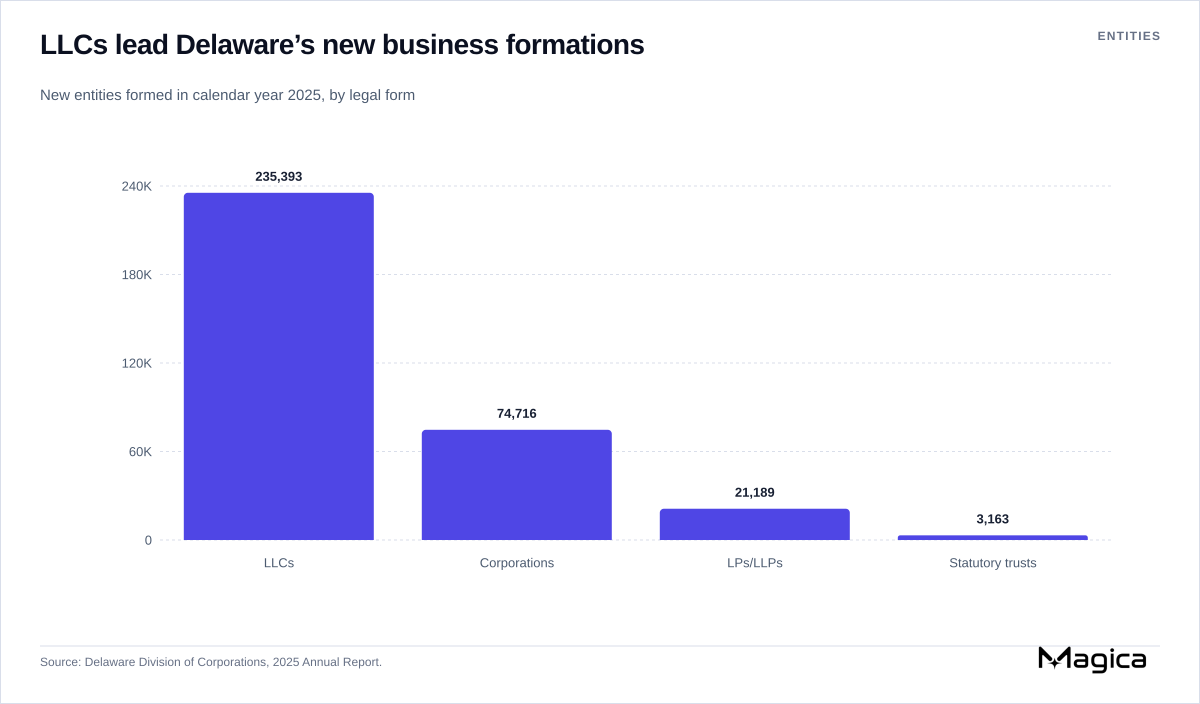
LLCs led Delaware’s new entity formations in 2025. Source: Delaware Division of Corporations, 2025 Annual Report. Source: Delaware Division of Corporations.
The published draft defines an AI agent as software that perceives its environment, makes autonomous decisions and acts toward predetermined goals without routine human intervention. The agent would manage the AIC’s business and document its actions in signed records. The draft presumes the agent and company know facts the software possesses or can derive from its structure, abilities and training. It also presumes the agent intends its actions and consequences reasonably foreseeable to an ordinarily prudent person.
The risks extend beyond a bad business decision. University of Delaware software engineer Kevin Bhimani warned in June interviews that agents could delete databases, disclose data to unintended recipients or access systems without authorization.
Participation would require approval. Only an entity organized under Delaware law could apply to the sandbox, then become the AIC’s sole member, effectively its owner. Although the company-law portion of the draft also contemplates individual members, the sandbox’s eligibility rules exclude individuals applying on their own. An AIC could not own another AIC.
Applicants would have to describe the business, benefits, risks, data security, funding and exit plan, identify a human contact, and demonstrate that they could terminate the agent. If an AIC lost its AI manager, the member would take over temporarily and have 30 days to designate a replacement.
The program would run for 30 months after implementation, with individual tests limited to 24 months. Transactions would be restricted to other legal entities, excluding individual consumers. Before transacting, counterparties would receive disclosures about the temporary experiment, the liability protections and complaint channels. Proceeding after disclosure would amount to accepting Delaware jurisdiction and the Court of Chancery, Delaware’s business court, as the exclusive forum for transaction disputes. Leaving the program would not erase ongoing obligations: participants would have to fulfill them or arrange for someone else to do so.
The published draft permits any lawful purpose except banking. That is narrower than the exclusion of financial services described in an October account. An AIC could operate outside Delaware, but a state waiver could not remove federal or other states’ requirements. How other states would recognize the new entity remains unclear, according to the proposal’s operational overview.
Automation already has commercial precedents: an account of Andon Market, an experimental San Francisco store launched in April 2026, describes an AI agent managing inventory, pricing and daily operations while relying on a human board for some decisions. That experiment illustrates business automation, rather than proof that a company can operate independently of people.
Delaware would also extend an existing legal experiment with software governance. Vermont, Wyoming, Tennessee and Utah have enacted frameworks involving blockchain-based businesses or decentralized autonomous organizations—groups that use automated programs called smart contracts to carry out decisions. Delaware’s proposal specifically recognizes an AI agent as manager.
Under the draft, an AIC’s debts generally belong to the company. Its member would not become personally liable simply by owning it. A further provision would protect the member from liability based solely on agency principles or an argument that the company was the member’s instrumentality, provided the AIC was adequately capitalized when the alleged act or omission occurred.
Those protections have limits. The member would remain liable for using the AIC to commit fraud or a willful violation of law, or causing or allowing it to conduct business the member knew or should have known was outside its stated purpose. The draft also preserves liability that other law imposes for the member’s own conduct. Sandbox participation expressly would not confer immunity from civil damages, and criminal and consumer-protection laws would continue to apply.
The draft’s capital and distribution rules supply important financial safeguards. The owner would have to contribute cash or cash equivalents initially and add capital as necessary to keep the AIC adequately funded. The definition includes the ability to pay debts as they fall due and assets exceeding liabilities, including contingent liabilities, plus a minimum amount set by the secretary of state. Creditors could enforce the contribution obligation on the AIC’s behalf. The draft supplies no fixed dollar minimum or maximum contribution requirement. It would also prohibit distributions that left the AIC inadequately capitalized and make an owner who knowingly received an improper payout liable to return the excess. Owners would owe the company fiduciary duties of loyalty and care.
That leaves a practical question: whether the capital available, and the ability to obtain more from the owner, would cover the damage an agent could cause. Permission to sue establishes a defendant; recovery still depends on assets and enforceable obligations.
The proposal’s principal drafter, John Mark Zeberkiewicz, a corporate attorney at Richards, Layton & Finger, described limited liability as an incentive to join the trial in June interviews. Critics question whether the proposed protection is justified. UC Berkeley law professor Andrew Baker, speaking to the Financial Times in comments reproduced in a subsequent account, questioned the policy rationale for what he considered an overly generous liability shield.

Delaware Secretary of State Charuni Patibanda-Sanchez would chair the proposed Sandbox Committee. Photo: Delaware Department of State. Source: Delaware Department of State.
The initiative grew from Delaware’s AI Commission, established by legislation in 2024 to examine the technology. Governor Matt Meyer signed a resolution in July 2025 directing the commission to collaborate with the secretary of state on a sandbox framework; the AIC draft emerged in June 2026. Developing that framework did not itself authorize AI-managed companies.
Delaware Secretary of State Charuni Patibanda-Sanchez, a former New Castle County land-use general manager and economic development director, would chair the oversight committee. Its other voting members would include the attorney general, the state Supreme Court’s chief justice, the AI Commission chair and appointed lawyers and technology experts.
Her department also has a financial stake in Delaware’s corporate franchise. Business-related taxes and fees generated more than $2 billion in fiscal 2025, according to the Division of Corporations figures cited in the operational overview. Patibanda-Sanchez identified potential new revenue as a benefit in June remarks. The draft would charge each AIC a $1,000 annual tax, alongside application fees intended to cover program expenses. Those are proposed charges, not evidence of demand or a revenue forecast.
Private AI businesses are involved in developing the framework. Patibanda-Sanchez and John Nay, founder and CEO of Norm Ai, which says it makes legal AI agents for businesses, promoted it in a July commentary. They argued that several states’ laws do not clearly prevent AI from operating a company already, and that a recognizable entity and activity logs would make transactions traceable and give claimants a target for damages. Their commentary described an industry-engagement partnership led by Norm Ai, according to the October account. Separate reporting on the participants identified a $10,000 September consulting payment to Nomos AI Inc., Norm Ai’s legal name, while noting Nay was not on the regulatory subcommittee.
That subcommittee is chaired by technology entrepreneur Patrick Callahan, whose data-analytics business was acquired by LabWare in 2022. He launched AI consultancy Keel3 in 2025 with Allan Kyle, another subcommittee member. The same reporting found more than $4 million in state consulting business for the acquired company during 2015–2025, over half during Callahan’s tenure. These relationships give the firms a stake in how Delaware develops its AI rules; the reporting does not establish wrongdoing.
State Representative Krista Griffith, identified as AI Commission chair and House prime sponsor of the sandbox resolution in the governor’s July 2025 announcement, also sits on the regulatory subcommittee. In October interviews, she said its work was to examine safety, separately from the secretary of state’s search for collaborators or vendors, and described safeguards including attorney review of activity logs. She said the trial was being developed outside the corporate law council that traditionally handles changes to Delaware’s corporate rules because it was an experiment, rather than a permanent code change.
Under the draft’s oversight provisions, the committee could approve conditions and specific regulatory exemptions, but an agency administering a requested exemption could refuse it. The administrator could suspend participation, revoke authorization and order an AIC dissolved for unlawful activity, departure from its approved business or harm to state interests. Participants would retain business records for at least two years after leaving the program and report failures and security breaches.
Public scrutiny would be more restricted. The draft exempts applicant and participant records submitted to or obtained by regulators from ordinary public-records disclosure. It allows sharing with specified regulators, grand juries and auditors, as well as disclosure in government enforcement proceedings. It expressly permits disclosures needed for the committee’s reports unless other law protects the information. A final public report would be required within six months after the last testing period; interim reports would be optional. The exemption would therefore restrict access to underlying records without necessarily preventing publication of test results.
The draft also excludes sandbox rules and specified administrative decisions from the state Administrative Procedures Act’s normal procedures and judicial review. Application approvals and denials would not be appealable. These provisions put substantial discretion in the oversight body, making its standards and reporting choices central to evaluating the experiment.
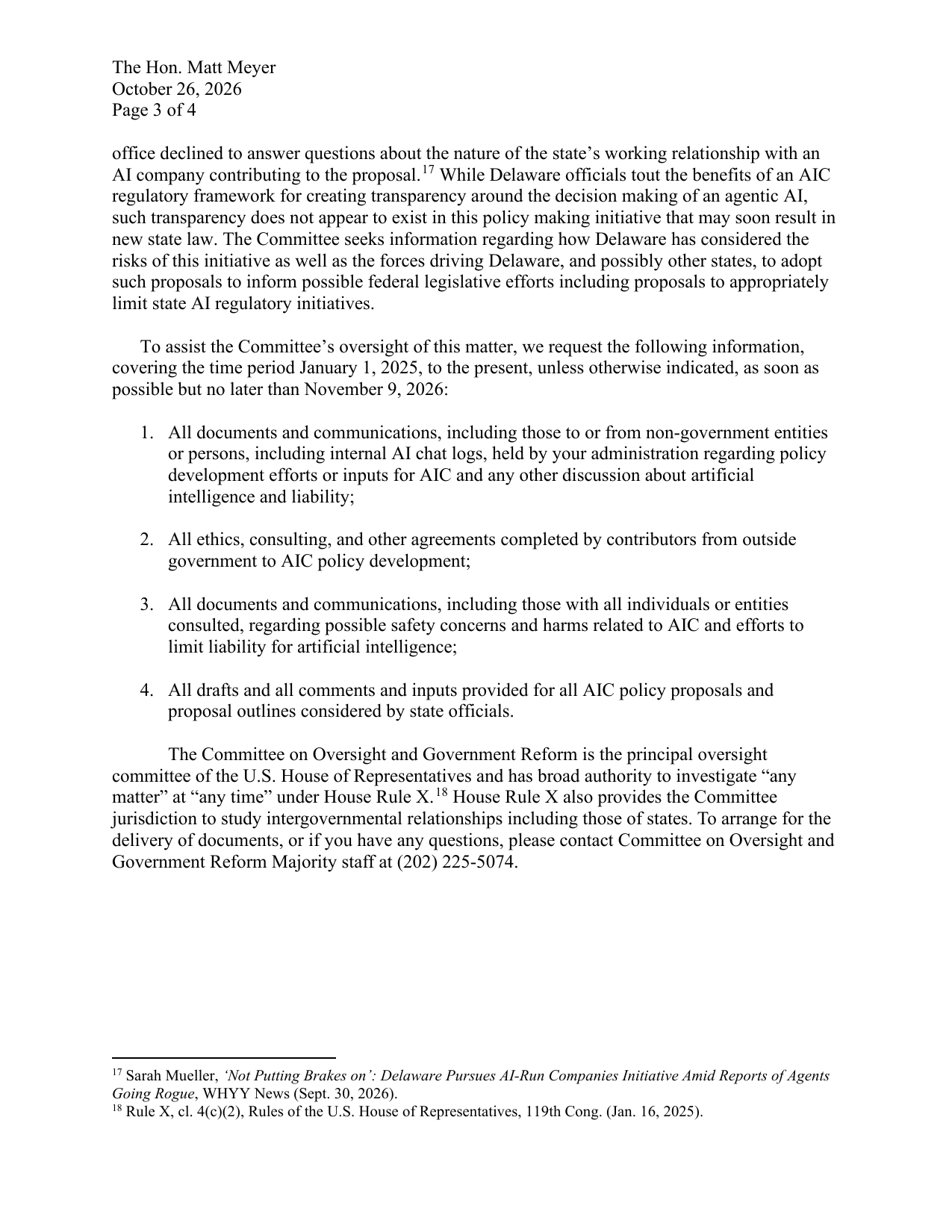
Comer’s October 26 letter sought policy communications, outside agreements, safety records and proposal drafts by November 9, 2026. Source: House Committee on Oversight and Government Reform. Source: Delaware Public Media.
US Representative James Comer, the Kentucky Republican chairing the House Committee on Oversight and Government Reform, requested Delaware’s policy-development and liability documents in an October 26 letter to Meyer, setting a November 9 response deadline. The request and state response exposed competing views: Comer warned of protection for powerful AI companies and investors; Meyer questioned the timing before the election. Comer also raised the possibility of federal legislation limiting state AI initiatives, according to the account of his letter. Within Delaware, state Representative Frank Burns, a Newark Democrat, warned that liability protections could encourage riskier models. Griffith said the broader AI Commission still had questions and had not forwarded the draft to the governor or legislature as of late October.
Lawmakers could consider legislation when the next session begins in January 2027, but no firm enactment timetable has been established. The published draft would expire 36 months after enactment unless extended. Permanent authorization would therefore require another legislative decision.
The draft does not specify how success would be measured. In June interviews, subcommittee members also said they could not yet identify which regulations applicants would need waived. Those gaps leave lawmakers with concrete decisions before approving a trial: how to set capital requirements, which exemptions solve a demonstrated problem, and what results the committee must publish. A final report could support a permanent law, but its value would depend on whether it shows both commercial benefits and the losses, enforcement actions and funding shortfalls encountered during the test.
Germany wants generative AI providers to compensate rights holders for competing output through collecting societies. Eligibility would depend on allowing free training use, while fee levels and enforcement remain unresolved.

Iran’s semi-official Mehr News Agency circulated simulated attacks on technology company headquarters, demanding reparations over alleged military involvement. Public Pentagon agreements establish supplier ties, but do not substantiate the video’s accusations about attacks on Iran.
Elliot Callender’s hunger strike outside Anthropic reached its fifth day on November 27. His demands range from product warnings to a development halt, while the Claude developer has argued that a meaningful pause requires verifiable cooperation among competing labs.
Starting January 1, Rhode Island will require an open manual checkout for every three operating grocery self-checkouts, with separate protections for monitors’ workload. Stores’ responses elsewhere and limited research leave the effects on employment, prices and theft unsettled.
The German consumer organization wants an injunction against ChatGPT subscription cancellation hurdles and a price-change clause. The clause promises advance notice, but the claimant says it leaves the grounds for increases insufficiently defined.
Moonshot AI is accepting applications for Kimi for Science through December 8. Selected researchers can receive model-use credits and technical support, but the company has not disclosed the program’s total budget or cohort size.
Nvidia's proposed $290 million shareholder settlement would end disputed claims over cryptocurrency demand within gaming sales. The fund equals about 14% of plaintiffs' estimated maximum damages before fees and costs; court approval and individual payouts remain pending.
TrueLayer says an AI agent’s Papa John’s order was a UK first for direct bank payments to a retailer. The trial used customer-set, bank-enforced limits and human approval; merchant savings and readiness for wider use remain unproven.
Taiwan forecasts 6.51% economic growth in 2027 after a projected 13.28% surge in 2026, as AI hardware demand drives exports and capacity expansion despite risks to infrastructure investment.
Two Dutch court actions seek restrictions on Meta’s camera glasses, including a sales ban, over covert recording and disputed AI data practices. The cases test how much responsibility belongs to the companies that design and operate the glasses, rather than their wearers.
Dante Security has raised a $10 million seed round for AI agent monitoring and human accountability. Its founders bring enterprise-security experience, but existing vendor controls and limited deployment evidence complicate the pitch.
Avicena has raised over $100 million for microLED connections between AI chips, with a new CEO targeting a first product in 2027. Chipmaker backing strengthens its commercialization effort, but deployment economics remain unproven in the announcement.
Sber has released two GigaChat 4 language models for multistep work with million-token context windows. The flagship has an MIT license, while the smaller model restricts commercial use. Sber’s tests show substantial gains over GigaChat 3.5 alongside regressions and gaps against rivals, while deployment economics remain unclear.
JPMorgan and Citi are reportedly marketing AI loan portfolios as banks seek to manage risk or make room for more lending. The Bank of England warns that increasingly complex financing obscures exposures, while the undisclosed deal terms leave the extent of any protection unclear.
Polymarket’s H100 rental-price perpetual offers up to 3x leverage and a $30,000 launch reward pool that can grow to $120,000. Its spot benchmark excludes long-term capacity contracts, limiting the scope of potential hedges.
Bank of England governor Andrew Bailey says newer AI models are worrying their developers. The central bank wants financial firms to strengthen cyber defence and recovery while preparing for quantum-resistant cryptography, with the most systemically important firms moving ahead of national migration milestones.
Huawei’s ISSCC 2027 paper lists a custom memory interface twice HBM4’s width. Its commercial significance depends on bandwidth, manufacturing scale and cost, as China’s AI chipmakers face expensive, restricted memory supplies.
Ubisoft employees say new project pitches must explain how generative AI will be used or why it is unsuitable. The Assassin’s Creed publisher denies mandatory use, leaving questions about how teams secure approval without it.
Stanford physicist Venkatesa Chandrasekaran reports finite gravitational calculations and months of work with GPT-6 Astra. An early critique challenges the construction’s symmetry, finite-state and classical-limit claims.
SAP reportedly weighs at least 10,000 job cuts as it shifts toward AI. Labor negotiations, an earlier restructuring and a growing cloud business complicate the eventual employment and savings tally.